Olive Dasia

Olive Dasia

Dasia olivacea

Silhouette: David Orr · PhyloPic

LCLeast ConcernNTVUENCR
Daily sighting probability ~10% · With luck
at Khao Yai National Park

In 3 days ~30% in a week ~60%

8 Verified sightings at Khao Yai National Park From 2019 to 2026
52 In all 5 parks
April Best month
🌅 Crepuscular When it's spotted

About the Olive Dasia

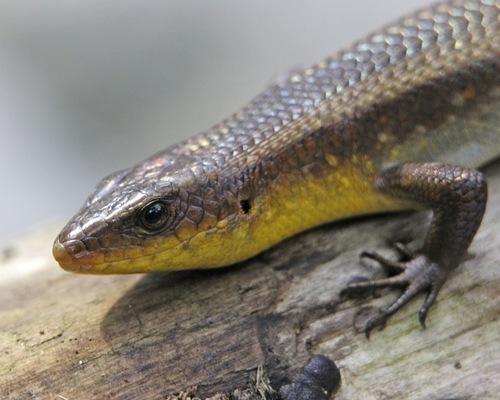
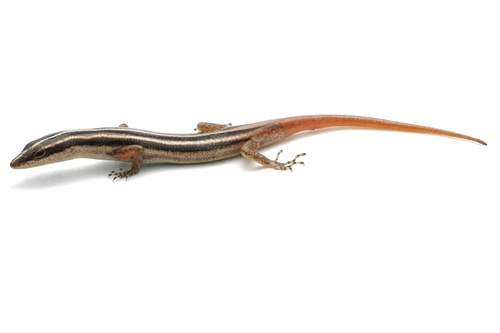
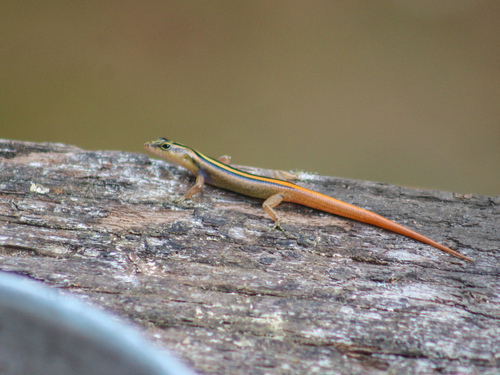
Dasia olivacea, the olive dasia or olive tree skink, is a semi-arboreal species of skink lizard native to Southeast Asia. Dasia olivacea is found south of approximately 15° north in Southeast Asia, including parts of Laos, Malaysia, Myanmar, Thailand, Singapore, Vietnam, throughout the island of Borneo (Sarawak, Kalimantan, Brunei), the Indonesian islands of Bali, Java and Sumatra (among others), as well as India's Andaman and Nicobar Islands.

The species is originally known from a single locality in Cambodia. The northernmost extreme for D. olivacea is possibly the Sakaerat Environmental Research Station in the Nakhon Ratchasima Province of eastern Thailand. Dasia olivacea lives almost exclusively in trees, only rarely descending to nest or to move between trees. Eggs may be laid more than once per year, in clutches of up to 14 eggs; incubation lasts 69 days. Because it is very widespread and ecologically flexible, D. olivacea is considered to be a species of Least Concern on the IUCN Red List.

Dasia olivacea was first described by John Edward Gray, in a publication of the Annals of Natural History (1839), as the type... Wikipedia →

Global Distribution

Parks Where Found

# Park Country Daily sighting probability
1 Khao Sok National Park 🇹🇭 Thailand
~20%
2 Kaeng Krachan National Park 🇹🇭 Thailand
~10%
3 Gunung Leuser National Park 🇮🇩 Indonesia
~10%
4 Cat Tien National Park 🇻🇳 Vietnam
~10%
5 Khao Yai National Park 🇹🇭 Thailand
~10%

Cities Where Found

# City Country Daily sighting probability
1 Jakarta 🇮🇩 Indonesia
~10%

Zoos & Centres Where Found

# Zoo / Centre Country
1 Basel Zoo 🇨🇭 Switzerland In captivity
2 Wrocław Zoological Garden 🇵🇱 Poland In captivity
3 National Zoo of Malaysia 🇲🇾 Malaysia In captivity
4 Africarium 🇵🇱 Poland In captivity
5 Jakarta Aquarium 🇮🇩 Indonesia In captivity
6 terrarium ogrodu zoologicznego we Wrocławiu 🇵🇱 Poland In captivity

Before you go

What are the chances of seeing an Olive Dasia in Khao Yai National Park?

With luck

About 10% of wildlife watchers report an Olive Dasia sighting in Khao Yai National Park on a given day, based on 8 verified sightings from GBIF citizen-science data from 2019 to 2026. It is the 30th most-seen of the 46 reptiles we can rate there. Over three days the chance rises to about 30%, and over a week to about 60%, if each day is a fresh chance.

When is the best time to see an Olive Dasia in Khao Yai National Park?

March–April and June–July

In those months about 20% of wildlife watchers report an Olive Dasia in Khao Yai National Park on a given day, against under 5% in May and August–February, the lowest months.

What time of day is best to see an Olive Dasia?

Between 8 and 11 am

Across all the parks we cover, that three-hour window holds the most Olive Dasia sightings with a recorded time, and about 6 in 10 of them come between 6 am and 6 pm: it is most active around dawn and dusk.

Which relatives of the Olive Dasia live in Khao Yai National Park?

Same family: Scincidae

The closest relatives of the Olive Dasia that you can see in Khao Yai National Park (family Scincidae, Skinks) are Spotted Forest Skink (about 40%), Many-lined Sun-skink (about 30%) and Common Striped Skink (about 30%), with each one's daily chance of a sighting.

Where does the Olive Dasia sighting chance come from?

GBIF citizen-science records

It is estimated from how often the Olive Dasia is recorded against all the reptiles logged in Khao Yai National Park (8 verified sightings from 2019 to 2026), calibrated against known sighting rates. Figures are rounded to the nearest 10% because citizen-science data supports honest approximations, not decimals, and months with records from fewer than five people show "—". How it works.

← Back to Khao Yai National Park