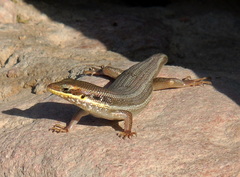
African Five-lined Skink

African Five-lined Skink

Trachylepis quinquetaeniata

Silhouette: David Orr · PhyloPic

LCLeast ConcernNTVUENCR
Daily sighting probability ~50% · Likely
at Kidepo Valley National Park

In 3 days ~80% in a week >90%

8 Verified sightings at Kidepo Valley National Park From 2019 to 2026
75 In all 4 parks
October Best month
☀️ Diurnal When it's spotted

About the African Five-lined Skink

The African five-lined skink (Trachylepis quinquetaeniata, formerly Mabuya quinquetaeniata), or rainbow mabuya, is a north-central African species of skink lizard. T. margaritifera is another closely related skink species that is also called the "rainbow skink" (although it occurs primarily in Eastern Africa); T. margaritifera, overall, possesses more colourful, "rainbow"-like scales (as opposed to the predominantly blue, black and yellowish five-lined skink, T. quinquetaeniata).

The African five-lined skink has two subspecies: Trachylepis quinquetaeniata quinquetaeniata (Lichtenstein, 1823) Trachylepis quinquetaeniata riggenbachi (Sternfeld, 1910) Trachylepis margaritifera, formerly treated as a subspecies of T. quinquetaeniata, was elevated to full species status in 1998.

Trachylepis quinquetaeniata is a smaller- to medium-sized lizard, maturing to a length of about 20 centimetres (7.9 in). The colour of this skink is quite variable, depending on the lizard's gender, its age and the time of the year. As with most skinks, its scales are glossy, shiny, and the body is rather smooth to the touch, with a 'metallic', reflective quality. The base scale... Wikipedia →

Global Distribution

Parks Where Found

# Park Country Daily sighting probability
1 Awash National Park 🇪🇹 Ethiopia
~50%
2 Samburu National Reserve 🇰🇪 Kenya
~50%
3 Kidepo Valley National Park 🇺🇬 Uganda
~50%
4 Murchison Falls National Park 🇺🇬 Uganda
~20%

Cities Where Found

# City Country Daily sighting probability
1 Luxor 🇪🇬 Egypt
~60%
2 Ouagadougou 🇧🇫 Burkina Faso
~40%
3 Cairo 🇪🇬 Egypt
~40%

Closest Relatives at Kidepo Valley National Park

No species of the same family or order lives in Kidepo Valley National Park, so these are its closest relatives here: other reptiles.

Before you go

What are the chances of seeing an African Five-lined Skink in Kidepo Valley National Park?

Likely

About 50% of wildlife watchers report an African Five-lined Skink sighting in Kidepo Valley National Park on a given day, based on 8 verified sightings from GBIF citizen-science data from 2019 to 2026. Over three days the chance rises to about 80%, and over a week to over 90%, if each day is a fresh chance.

When is the best time to see an African Five-lined Skink in Kidepo Valley National Park?

July and October

In those months about 60% of wildlife watchers report an African Five-lined Skink in Kidepo Valley National Park on a given day, against about 10% in February, the lowest month. Those are among Kidepo Valley National Park's wettest months, with about 110 mm of rain a month against 10 mm in February. September and November–December have too few records to rate.

What time of day is best to see an African Five-lined Skink?

Between 10 am and 1 pm

Across all the parks we cover, that three-hour window holds the most African Five-lined Skink sightings with a recorded time, and about 9 in 10 of them come between 6 am and 6 pm: it is a daytime animal.

Is Kidepo Valley National Park the best place to see an African Five-lined Skink?

Among the best

Of the 4 parks where we can rate African Five-lined Skink sightings, Kidepo Valley National Park ranks 3rd at about 50%, level with the leaders once rounded. The best odds are in Awash National Park (Ethiopia, about 50%) and Samburu National Reserve (Kenya, about 50%). All parks ranked.

Where does the African Five-lined Skink sighting chance come from?

GBIF citizen-science records

It is estimated from how often the African Five-lined Skink is recorded against all the reptiles logged in Kidepo Valley National Park (8 verified sightings from 2019 to 2026), calibrated against known sighting rates. Figures are rounded to the nearest 10% because citizen-science data supports honest approximations, not decimals, and months with records from fewer than five people show "—". How it works.

← Back to Kidepo Valley National Park