Cloud Bush Frog

Cloud Bush Frog

Philautus nephophilus

Silhouette: Jose Carlos Arenas-Monroy · PhyloPic

LCLeast ConcernNTVUENCR
Daily sighting probability ~20% · Possible
at Kinabalu Park

In 3 days ~50% in a week ~80%

24 Verified sightings at Kinabalu Park From 2019 to 2026
24 In 1 park
November Best month
☀️ Diurnal When it's spotted

About the Cloud Bush Frog

Philautus nephophilus is a species of frog in the family Rhacophoridae. It is endemic to Malaysia, where it has been observed in Kinabalu National Park, between 1400 and 1800 meters above sea level. This frog has been found in primary forest and near the edges of forests.

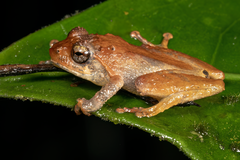
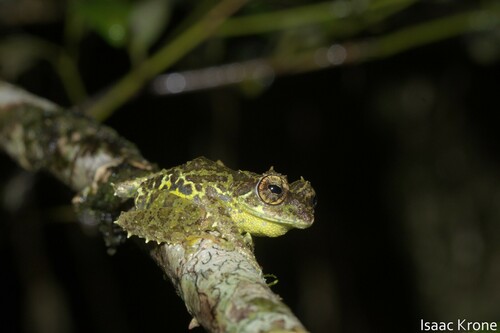
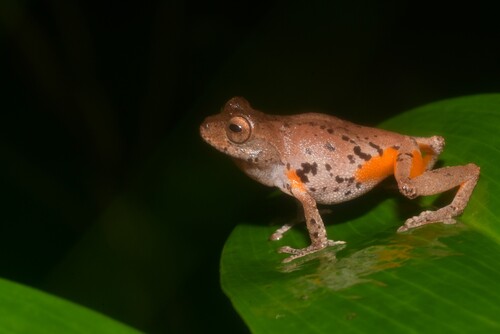
Scientists have not classified this frog as threatened because even though it has a small range, that range includes a well-managed park. The adult male frog measures 16.4–18.6 mm in snout-vent length and the adult female frog 20.3–23.1 mm. This frog can change color, being darker during the day, with a yellow belly and dark brown spots. At night, this frog's head and shoulders are deeper brown than the rest of the body. The sides of the back legs are gray in color with whitish spots or other marks. The skin around the tympanum is yellow in color. The iris of the eye is red in color, with horizontal pupils. This frog has teeth in its upper jaw. Its tongue is long and wide. All four legs are thin.

The Greek word Nepho means 'cloud' while the word philus means 'loving'. The name refers to the rainforests it lives in. Calling males form aggregations in lower vegetation and are found on leaves... Wikipedia →

Global Distribution

Parks Where Found

# Park Country Daily sighting probability
1 Kinabalu Park 🇲🇾 Malaysia
~20%

More parks will be added in future updates.

Before you go

What are the chances of seeing a Cloud Bush Frog in Kinabalu Park?

Possible

About 20% of wildlife watchers report a Cloud Bush Frog sighting in Kinabalu Park on a given day, based on 24 verified sightings from GBIF citizen-science data from 2019 to 2026. It is the 23rd most-seen of the 40 amphibians we can rate there. Over three days the chance rises to about 50%, and over a week to about 80%, if each day is a fresh chance.

When is the best time to see a Cloud Bush Frog in Kinabalu Park?

November

In that month about 40% of wildlife watchers report a Cloud Bush Frog in Kinabalu Park on a given day, against under 5% in January, April and October, the lowest months.

What time of day is best to see a Cloud Bush Frog?

Between 1 and 4 pm

Across all the parks we cover, that three-hour window holds the most Cloud Bush Frog sightings with a recorded time, and about 8 in 10 of them come between 6 am and 6 pm: it is a daytime animal.

Where else can you see a Cloud Bush Frog?

Only Kinabalu Park, in our data

Kinabalu Park is the only park on Wallace's Line with enough records to rate Cloud Bush Frog sightings: about 20% of wildlife watchers there report one on a given day.

Which relatives of the Cloud Bush Frog live in Kinabalu Park?

Same genus: Philautus

The closest relatives of the Cloud Bush Frog that you can see in Kinabalu Park (genus Philautus, shrub frogs) are Mossy Bush Frog (about 50%), Green Bush Frog (about 40%) and Golden-legged Bush Frog (about 30%), with each one's daily chance of a sighting.

Where does the Cloud Bush Frog sighting chance come from?

GBIF citizen-science records

It is estimated from how often the Cloud Bush Frog is recorded against all the amphibians logged in Kinabalu Park (24 verified sightings from 2019 to 2026), calibrated against known sighting rates. Figures are rounded to the nearest 10% because citizen-science data supports honest approximations, not decimals, and months with records from fewer than five people show "—". How it works.

← Back to Kinabalu Park