Giant Dead Leaf Mantis

Giant Dead Leaf Mantis

Deroplatys desiccata

Daily sighting probability ~10% · With luck
at Kinabalu Park

In 3 days ~30% in a week ~60%

10 Verified sightings at Kinabalu Park From 2019 to 2026
26 In all 3 parks
February Best month
☀️🌙 Day & Night When it's spotted

About the Giant Dead Leaf Mantis

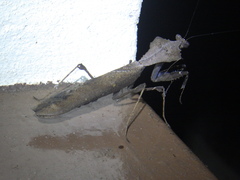
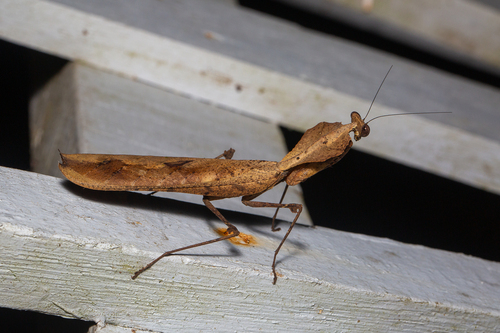
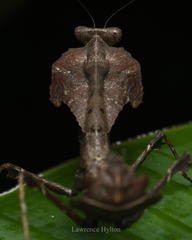
Deroplatys desiccata, known by the common name giant dead leaf mantis, is a praying mantis from Southeast Asia. This is the type species of genus Deroplatys. D. desiccata takes its common name from its resemblance to dead, leafy vegetation including having a flattened, greatly extended thorax and "intricate leaf patterns" on its wings. This insect varies in color from mottled brown through "pale orangey brown" to a very dark brown that is almost black.

This creature's camouflage is aided by its movements as well as its appearance. When disturbed, it rocks gently as if caught in the breeze. When threatened, it typically falls to the ground and lies motionless. It can also react with a threatening display consisting of "black underwings splayed out, with large eyespots, frightening away unsuspecting predators."

The intricate lines on the mantis' body, which serve to look like the natural veins on a leaf, as well as its dark brown colors, are beneficial to the species as it has been shown to avoid the attention of aerial predators or other insects.

As its common name indicates, D. desiccata is larger than other species of dead leaf mantis. Females grow to 75–80 mm... Wikipedia →
Global Distribution

Parks Where Found

# Park Country Daily sighting probability
1 Gunung Leuser National Park 🇮🇩 Indonesia
~20%
2 Danum Valley Conservation Area 🇲🇾 Malaysia
~10%
3 Kinabalu Park 🇲🇾 Malaysia
~10%

Cities Where Found

# City Country Daily sighting probability
1 Singapore 🇸🇬 Singapore
<5%

Before you go

What are the chances of seeing a Giant Dead Leaf Mantis in Kinabalu Park?

With luck

About 10% of wildlife watchers report a Giant Dead Leaf Mantis sighting in Kinabalu Park on a given day, based on 10 verified sightings from GBIF citizen-science data from 2019 to 2026. It is the 123rd most-seen of the 297 insects we can rate there. Over three days the chance rises to about 30%, and over a week to about 60%, if each day is a fresh chance.

When is the best time to see a Giant Dead Leaf Mantis in Kinabalu Park?

January–February and October

In those months about 20% of wildlife watchers report a Giant Dead Leaf Mantis in Kinabalu Park on a given day, against under 5% in March, May, August–September and November–December, the lowest months.

What time of day is best to see a Giant Dead Leaf Mantis?

Between 9 pm and midnight

Across all the parks we cover, that three-hour window holds the most Giant Dead Leaf Mantis sightings with a recorded time, and about 6 in 10 of them come between 6 pm and 6 am: it is seen both by day and at night.

Is Kinabalu Park the best place to see a Giant Dead Leaf Mantis?

3rd of 3

Of the 3 parks where we can rate Giant Dead Leaf Mantis sightings, Kinabalu Park ranks 3rd at about 10%. The best odds are in Gunung Leuser National Park (Indonesia, about 20%) and Danum Valley Conservation Area (Malaysia, about 10%).

Where does the Giant Dead Leaf Mantis sighting chance come from?

GBIF citizen-science records

It is estimated from how often the Giant Dead Leaf Mantis is recorded against all the insects logged in Kinabalu Park (10 verified sightings from 2019 to 2026), calibrated against known sighting rates. Figures are rounded to the nearest 10% because citizen-science data supports honest approximations, not decimals, and months with records from fewer than five people show "—". How it works.

← Back to Kinabalu Park