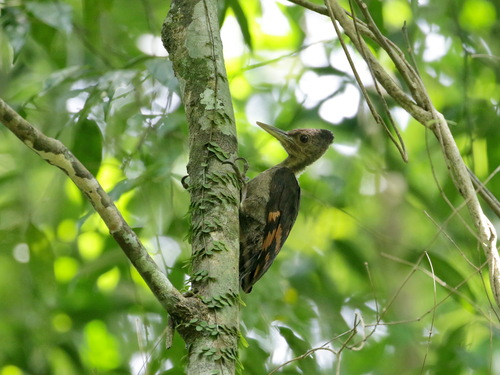
Golden-naped Barbet

Golden-naped Barbet

Psilopogon pulcherrimus

Silhouette: Vijay Cavale (photo), John E. McCormack, Michael G. Harvey, Brant C. Faircloth, Nicholas G. Crawford, Travis C. Glenn, Robb T. Brumfield & T. Michael Keesey · PhyloPic

LCLeast ConcernNTVUENCR
Daily sighting probability ~60% · Likely
at Kinabalu Park

In 3 days >90%

2,273 Verified sightings at Kinabalu Park From 2019 to 2026
2,273 In 1 park
March Best month
🌙 Nocturnal When it's spotted

About the Golden-naped Barbet

The golden-naped barbet (Psilopogon pulcherrimus) is a member of the family Megalaimidae. It is found in Indonesia and Malaysia, where it is endemic to the island of Borneo. Its natural habitats are subtropical or tropical moist lowland forest and subtropical or tropical moist montane forest.

Medium-sized bird (20-21.5 cm); overall stocky built. Bill- thick and distinctive. Body coloration, primarily green. Wings having darker shade of green compared to underparts. Azure blue on forehead, extending up to nape; blue coloration on throat. Small but distinct yellow nape forms a collar. A distinctive black band from the base of bill to eye. Black pupils. Black mandibles. Greyish green tarsus

Endemic to lowland and montane forests of Borneo. It is presumably a resident species in this region. Most often reported from Mount Kinabalu and Trus Madi south to Mulu and Murud. Primarily feeds on fruits and berries. Occasionally takes insects like other barbet species. They are often found foraging in the mid-storey layer of the forest and are known to nest in tree cavities. Wikipedia →

Sounds

Song0:48

Malaysia · 2026

© Ding Li Yong · XC1103990 · CC BY-NC-ND 4.0

Call0:41

Malaysia · 2024

© Lim Ying Hien · XC953835 · CC BY-NC-ND 4.0

Song0:31

Malaysia · 2022

© Wonseok Jang · XC748017 · CC BY-NC-SA 4.0

Global Distribution

Parks Where Found

# Park Country Daily sighting probability
1 Kinabalu Park 🇲🇾 Malaysia
~60%

More parks will be added in future updates.

Before you go

What are the chances of seeing a Golden-naped Barbet in Kinabalu Park?

Likely

About 60% of wildlife watchers report a Golden-naped Barbet sighting in Kinabalu Park on a given day, based on 2,273 verified sightings from GBIF citizen-science data from 2019 to 2026. It is the 6th most-seen of the 247 birds we can rate there. Over three days the chance rises to over 90%, if each day is a fresh chance.

When is the best time to see a Golden-naped Barbet in Kinabalu Park?

March

In that month about 80% of wildlife watchers report a Golden-naped Barbet in Kinabalu Park on a given day, against about 50% in June, the lowest month.

What time of day is best to see a Golden-naped Barbet?

Between 1 and 4 am

Across all the parks we cover, that three-hour window holds the most Golden-naped Barbet sightings with a recorded time, and about 8 in 10 of them come between 6 pm and 6 am: it is mostly seen at night.

Where else can you see a Golden-naped Barbet?

Only Kinabalu Park, in our data

Kinabalu Park is the only park on Wallace's Line with enough records to rate Golden-naped Barbet sightings: about 60% of wildlife watchers there report one on a given day.

Which relatives of the Golden-naped Barbet live in Kinabalu Park?

Same genus: Psilopogon

The closest relatives of the Golden-naped Barbet that you can see in Kinabalu Park (genus Psilopogon, Typical Asian Barbets) are Mountain Barbet (about 10%) and Gold-whiskered Barbet (about 10%), with each one's daily chance of a sighting.

Where does the Golden-naped Barbet sighting chance come from?

GBIF citizen-science records

It is estimated from how often the Golden-naped Barbet is recorded against all the birds logged in Kinabalu Park (2,273 verified sightings from 2019 to 2026), calibrated against known sighting rates. Figures are rounded to the nearest 10% because citizen-science data supports honest approximations, not decimals, and months with records from fewer than five people show "—". How it works.

← Back to Kinabalu Park