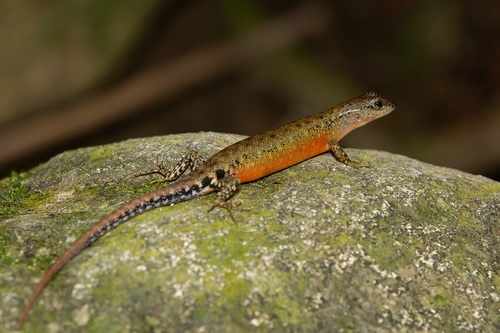
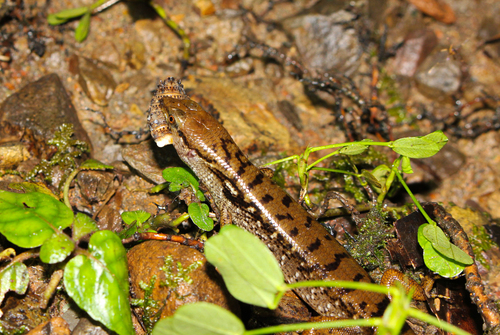
Kinabalu Forest Skink

Kinabalu Forest Skink

Sphenomorphus kinabaluensis

Silhouette: Gopal Murali · PhyloPic

LCLeast ConcernNTVUENCR
Daily sighting probability ~10% · With luck
at Kinabalu Park

In 3 days ~30% in a week ~50%

5 Verified sightings at Kinabalu Park From 2019 to 2026
5 In 1 park
May Best month
☀️ Diurnal When it's spotted

About the Kinabalu Forest Skink

Sphenomorphus kinabaluensis is a species of skink found in Malaysia, and is endemic to the Crocker Mountains in Borneo, including the area surrounding Mount Kinabalu. S. kinabaluensis resides in the southern part of the Crocker Mountains to southwestern Sabah, including Lumaku, Mesilau, and Sunsuron, with a possible habitat extension further south to neighbouring states of Sarawak and Kalimantan of Indonesia. The skink was also identified in Marai Parai, northwest of Mount Kinabalu.

S. kinabaluensis was firstly identified as Lygosoma kinabaluensis by Edward Bartlett in 1895, and also formerly described as an Otosaurus species, before its genus was reclassified as Sphenomorphus. Bartlett initially described S. kinabaluensis as similar to S. variegatus, but with a mottled back with no striations, and without a distinct dorsolateral band, with Smith called it a "high altitude derivative" of S. variegatus. It was also been described as similar in shape with lowland-living S. cyanolaemus in general, but with a more elongated trunk, fewer scale rows and sub-digit lamellae.

Its head and body length is around 51 mm, with a tail length... Wikipedia →
Global Distribution

Parks Where Found

# Park Country Daily sighting probability
1 Kinabalu Park 🇲🇾 Malaysia
~10%

More parks will be added in future updates.

Before you go

What are the chances of seeing a Kinabalu Forest Skink in Kinabalu Park?

With luck

About 10% of wildlife watchers report a Kinabalu Forest Skink sighting in Kinabalu Park on a given day, based on 5 verified sightings from GBIF citizen-science data from 2019 to 2026. It is the 63rd most-seen of the 69 reptiles we can rate there. Over three days the chance rises to about 30%, and over a week to about 50%, if each day is a fresh chance.

When is the best time to see a Kinabalu Forest Skink in Kinabalu Park?

May

In that month about 30% of wildlife watchers report a Kinabalu Forest Skink in Kinabalu Park on a given day, against under 5% in June and August–March, the lowest months.

What time of day is best to see a Kinabalu Forest Skink?

Between noon and 3 pm

Across all the parks we cover, that three-hour window holds the most Kinabalu Forest Skink sightings with a recorded time, and about 8 in 10 of them come between 6 am and 6 pm: it is a daytime animal.

Where else can you see a Kinabalu Forest Skink?

Only Kinabalu Park, in our data

Kinabalu Park is the only park on Wallace's Line with enough records to rate Kinabalu Forest Skink sightings: about 10% of wildlife watchers there report one on a given day.

Where does the Kinabalu Forest Skink sighting chance come from?

GBIF citizen-science records

It is estimated from how often the Kinabalu Forest Skink is recorded against all the reptiles logged in Kinabalu Park (5 verified sightings from 2019 to 2026), calibrated against known sighting rates. Figures are rounded to the nearest 10% because citizen-science data supports honest approximations, not decimals, and months with records from fewer than five people show "—". How it works.

← Back to Kinabalu Park