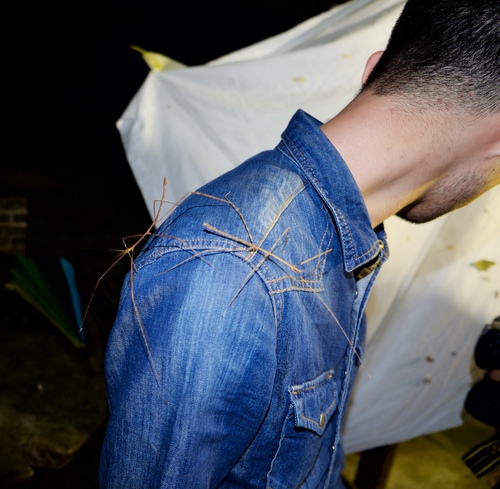
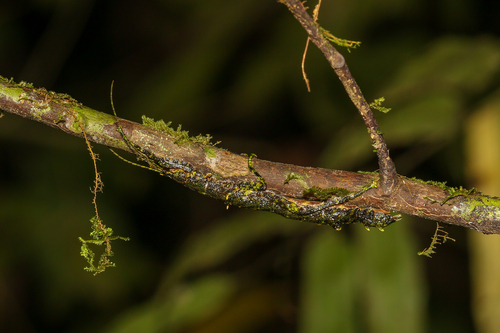
Thorny Stick Insect

Thorny Stick Insect

Aretaon asperrimus

Daily sighting probability ~20% · Possible
at Kinabalu Park

In 3 days ~50% in a week ~80%

26 Verified sightings at Kinabalu Park From 2019 to 2026
26 In 1 park
October Best month
🌙 Nocturnal When it's spotted

About the Thorny Stick Insect

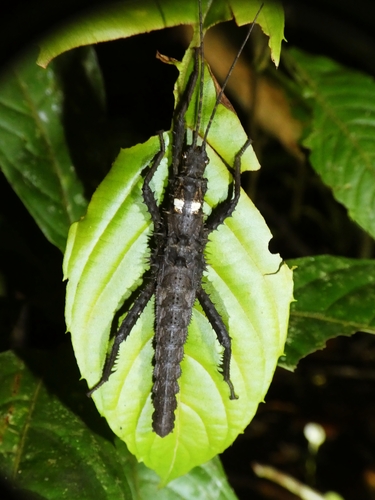
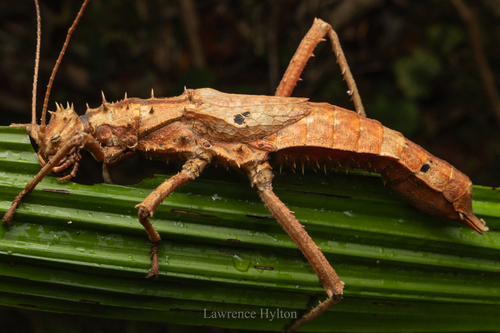
Aretaon asperrimus is a species of insect in the Aretaon genus of the Phasmatodea order. The sometimes used common name thorny stick insect is a bit misleading, since the species does not correspond to the typical stick-like habitus and many other species are thorny as well.

Both sexes are completely wingless and have conspicuous thorns. Their eyes are mottled dark-brown and yellow. On the head, the pro- and the metathorax there is a pair, on the mesothorax two pairs of thorns are particularly well developed. These thorns are dark, red-brown, black-brown towards the tips. The rear pair on the mesothorax and that on the metathorax have even smaller side spines at their base. They stand out particularly clearly due to their contrast to the otherwise brown and beige marbled body of the female, or the male, which is drawn with yellow vertical stripes on a brown background. The legs, which are also brown, are thorny too.

In addition to these normal-colored animals, very light-colored animals can occasionally be found in which the brown colors are lighter, sometimes light beige. As a result, the parts of the thorns that then appear wine-red are much more noticeable.... Wikipedia →

Global Distribution

Parks Where Found

# Park Country Daily sighting probability
1 Kinabalu Park 🇲🇾 Malaysia
~20%

More parks will be added in future updates.

Before you go

What are the chances of seeing a Thorny Stick Insect in Kinabalu Park?

Possible

About 20% of wildlife watchers report a Thorny Stick Insect sighting in Kinabalu Park on a given day, based on 26 verified sightings from GBIF citizen-science data from 2019 to 2026. It is the 32nd most-seen of the 297 insects we can rate there. Over three days the chance rises to about 50%, and over a week to about 80%, if each day is a fresh chance.

When is the best time to see a Thorny Stick Insect in Kinabalu Park?

October

In that month about 40% of wildlife watchers report a Thorny Stick Insect in Kinabalu Park on a given day, against under 5% in May and August–September, the lowest months.

What time of day is best to see a Thorny Stick Insect?

Between 7 and 10 pm

Across all the parks we cover, that three-hour window holds the most Thorny Stick Insect sightings with a recorded time, and about 8 in 10 of them come between 6 pm and 6 am: it is mostly seen at night.

Where else can you see a Thorny Stick Insect?

Only Kinabalu Park, in our data

Kinabalu Park is the only park on Wallace's Line with enough records to rate Thorny Stick Insect sightings: about 20% of wildlife watchers there report one on a given day.

Which relatives of the Thorny Stick Insect live in Kinabalu Park?

Same family: Heteropterygidae

The closest relatives of the Thorny Stick Insect that you can see in Kinabalu Park (family Heteropterygidae) are Prickly Haaniella (about 20%) and Haaniella scabra (about 20%), with each one's daily chance of a sighting.

Where does the Thorny Stick Insect sighting chance come from?

GBIF citizen-science records

It is estimated from how often the Thorny Stick Insect is recorded against all the insects logged in Kinabalu Park (26 verified sightings from 2019 to 2026), calibrated against known sighting rates. Figures are rounded to the nearest 10% because citizen-science data supports honest approximations, not decimals, and months with records from fewer than five people show "—". How it works.

← Back to Kinabalu Park