Balkan Wall Lizard

Balkan Wall Lizard

Podarcis tauricus

Silhouette: Alex Slavenko · PhyloPic

LCLeast ConcernNTVUENCR
Daily sighting probability ~40% · Likely
at Kiskunság National Park

In 3 days ~80% in a week >90%

17 Verified sightings at Kiskunság National Park From 2019 to 2026
17 In 1 park
April Best month
☀️ Diurnal When it's spotted

About the Balkan Wall Lizard

Podarcis tauricus, the Balkan wall lizard, is a common lizard in the family Lacertidae native to southeastern Europe and Asia Minor. It is a terrestrial species found in steppe, grassland, olive groves, cultivated land, meadows, rural gardens, sparsely vegetated sand dunes and scrubby areas.

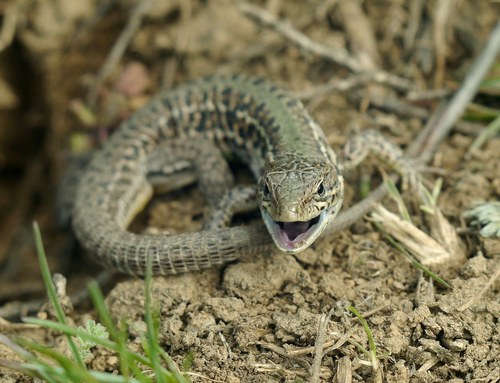
The Balkan wall lizard grows to a snout-to-vent length of about 8 cm (3.1 in) with a tail twice as long as this. It is a sturdy deep-headed lizard somewhat resembling a small green lizard. The basic colour is bright green in spring, fading to an olive-green olive-brown in summer. The markings are somewhat variable but may consist of two narrow, pale-coloured dorso-lateral stripes with the central part of the back brownish with black patches. The underparts are white and unblotched, but breeding males develop yellow, orange or red underparts and green throats.

South-west Ukraine, Crimea Peninsula, eastern and southern Romania, south-east Hungary, North Macedonia, Bulgaria, mainland Greece, the Ionian Islands, Thassos, western Turkey (Thrace and north western Anatolia), Albania and southern Moldova. south-eastern Czech Republic

Podarcis... Wikipedia →
Global Distribution

Parks Where Found

# Park Country Daily sighting probability
1 Kiskunság National Park 🇭🇺 Hungary
~40%

More parks will be added in future updates.

Before you go

What are the chances of seeing a Balkan Wall Lizard in Kiskunság National Park?

Likely

About 40% of wildlife watchers report a Balkan Wall Lizard sighting in Kiskunság National Park on a given day, based on 17 verified sightings from GBIF citizen-science data from 2019 to 2026. It is the 3rd most-seen of the 6 reptiles we can rate there. Over three days the chance rises to about 80%, and over a week to over 90%, if each day is a fresh chance.

When is the best time to see a Balkan Wall Lizard in Kiskunság National Park?

April

In that month about 70% of wildlife watchers report a Balkan Wall Lizard in Kiskunság National Park on a given day, against about 10% in September to February, the lowest months.

What time of day is best to see a Balkan Wall Lizard?

Between 10 am and 1 pm

Across all the parks we cover, that three-hour window holds the most Balkan Wall Lizard sightings with a recorded time, and nearly all of them come between 6 am and 6 pm: it is a daytime animal.

Where else can you see a Balkan Wall Lizard?

Only Kiskunság National Park, in our data

Kiskunság National Park is the only park on Wallace's Line with enough records to rate Balkan Wall Lizard sightings: about 40% of wildlife watchers there report one on a given day.

Which relatives of the Balkan Wall Lizard live in Kiskunság National Park?

Same family: Lacertidae

The closest relatives of the Balkan Wall Lizard that you can see in Kiskunság National Park (family Lacertidae, Wall Lizards) are Green Lizard (about 70%) and Sand Lizard (about 30%), with each one's daily chance of a sighting.

Where does the Balkan Wall Lizard sighting chance come from?

GBIF citizen-science records

It is estimated from how often the Balkan Wall Lizard is recorded against all the reptiles logged in Kiskunság National Park (17 verified sightings from 2019 to 2026), calibrated against known sighting rates. Figures are rounded to the nearest 10% because citizen-science data supports honest approximations, not decimals, and months with records from fewer than five people show "—". How it works.

← Back to Kiskunság National Park