Barred Dove

Barred Dove

Geopelia maugeus

Silhouette: Sheatherius · PhyloPic

LCLeast ConcernNTVUENCR
Daily sighting probability ~90% · Very likely
at Komodo National Park

In 3 days >90%

286 Verified sightings at Komodo National Park From 2019 to 2026
286 In 1 park
September Best month
☀️ Diurnal When it's spotted

About the Barred Dove

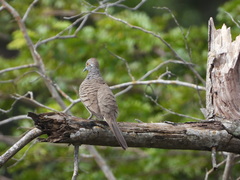
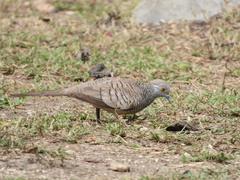
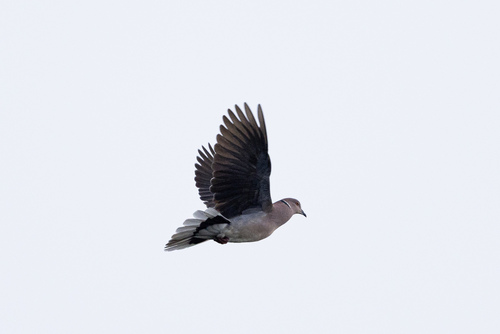
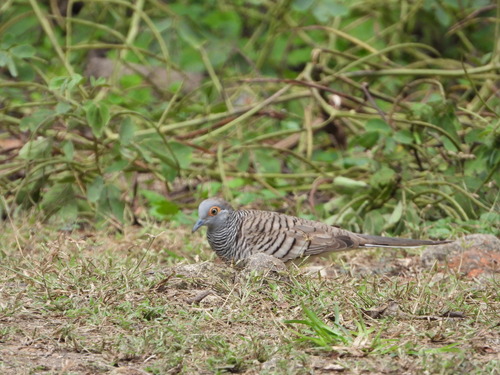
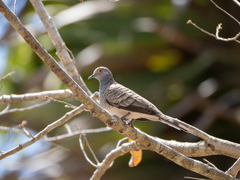
The barred dove (Geopelia maugeus), also known as temminck's zebra dove or the lesser sunda dove, is a small dove that is native and endemic to the Lesser Sunda Islands in Indonesia and Timor-Leste. It is closely related to the zebra dove of Southeast Asia and the peaceful dove of Australia and New Guinea.

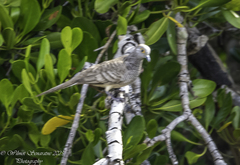
The bird is a relatively small pigeon and varies in length from 23 to 25 centimeters (9.1 to 10.2 inches). It is generally greyish with a black-barred pattern over most of its underparts and the breast. Its orbital skin is yellowish.

It inhabits scrubs, cultivated lands, and woodland edges in lowland areas. The barred dove is found on Sumbawa, Flores, Sumba, Wetar, Alor, Timor, the Tanimbar Islands, the Kei Islands, and other small islands. It lives at elevations between 0 - 1400 meters above sea level. They are found in dry, open habitat with some shrub cover or along the edge of dry woodland areas.

It is sometimes confused with the zebra dove, which is found in Sumbawa, but can be distinguished by its yellow orbital skin and more extensive black-and-white barring across the breast and belly Wikipedia →
Sounds

Song0:30

Indonesia · 2025

© Untung Sarmawi · XC1001345 · CC BY-NC-SA 4.0

Call0:29

Indonesia · 2019

© Kim Chuah Lim · XC553052 · CC BY-NC-SA 4.0

Song0:04

Indonesia · 2013

© Frank Lambert · XC156500 · CC BY-NC-ND 4.0

Global Distribution

Parks Where Found

# Park Country Daily sighting probability
1 Komodo National Park 🇮🇩 Indonesia
~90%

More parks will be added in future updates.

Before you go

What are the chances of seeing a Barred Dove in Komodo National Park?

Very likely

About 90% of wildlife watchers report a Barred Dove sighting in Komodo National Park on a given day, based on 286 verified sightings from GBIF citizen-science data from 2019 to 2026. It is the 2nd most-seen of the 76 birds we can rate there. Over three days the chance rises to over 90%, if each day is a fresh chance.

When is the best time to see a Barred Dove in Komodo National Park?

February–April, June and August–September

In those months about 90% of wildlife watchers report a Barred Dove in Komodo National Park on a given day, against about 70% in November, the lowest month.

What time of day is best to see a Barred Dove?

Between 7 and 10 am

Across all the parks we cover, that three-hour window holds the most Barred Dove sightings with a recorded time, and about 9 in 10 of them come between 6 am and 6 pm: it is a daytime animal.

Where else can you see a Barred Dove?

Only Komodo National Park, in our data

Komodo National Park is the only park on Wallace's Line with enough records to rate Barred Dove sightings: about 90% of wildlife watchers there report one on a given day.

Which relatives of the Barred Dove live in Komodo National Park?

Same family: Columbidae

The closest relatives of the Barred Dove that you can see in Komodo National Park (family Columbidae, Pigeons and Doves) are Green Imperial-Pigeon (about 70%), Pearl-necked Dove (about 50%) and Island Collared Dove (about 40%), with each one's daily chance of a sighting.

Where does the Barred Dove sighting chance come from?

GBIF citizen-science records

It is estimated from how often the Barred Dove is recorded against all the birds logged in Komodo National Park (286 verified sightings from 2019 to 2026), calibrated against known sighting rates. Figures are rounded to the nearest 10% because citizen-science data supports honest approximations, not decimals, and months with records from fewer than five people show "—". How it works.

← Back to Komodo National Park