Barred Cuckoo-Dove

Barred Cuckoo-Dove

Macropygia unchall

Silhouette: Sheatherius · PhyloPic

LCLeast ConcernNTVUENCR
Daily sighting probability <5% · Rare
at Komodo National Park

In 3 days ~10% in a week ~20%

7 Verified sightings at Komodo National Park From 2019 to 2026
915 In all 7 parks
June Best month
🌅 Crepuscular When it's spotted

About the Barred Cuckoo-Dove

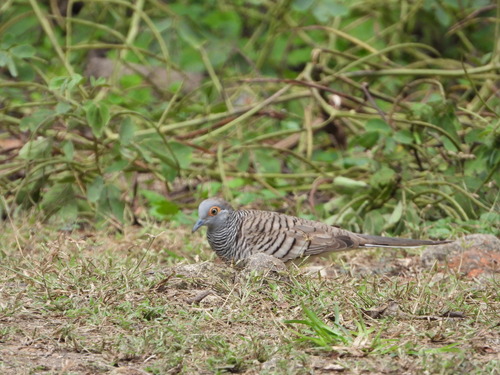
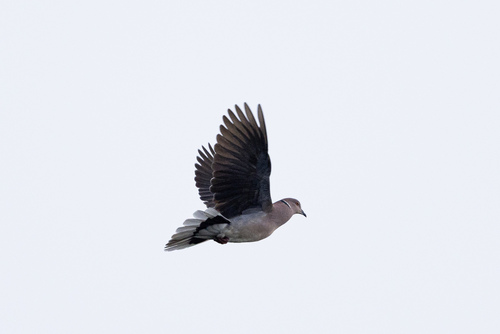
The barred cuckoo-dove (Macropygia unchall) is a bird species in the family Columbidae. It is native to South and Southeast Asia, and listed as Least Concern on the IUCN Red List. German herpetologist Johann Georg Wagler first described the barred cuckoo-dove in 1827. It has three recognized subspecies:

Its iris is yellow or pale brown, the beak is black and short, and the feet are red. It has blackish brown upperparts. The back, mantle (between the nape and the starting of the back), rump, wing coverts, and scapulars have reddish brown fringes. The tail is blackish brown, and is heavily barred reddish brown.

It is similar to the little cuckoo-dove, but it is much larger and darker, and is black-barred on the mantle, breast, coverts, and tail. The barred cuckoo-dove occurs from the Himalayas to Southeast Asia. It inhabits dense subtropical woodlands... Wikipedia →

Sounds

Call0:55

Vietnam · 2026

© Tim Dinh / Annambirding · XC1184693 · CC BY-NC-SA 4.0

Song0:40

Cambodia · 2025

© Ding Li Yong · XC981330 · CC BY-NC-ND 4.0

Recording0:23

Nepal · 2023

© Marc Anderson · XC814774 · CC BY-NC-ND 4.0

Global Distribution

Parks Where Found

# Park Country Daily sighting probability
1 Kerinci Seblat National Park 🇮🇩 Indonesia
~20%
2 Khao Yai National Park 🇹🇭 Thailand
~20%
3 Royal Manas National Park 🇧🇹 Bhutan
~10%
4 Manas National Park 🇮🇳 India
~10%
5 Namdapha National Park 🇮🇳 India
<5%
6 Komodo National Park 🇮🇩 Indonesia
<5%
7 Doi Inthanon National Park 🇹🇭 Thailand
<5%

Cities Where Found

# City Country Daily sighting probability
1 Shanghai 🇨🇳 China
<5%

Zoos & Centres Where Found

# Zoo / Centre Country
1 Singapore Zoo 🇸🇬 Singapore In captivity
2 Bird Paradise 🇸🇬 Singapore In captivity
3 Rainforest Wild Asia 🇸🇬 Singapore In captivity

Before you go

What are the chances of seeing a Barred Cuckoo-Dove in Komodo National Park?

Rare

Under 5% of wildlife watchers report a Barred Cuckoo-Dove sighting in Komodo National Park on a given day, based on 7 verified sightings from GBIF citizen-science data from 2019 to 2026. It is the 63rd most-seen of the 76 birds we can rate there. Over three days the chance rises to about 10%, and over a week to about 20%, if each day is a fresh chance.

When is the best time to see a Barred Cuckoo-Dove in Komodo National Park?

June

In that month about 20% of wildlife watchers report a Barred Cuckoo-Dove in Komodo National Park on a given day, against under 5% in July–August and October–May, the lowest months. That is one of Komodo National Park's driest months, with about 25 mm of rain against 200 mm in January.

What time of day is best to see a Barred Cuckoo-Dove?

Between 1 and 4 am

Across all the parks we cover, that three-hour window holds the most Barred Cuckoo-Dove sightings with a recorded time, and about 6 in 10 of them come between 6 pm and 6 am: it is most active around dawn and dusk.

Which relatives of the Barred Cuckoo-Dove live in Komodo National Park?

Same family: Columbidae

The closest relatives of the Barred Cuckoo-Dove that you can see in Komodo National Park (family Columbidae, Pigeons and Doves) are Barred Dove (about 90%), Green Imperial-Pigeon (about 70%) and Pearl-necked Dove (about 50%), with each one's daily chance of a sighting.

Where does the Barred Cuckoo-Dove sighting chance come from?

GBIF citizen-science records

It is estimated from how often the Barred Cuckoo-Dove is recorded against all the birds logged in Komodo National Park (7 verified sightings from 2019 to 2026), calibrated against known sighting rates. Figures are rounded to the nearest 10% because citizen-science data supports honest approximations, not decimals, and months with records from fewer than five people show "—". How it works.

← Back to Komodo National Park