Mangrove Ray

Mangrove Ray

Urogymnus granulatus

Silhouette: M Kolmann · PhyloPic

Daily sighting probability ~30% · Possible
at Komodo National Park

In 3 days ~60% in a week ~90%

8 Verified sightings at Komodo National Park From 2019 to 2026
8 In 1 park
June Best month
☀️ Diurnal When it's spotted

About the Mangrove Ray

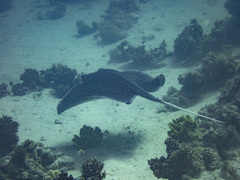
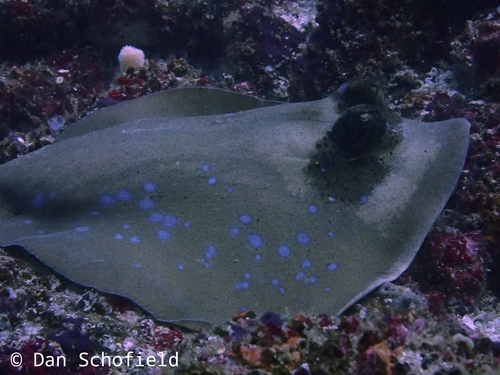
The mangrove whipray (Urogymnus granulatus) or whitetail stingray, is a species of stingray in the family Dasyatidae. It is widely distributed in the Indo-Pacific region from the Red Sea to northern Australia and Micronesia. A benthic inhabitant of shallow inshore waters, juvenile mangrove whiprays favor mangrove and estuarine habitats, while adults favor sandy to rocky areas in lagoons and coral reefs. This species can be identified by its thick, oval pectoral fin disc that is dark gray above with numerous white flecks, and by its relatively short, whip-like tail that is white past the stinging spine. It grows up to 1.4 m (4.6 ft) across.

Solitary in nature, the mangrove whipray preys mainly on small, bottom-dwelling bony fishes and invertebrates. It is, like other stingrays, aplacental viviparous, with the females nourishing their unborn young via histotroph ("uterine milk"). The mangrove whipray is caught for its meat, skin, and cartilage across much of its range. The International Union for Conservation of Nature (IUCN) has assessed it as Vulnerable globally and as Endangered in Southeast Asia, where its population has declined substantially due to intensive artisanal and commercial fisheries as well as widespread habitat degradation. In particular, juvenile rays have been disproportionately targeted by fishers and affected by the large-scale destruction of mangrove forests. Wikipedia →

Global Distribution

Parks Where Found

# Park Country Daily sighting probability
1 Komodo National Park 🇮🇩 Indonesia
~30%

More parks will be added in future updates.

Zoos & Centres Where Found

# Zoo / Centre Country
1 Sea World 🇦🇺 Australia In captivity
2 Aquarium of the Pacific 🇺🇸 United States In captivity
3 Wonders of Wildlife Museum & Aquarium 🇺🇸 United States In captivity
4 Cairns Aquarium 🇦🇺 Australia In captivity
5 Bangsaen Aquarium 🇹🇭 Thailand In captivity
6 Indraloka Animal Sanctuary 🇺🇸 United States In captivity
7 Sea Life Grapevine 🇺🇸 United States In captivity

Before you go

What are the chances of seeing a Mangrove Ray in Komodo National Park?

Possible

About 30% of wildlife watchers report a Mangrove Ray sighting in Komodo National Park on a given day, based on 8 verified sightings from GBIF citizen-science data from 2019 to 2026. It is the 8th most-seen of the 8 sharks and rays we can rate there. Over three days the chance rises to about 60%, and over a week to about 90%, if each day is a fresh chance.

When is the best time to see a Mangrove Ray in Komodo National Park?

January and June

In those months about 60% of wildlife watchers report a Mangrove Ray in Komodo National Park on a given day, against under 5% in April, the lowest month. February has too few records to rate.

What time of day is best to see a Mangrove Ray?

Between 2 and 5 pm

Across all the parks we cover, that three-hour window holds the most Mangrove Ray sightings with a recorded time, and about 8 in 10 of them come between 6 am and 6 pm: it is a daytime animal.

Where else can you see a Mangrove Ray?

Only Komodo National Park, in our data

Komodo National Park is the only park on Wallace's Line with enough records to rate Mangrove Ray sightings: about 30% of wildlife watchers there report one on a given day.

Which relatives of the Mangrove Ray live in Komodo National Park?

Same family: Dasyatidae

The closest relatives of the Mangrove Ray that you can see in Komodo National Park (family Dasyatidae, Whiptail Stingrays) are Reef ray (about 60%) and Australian Bluespotted Maskray (about 40%), with each one's daily chance of a sighting.

Where does the Mangrove Ray sighting chance come from?

GBIF citizen-science records

It is estimated from how often the Mangrove Ray is recorded against all the sharks and rays logged in Komodo National Park (8 verified sightings from 2019 to 2026), calibrated against known sighting rates. Figures are rounded to the nearest 10% because citizen-science data supports honest approximations, not decimals, and months with records from fewer than five people show "—". How it works.

← Back to Komodo National Park