Reef ray

Reef ray

Taeniura lymma

Silhouette: Richard J. Harris · PhyloPic

Daily sighting probability ~60% · Likely
at Komodo National Park

In 3 days ~90% in a week >90%

36 Verified sightings at Komodo National Park From 2019 to 2026
230 In all 4 parks
November Best month
☀️ Diurnal When it's spotted

About the Reef ray

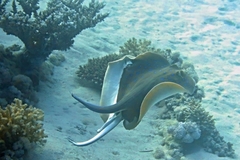
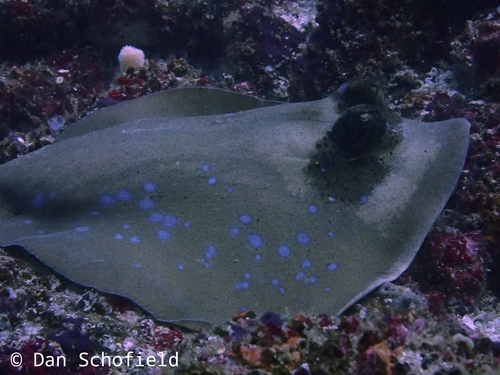
The bluespotted ribbontail ray (Taeniura lymma) is a species of stingray in the family Dasyatidae. Found from the intertidal zone to a depth of 30 m (100 ft), this species is common throughout the tropical Indian and western Pacific Oceans in nearshore, coral reef–associated habitats. It is a fairly small ray, not exceeding 35 cm (14 in) in width, with a mostly smooth, oval pectoral fin disc, large protruding eyes, and a relatively short and thick tail with a deep fin fold underneath. It can be easily identified by its striking color pattern of many electric blue spots on a yellowish background, with a pair of blue stripes on the tail.

At night, small groups of bluespotted ribbontail rays follow the rising tide onto sandy flats to root for small benthic invertebrates and bony fishes in the sediment. When the tide recedes, the rays separate and withdraw to shelters on the reef. Reproduction is Ovoviviparity. With the females giving birth to litters of up to seven young. This ray is capable of injuring humans with its venomous tail spines, though it prefers to flee if threatened. Because of its beauty and size, the bluespotted ribbontail ray is popular with private aquarists despite being poorly suited to captivity. Wikipedia →

Global Distribution

Parks Where Found

# Park Country Daily sighting probability
1 Ningaloo Marine Park 🇦🇺 Australia
~70%
2 Komodo National Park 🇮🇩 Indonesia
~60%
3 Raja Ampat 🇮🇩 Indonesia
~50%
4 Tangkoko Nature Reserve 🇮🇩 Indonesia
~50%

Zoos & Centres Where Found

# Zoo / Centre Country
1 Shedd Aquarium 🇺🇸 United States In captivity
2 SeaWorld Abu Dhabi 🇦🇪 United Arab Emirates In captivity
3 Natura Artis Magistra 🇳🇱 Netherlands In captivity
4 Aquarium of Genoa 🇮🇹 Italy In captivity
5 California Academy of Sciences 🇺🇸 United States In captivity
6 Lisbon Oceanarium 🇵🇹 Portugal In captivity
7 Aquarium de la Réunion 🇫🇷 France In captivity
8 Burgers' Ocean 🇳🇱 Netherlands In captivity
9 Royal Burgers' Zoo 🇳🇱 Netherlands In captivity
10 Sea World 🇦🇺 Australia In captivity
11 Zoo Aquarium de Madrid 🇪🇸 Spain In captivity
12 Point Defiance Zoo & Aquarium 🇺🇸 United States In captivity
13 L'Oceanogràfic 🇪🇸 Spain In captivity
14 Mystic Aquarium & Institute for Exploration 🇺🇸 United States In captivity
15 Oregon Coast Aquarium 🇺🇸 United States In captivity
16 Oceanopolis 🇫🇷 France In captivity
17 Georgia Aquarium 🇺🇸 United States In captivity
18 Aquarium of the Pacific 🇺🇸 United States In captivity
19 Aqua Park Shinagawa 🇯🇵 Japan In captivity
20 AquaRio 🇧🇷 Brazil In captivity
21 Downtown Aquarium, Denver 🇺🇸 United States In captivity
22 Mote SEA 🇺🇸 United States In captivity
23 Osaka Aquarium Kaiyukan 🇯🇵 Japan In captivity
24 Ripley's Aquarium of Canada 🇨🇦 Canada In captivity
25 SEA LIFE Orlando Aquarium 🇺🇸 United States In captivity
26 Seattle Aquarium 🇺🇸 United States In captivity
27 Two Oceans Aquarium 🇿🇦 South Africa In captivity
28 Wonders of Wildlife Museum & Aquarium 🇺🇸 United States In captivity
29 OdySea Aquarium 🇺🇸 United States In captivity
30 Sea World Indonesia 🇮🇩 Indonesia In captivity
31 Marine Life Park 🇸🇬 Singapore In captivity
32 Singapore Oceanarium 🇸🇬 Singapore In captivity
33 Acuario de Sevilla 🇪🇸 Spain In captivity
34 Aquarium of Western Australia 🇦🇺 Australia In captivity
35 Cairns Aquarium 🇦🇺 Australia In captivity
36 Sea Life Sunshine Coast 🇦🇺 Australia In captivity
37 Taichung Aquarium 🇹🇼 Taiwan In captivity
38 The Deep 🇬🇧 United Kingdom In captivity
39 Aquarium de La Rochelle 🇫🇷 France In captivity
40 Dallas World Aquarium 🇺🇸 United States In captivity
41 New England Aquarium 🇺🇸 United States In captivity
42 Sea Life Centre 🇬🇧 United Kingdom In captivity
43 Akvario de Zella-Mehlis 🇩🇪 Germany In captivity
44 National Marine Aquarium of Namibia 🇳🇦 Namibia In captivity
45 Gdynia Aquarium 🇵🇱 Poland In captivity
46 Aquaria KLCC 🇲🇾 Malaysia In captivity
47 Bangsaen Aquarium 🇹🇭 Thailand In captivity
48 Dubai Aquarium and Underwater Zoo 🇦🇪 United Arab Emirates In captivity
49 Jakarta Aquarium 🇮🇩 Indonesia In captivity
50 Manly Sea Life Sanctuary 🇦🇺 Australia In captivity

Before you go

What are the chances of seeing a Reef ray in Komodo National Park?

Likely

About 60% of wildlife watchers report a Reef ray sighting in Komodo National Park on a given day, based on 36 verified sightings from GBIF citizen-science data from 2019 to 2026. It is the 4th most-seen of the 8 sharks and rays we can rate there. Over three days the chance rises to about 90%, and over a week to over 90%, if each day is a fresh chance.

When is the best time to see a Reef ray in Komodo National Park?

November

In that month about 90% of wildlife watchers report a Reef ray in Komodo National Park on a given day, against about 10% in May, the lowest month. February has too few records to rate.

What time of day is best to see a Reef ray?

Between 1 and 4 pm

Across all the parks we cover, that three-hour window holds the most Reef ray sightings with a recorded time, and about 8 in 10 of them come between 6 am and 6 pm: it is a daytime animal.

Is Komodo National Park the best place to see a Reef ray?

2nd of 4

Of the 4 parks where we can rate Reef ray sightings, Komodo National Park ranks 2nd at about 60%. The best odds are in Ningaloo Marine Park (Australia, about 70%). All parks ranked.

Which relatives of the Reef ray live in Komodo National Park?

Same family: Dasyatidae

The closest relatives of the Reef ray that you can see in Komodo National Park (family Dasyatidae, Whiptail Stingrays) are Australian Bluespotted Maskray (about 40%) and Mangrove Ray (about 30%), with each one's daily chance of a sighting.

Where does the Reef ray sighting chance come from?

GBIF citizen-science records

It is estimated from how often the Reef ray is recorded against all the sharks and rays logged in Komodo National Park (36 verified sightings from 2019 to 2026), calibrated against known sighting rates. Figures are rounded to the nearest 10% because citizen-science data supports honest approximations, not decimals, and months with records from fewer than five people show "—". How it works.

← Back to Komodo National Park