Diamond Firetail

Diamond Firetail

Stagonopleura guttata

Silhouette: Sheatherius · PhyloPic

LCNTVUVulnerableENCR Endemic
Daily sighting probability <5% · Rare
at Kosciuszko National Park

In 3 days <5% in a week ~10%

8 Verified sightings at Kosciuszko National Park From 2019 to 2026
16 In all 2 parks
March Best month
☀️ Diurnal When it's spotted

About the Diamond Firetail

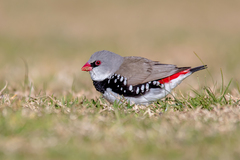
The diamond firetail (Stagonopleura guttata) is a species of estrildid finch that is endemic to Australia. It has a patchy distribution and generally occupies drier forests and grassy woodlands west of the Great Dividing Range from South East Queensland to the Eyre Peninsula in South Australia. While it is a small stocky bird it is one of the largest finches in Australia. The birds are very distinctive with a black breast-band on a white breast. The flanks are black with white spots and it has a scarlet rump (hence the name) and a black tail.

The family Estrildidae (grass-finches) was named by Swainson in 1827 and "finch" can be traced back to the Old English finc but its origin is debated. Firetail is now used to describe the three species of Stagonopleura. The red-browed finch (Neochmia temporalis) is no longer considered a firetail even though it has a red rump. Wikipedia →

Sounds

Song0:43

Australia · 2020

© Marc Anderson · XC576505 · CC BY-NC-ND 4.0

Call0:12

Australia · 2016

© nick talbot · XC336763 · CC BY-NC-SA 4.0

Song0:32

Australia · 2022

© Eddy Smith · XC750551 · CC BY-NC-SA 4.0

Global Distribution

Parks Where Found

# Park Country Daily sighting probability
1 Kosciuszko National Park 🇦🇺 Australia
<5%
2 Blue Mountains National Park 🇦🇺 Australia
<5%

Zoos & Centres Where Found

# Zoo / Centre Country
1 San Diego Zoo 🇺🇸 United States In captivity
2 Aquarium of Genoa 🇮🇹 Italy In captivity
3 Parc des oiseaux 🇫🇷 France In captivity
4 Werribee Open Range Zoo 🇦🇺 Australia In captivity
5 Bronx Zoo 🇺🇸 United States In captivity
6 Toledo Zoo 🇺🇸 United States In captivity
7 Healesville Sanctuary 🇦🇺 Australia In captivity
8 Taronga Zoo 🇦🇺 Australia In captivity
9 Adelaide Zoo 🇦🇺 Australia In captivity
10 Featherdale Sydney Wildlife Park 🇦🇺 Australia In captivity
11 Zoo Lagos 🇵🇹 Portugal In captivity
12 Zoopark Nehvizdy 🇨🇿 Czechia In captivity
13 Helsingborgs Djur- och Lekpark 🇸🇪 Sweden In captivity
14 Bloedel Conservatory 🇨🇦 Canada In captivity
15 Key West Butterfly and Nature Conservatory 🇺🇸 United States In captivity
16 African Safari World 🇦🇺 Australia In captivity
17 Ranger Red’s Zoo & Conservation Park 🇦🇺 Australia In captivity

Before you go

What are the chances of seeing a Diamond Firetail in Kosciuszko National Park?

Rare

Under 5% of wildlife watchers report a Diamond Firetail sighting in Kosciuszko National Park on a given day, based on 8 verified sightings from GBIF citizen-science data from 2019 to 2026. It is the 119th most-seen of the 127 birds we can rate there. Over three days the chance rises to under 5%, and over a week to about 10%, if each day is a fresh chance.

When is the best time to see a Diamond Firetail in Kosciuszko National Park?

Any time of year

In every month with enough records, under 5% of wildlife watchers report a Diamond Firetail in Kosciuszko National Park on a given day, so our monthly data shows no clear season. June has too few records to rate.

What time of day is best to see a Diamond Firetail?

Between 9 am and noon

Across all the parks we cover, that three-hour window holds the most Diamond Firetail sightings with a recorded time, and about 9 in 10 of them come between 6 am and 6 pm: it is a daytime animal.

Is Kosciuszko National Park the best place to see a Diamond Firetail?

Yes

Of the 2 parks where we can rate Diamond Firetail sightings, Kosciuszko National Park has the highest daily chance: under 5%. Next come Blue Mountains National Park (Australia, under 5%).

Where does the Diamond Firetail sighting chance come from?

GBIF citizen-science records

It is estimated from how often the Diamond Firetail is recorded against all the birds logged in Kosciuszko National Park (8 verified sightings from 2019 to 2026), calibrated against known sighting rates. Figures are rounded to the nearest 10% because citizen-science data supports honest approximations, not decimals, and months with records from fewer than five people show "—". How it works.

← Back to Kosciuszko National Park

