Turquoise Parrot

Turquoise Parrot

Neophema pulchella

Silhouette: Farelli (photo), John E. McCormack, Michael G. Harvey, Brant C. Faircloth, Nicholas G. Crawford, Travis C. Glenn, Robb T. Brumfield & T. Michael Keesey · PhyloPic

LCLeast ConcernNTVUENCR Endemic
Daily sighting probability <5% · Rare
at Kosciuszko National Park

In 3 days ~10% in a week ~20%

14 Verified sightings at Kosciuszko National Park From 2019 to 2026
14 In 1 park
March Best month
☀️ Diurnal When it's spotted

About the Turquoise Parrot

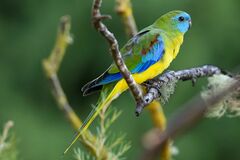
The turquoise parrot (Neophema pulchella) is a species of parrot in the genus Neophema native to eastern Australia, from south-eastern Queensland, through New South Wales and into north-eastern Victoria. It was described by George Shaw in 1792. A small lightly built parrot at around 20 cm (7.9 in) long and 40 g (1+1⁄2 oz) in weight, it exhibits sexual dimorphism. The male is predominantly green with more yellowish underparts and a bright turquoise blue face. Its wings are predominantly blue with red shoulders. The female is generally duller and paler, with a pale green breast and yellow belly, and lacks the red wing patch.

Found in grasslands and open woodlands dominated by Eucalyptus and Callitris trees, the turquoise parrot feeds mainly on grasses and seeds and occasionally flowers, fruit and scale insects. It nests in hollows of gum trees. Much of its habitat has been altered and potential nesting sites lost. Predominantly sedentary, the turquoise parrot can be locally nomadic. Populations appear to be recovering from a crash in the early 20th century. The turquoise parrot has been kept in captivity since the 19th century, and several colour variants exist. Wikipedia →

Sounds

Call0:15

Australia · 2016

© Andrew Spencer · XC328216 · CC BY-NC-ND 4.0

Call0:20

Australia · 2015

© Pieter de Groot Boersma · XC327277 · CC BY-NC-SA 4.0

Call0:09

Australia · 2015

© Marc Anderson · XC233833 · CC BY-NC-ND 4.0

Global Distribution

Parks Where Found

# Park Country Daily sighting probability
1 Kosciuszko National Park 🇦🇺 Australia
<5%

More parks will be added in future updates.

Zoos & Centres Where Found

# Zoo / Centre Country
1 Prague Zoo 🇨🇿 Czechia In captivity
2 Twycross Zoo 🇬🇧 United Kingdom In captivity
3 Wilhelma 🇩🇪 Germany In captivity
4 Auckland Zoo 🇳🇿 New Zealand In captivity
5 Featherdale Sydney Wildlife Park 🇦🇺 Australia In captivity
6 Haus des Meeres 🇦🇹 Austria In captivity
7 Rákosův pavilon 🇨🇿 Czechia In captivity
8 Velemlokárium 🇨🇿 Czechia In captivity
9 All Fish 2U Aquarium 🇦🇺 Australia In captivity
10 Ranger Red’s Zoo & Conservation Park 🇦🇺 Australia In captivity

Before you go

What are the chances of seeing a Turquoise Parrot in Kosciuszko National Park?

Rare

Under 5% of wildlife watchers report a Turquoise Parrot sighting in Kosciuszko National Park on a given day, based on 14 verified sightings from GBIF citizen-science data from 2019 to 2026. It is the 101st most-seen of the 127 birds we can rate there. Over three days the chance rises to about 10%, and over a week to about 20%, if each day is a fresh chance.

When is the best time to see a Turquoise Parrot in Kosciuszko National Park?

February and March

In those months about 10% of wildlife watchers report a Turquoise Parrot in Kosciuszko National Park on a given day, against under 5% in April–May and July–January, the lowest months. June has too few records to rate.

What time of day is best to see a Turquoise Parrot?

Between 9 am and noon

Across all the parks we cover, that three-hour window holds the most Turquoise Parrot sightings with a recorded time, and about 9 in 10 of them come between 6 am and 6 pm: it is a daytime animal.

Where else can you see a Turquoise Parrot?

Only Kosciuszko National Park, in our data

Kosciuszko National Park is the only park on Wallace's Line with enough records to rate Turquoise Parrot sightings: under 5% of wildlife watchers there report one on a given day.

Which relatives of the Turquoise Parrot live in Kosciuszko National Park?

Same family: Psittacidae

The closest relatives of the Turquoise Parrot that you can see in Kosciuszko National Park (family Psittacidae, New World and African Parrots) are Crimson Rosella (about 80%), Sulphur-crested Cockatoo (about 40%) and Gang-gang Cockatoo (about 20%), with each one's daily chance of a sighting.

Where does the Turquoise Parrot sighting chance come from?

GBIF citizen-science records

It is estimated from how often the Turquoise Parrot is recorded against all the birds logged in Kosciuszko National Park (14 verified sightings from 2019 to 2026), calibrated against known sighting rates. Figures are rounded to the nearest 10% because citizen-science data supports honest approximations, not decimals, and months with records from fewer than five people show "—". How it works.

← Back to Kosciuszko National Park