Crimson Rosella

Crimson Rosella

Platycercus elegans

Silhouette: Farelli (photo), John E. McCormack, Michael G. Harvey, Brant C. Faircloth, Nicholas G. Crawford, Travis C. Glenn, Robb T. Brumfield & T. Michael Keesey · PhyloPic

LCLeast ConcernNTVUENCR Endemic
Daily sighting probability ~80% · Very likely
at Kosciuszko National Park

In 3 days >90%

581 Verified sightings at Kosciuszko National Park From 2019 to 2026
18,127 In all 11 parks
August Best month
☀️ Diurnal When it's spotted

About the Crimson Rosella

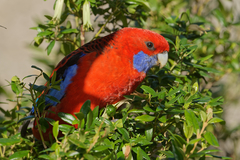
The crimson rosella (Platycercus elegans) is a parrot native to eastern and south eastern Australia which has been introduced to New Zealand and Norfolk Island. It is commonly found in, but not restricted to, mountain forests and gardens. The species as it now stands has subsumed two former separate species, the yellow rosella and the Adelaide rosella. Molecular studies show one of the three red-coloured races, P. e. nigrescens, is genetically more distinct.

The crimson rosella was formally described in 1788 by the German naturalist Johann Friedrich Gmelin in his revised and expanded edition of Carl Linnaeus's Systema Naturae. He placed it with the parrots in the genus Psittacus and coined the binomial name Psittacus elegans. This Latin name had been used in 1605 by the Flemish botanist Carolus Clusius in his book Exoticorum libri decem for the hawk-headed parrot, however this predates the start of Linnean taxonomy.

The crimson rosella had been described and named by John Latham in 1781 as the "Beautiful Lory", from a specimen in the collection of Sir Joseph Banks, and then as the "Pennantian Parrot" in 1787 in honour of Thomas Pennant. However, Latham did not give the... Wikipedia →

Sounds

Call0:31

Australia · 2024

© Romuald Mikusek · XC1173944 · CC BY-NC-SA 4.0

Song0:36

Australia · 2026

© Marc Anderson · XC1085041 · CC BY-NC-ND 4.0

Flight call0:08

Australia · 2022

© nick talbot · XC726663 · CC BY-NC-SA 4.0

Global Distribution

Parks Where Found

# Park Country Daily sighting probability
1 Lamington National Park 🇦🇺 Australia
~90%
2 Grampians National Park 🇦🇺 Australia
~80%
3 Kosciuszko National Park 🇦🇺 Australia
~80%
4 Great Otway National Park 🇦🇺 Australia
~80%
5 Wilsons Promontory National Park 🇦🇺 Australia
~70%
6 Blue Mountains National Park 🇦🇺 Australia
~70%
7 Booderee National Park 🇦🇺 Australia
~60%
8 Flinders Chase 🇦🇺 Australia
~50%
9 Royal National Park 🇦🇺 Australia
~40%
10 Hattah-Kulkyne National Park 🇦🇺 Australia
~40%
11 Springbrook National Park 🇦🇺 Australia
~30%

Cities Where Found

# City Country Daily sighting probability
1 Sydney 🇦🇺 Australia
~10%
2 Melbourne 🇦🇺 Australia
~10%

Zoos & Centres Where Found

# Zoo / Centre Country
1 Le Pal 🇫🇷 France In captivity
2 Liberec Zoo 🇨🇿 Czechia In captivity
3 Walsrode World Bird Park 🇩🇪 Germany In captivity
4 Toronto Zoo 🇨🇦 Canada In captivity
5 Yumka' 🇲🇽 Mexico In captivity
6 Yerevan Zoo 🇦🇲 Armenia In captivity
7 Kyiv Zoo 🇺🇦 Ukraine In captivity
8 Dyrehaven i Nørreskoven 🇩🇰 Denmark In captivity
9 Fort Worth Zoo 🇺🇸 United States In captivity
10 Potter Park Zoo 🇺🇸 United States In captivity
11 Auckland Zoo 🇳🇿 New Zealand In captivity
12 Bioparque Educativo Quillón 🇨🇱 Chile In captivity
13 Paphos Zoo 🇨🇾 Cyprus In captivity
14 Loro Parque 🇪🇸 Spain In captivity
15 Castellar Zoo 🇪🇸 Spain In captivity
16 The Green Planet 🇦🇪 United Arab Emirates In captivity
17 Ranger Red’s Zoo & Conservation Park 🇦🇺 Australia In captivity

Before you go

What are the chances of seeing a Crimson Rosella in Kosciuszko National Park?

Very likely

About 80% of wildlife watchers report a Crimson Rosella sighting in Kosciuszko National Park on a given day, based on 581 verified sightings from GBIF citizen-science data from 2019 to 2026. It is the most-seen of the 127 birds we can rate there. Over three days the chance rises to over 90%, if each day is a fresh chance.

When is the best time to see a Crimson Rosella in Kosciuszko National Park?

March–April and August

In those months about 90% of wildlife watchers report a Crimson Rosella in Kosciuszko National Park on a given day, against about 70% in February, May and September–November, the lowest months. June has too few records to rate.

What time of day is best to see a Crimson Rosella?

Between 2 and 5 pm

Across all the parks we cover, that three-hour window holds the most Crimson Rosella sightings with a recorded time, and nearly all of them come between 6 am and 6 pm: it is a daytime animal.

Is Kosciuszko National Park the best place to see a Crimson Rosella?

3rd of 11

Of the 11 parks where we can rate Crimson Rosella sightings, Kosciuszko National Park ranks 3rd at about 80%. The best odds are in Lamington National Park (Australia, about 90%) and Grampians National Park (Australia, about 80%). All parks ranked.

Where does the Crimson Rosella sighting chance come from?

GBIF citizen-science records

It is estimated from how often the Crimson Rosella is recorded against all the birds logged in Kosciuszko National Park (581 verified sightings from 2019 to 2026), calibrated against known sighting rates. Figures are rounded to the nearest 10% because citizen-science data supports honest approximations, not decimals, and months with records from fewer than five people show "—". How it works.

← Back to Kosciuszko National Park