Acacia Rat

Acacia Rat

Thallomys paedulcus

Silhouette: T. Michael Keesey · PhyloPic

LCLeast ConcernNTVUENCR
Daily sighting probability <5% · Rare
at Kruger National Park

In 3 days ~10% in a week ~20%

5 Verified sightings at Kruger National Park From 2019 to 2026
5 In 1 park
August Best month
🌅 Crepuscular When it's spotted

About the Acacia Rat

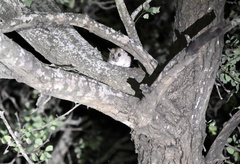
The acacia rat (Thallomys paedulcus), or black-tailed tree rat, is a species of rodent in the family Muridae. It is a small arboreal rodent that is extensively dependent on Acacia trees. It is found in Botswana, Democratic Republic of the Congo, Ethiopia, Kenya, Malawi, Mozambique, Namibia, Somalia, South Africa, Eswatini, Tanzania, Zambia, and Zimbabwe.

Its natural habitat is subtropical or tropical dry shrubland. Child, M.F. & Taylor, P. (2017) [errata version of 2016 assessment]. "Thallomys paedulcus". IUCN Red List of Threatened Species. 2016 e.T21692A115163143. doi:10.2305/IUCN.UK.2016-3.RLTS.T21692A22435824.en. Retrieved 26 November 2023.

Musser, G. G.; Carleton, M. D. (2005). "Superfamily Muroidea". In Wilson, D. E.; Reeder, D. M. (eds.). Mammal Species of the World: A Taxonomic and Geographic Reference (3rd ed.). Johns Hopkins University Press. p. 1509. ISBN 978-0-8018-8221-0. OCLC 62265494.

Karantanis, N., Rychlik, L., Herrel, A., & Youlatos, D. (2017). Arboreality in acacia rats ( Thallomys paedulcus; Rodentia, Muridae): gaits and gait metrics. Journal of Zoology : Proceedings of the Zoological Society of London., 303(2), 107–119. https://doi.org/10.1111/jzo... Wikipedia →

Global Distribution

Parks Where Found

# Park Country Daily sighting probability
1 Kruger National Park 🇿🇦 South Africa
<5%

More parks will be added in future updates.

Zoos & Centres Where Found

# Zoo / Centre Country
1 Chester Zoo 🇬🇧 United Kingdom In captivity

Before you go

What are the chances of seeing an Acacia Rat in Kruger National Park?

Rare

Under 5% of wildlife watchers report an Acacia Rat sighting in Kruger National Park on a given day, based on 5 verified sightings from GBIF citizen-science data from 2019 to 2026. It is the 57th most-seen of the 60 mammals we can rate there. Over three days the chance rises to about 10%, and over a week to about 20%, if each day is a fresh chance.

When is the best time to see an Acacia Rat in Kruger National Park?

April and August

In those months about 10% of wildlife watchers report an Acacia Rat in Kruger National Park on a given day, against under 5% in May–July and September–March, the lowest months. Those are among Kruger National Park's driest months, with about 15 mm of rain a month against 110 mm in February.

What time of day is best to see an Acacia Rat?

Between 5 and 8 pm

Across all the parks we cover, that three-hour window holds the most Acacia Rat sightings with a recorded time, and about 6 in 10 of them come between 6 pm and 6 am: it is most active around dawn and dusk.

Where else can you see an Acacia Rat?

Only Kruger National Park, in our data

Kruger National Park is the only park on Wallace's Line with enough records to rate Acacia Rat sightings: under 5% of wildlife watchers there report one on a given day.

Where does the Acacia Rat sighting chance come from?

GBIF citizen-science records

It is estimated from how often the Acacia Rat is recorded against all the mammals logged in Kruger National Park (5 verified sightings from 2019 to 2026), calibrated against known sighting rates. Figures are rounded to the nearest 10% because citizen-science data supports honest approximations, not decimals, and months with records from fewer than five people show "—". How it works.

← Back to Kruger National Park