Common Rain Frog

Common Rain Frog

Breviceps adspersus

Silhouette: Jose Carlos Arenas-Monroy · PhyloPic

LCLeast ConcernNTVUENCR
Daily sighting probability ~10% · With luck
at Kruger National Park

In 3 days ~30% in a week ~50%

41 Verified sightings at Kruger National Park From 2019 to 2026
41 In 1 park
December Best month
☀️🌙 Day & Night When it's spotted

About the Common Rain Frog

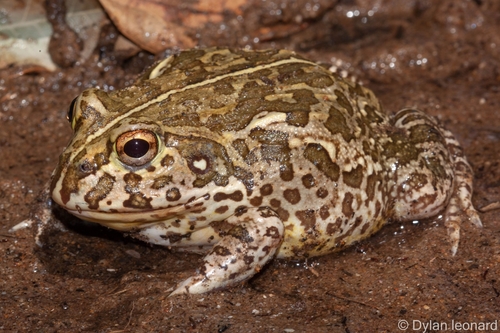
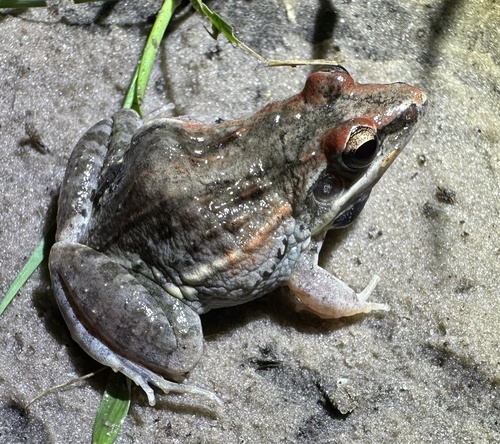
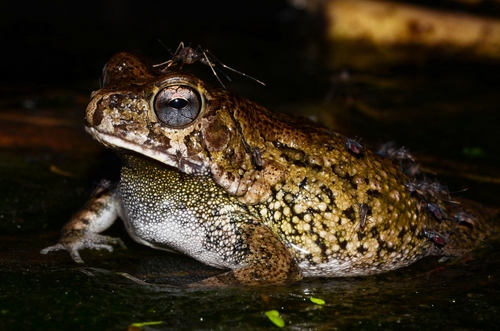
Breviceps adspersus, also known as common rain frog, bushveld rain frog, and many other vernacular names, is a species of frog in the family Brevicipitidae. It is found in Southern Africa, in Angola, Democratic Republic of the Congo,

Namibia, Botswana, Zambia, Zimbabwe, South Africa, Eswatini, and Mozambique. The common rain frog is brownish-green and has a round body and stumpy legs. It cannot jump or swim. It has sharply rigid metatarsal tubercles that are used to dig deep burrows. The species has significant sexual dimorphism. Males are 30–47 mm in length, while females are usually larger, at 40–60 mm. There are two types of common rain frog, Breviceps adspersus adspersus and Breviceps adspersus pentheri of which B. adspersus is found mostly in southeast Africa and B. pentheri in the southern regions of Africa. It is difficult to assert that the two are a subspecies; however, they are still distinguished as such because of differences in colouration and markings.

The common rain frog inhabits temperate forests and open grasslands of Southeast Africa. They spend the dry winter months in burrows and emerge after rain to feed and mate, usually... Wikipedia →

Sounds

Recording0:20

South Africa · 2021

© Alex Rebelo · iNaturalist · CC BY-NC 4.0

Recording0:10

Botswana · 2019

© Dewald du Plessis · iNaturalist · CC BY-NC 4.0

Recording0:11

South Africa · 2021

© Nick Helme · iNaturalist · CC BY-NC 4.0

Global Distribution

Parks Where Found

# Park Country Daily sighting probability
1 Kruger National Park 🇿🇦 South Africa
~10%

More parks will be added in future updates.

Before you go

What are the chances of seeing a Common Rain Frog in Kruger National Park?

With luck

About 10% of wildlife watchers report a Common Rain Frog sighting in Kruger National Park on a given day, based on 41 verified sightings from GBIF citizen-science data from 2019 to 2026. It is the 7th most-seen of the 28 amphibians we can rate there. Over three days the chance rises to about 30%, and over a week to about 50%, if each day is a fresh chance.

When is the best time to see a Common Rain Frog in Kruger National Park?

March and December

In those months about 20% of wildlife watchers report a Common Rain Frog in Kruger National Park on a given day, against under 5% in April, July–August and October, the lowest months. Those are among Kruger National Park's wettest months, with about 65 mm of rain a month against almost none in August.

What time of day is best to see a Common Rain Frog?

Between 8 and 11 pm

Across all the parks we cover, that three-hour window holds the most Common Rain Frog sightings with a recorded time, and about half of them come between 6 pm and 6 am: it is seen both by day and at night.

Where else can you see a Common Rain Frog?

Only Kruger National Park, in our data

Kruger National Park is the only park on Wallace's Line with enough records to rate Common Rain Frog sightings: about 10% of wildlife watchers there report one on a given day.

Where does the Common Rain Frog sighting chance come from?

GBIF citizen-science records

It is estimated from how often the Common Rain Frog is recorded against all the amphibians logged in Kruger National Park (41 verified sightings from 2019 to 2026), calibrated against known sighting rates. Figures are rounded to the nearest 10% because citizen-science data supports honest approximations, not decimals, and months with records from fewer than five people show "—". How it works.

← Back to Kruger National Park