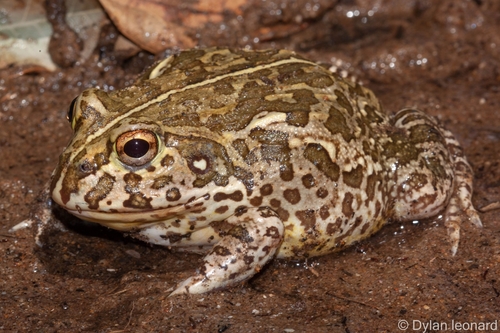
Garman's Toad

Garman's Toad

Sclerophrys garmani

Silhouette: Michael Scroggie, from original photograph by Gary M. Stolz, USFWS (original photograph in public domain). · PhyloPic

LCLeast ConcernNTVUENCR
Daily sighting probability ~20% · Possible
at Kruger National Park

In 3 days ~50% in a week ~80%

136 Verified sightings at Kruger National Park From 2019 to 2026
153 In all 3 parks
March Best month
🌙 Nocturnal When it's spotted

About the Garman's Toad

Sclerophrys garmani, also known as Garman's toad or eastern olive toad (among others), is a species of toad in the family Bufonidae. It is widely distributed in East and Southern Africa. However, populations north and south of Tanzania might represent distinct species. If so, the name Sclerophrys garmani would apply to populations from northeastern Africa. Furthermore, its southern boundary towards the range of Sclerophrys poweri in South Africa is also unclear.

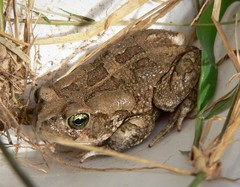
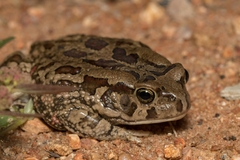
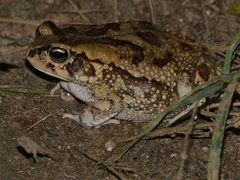
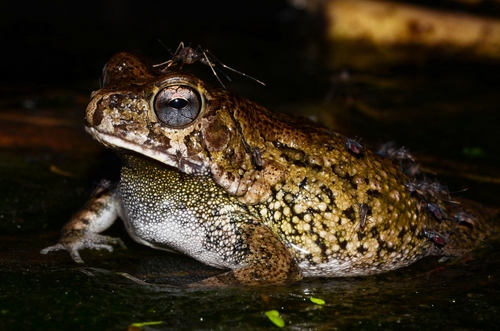
The specific name garmani honors Samuel Garman, an American ichthyologist and herpetologist. Males grow to 106 mm (4.2 in) and females to 115 mm (4.5 in) in snout–vent length. The tympanum is almost as big as the eye diameter. The parotoid glands are large. The back is tan to olive-brown and bears large paired markings edged with black. A thin vertebral stripe may be present. Dorsal skin has distinct warts that bear small, black spines. The ventrum is off-white.

The male advertisement call is a loud, low-pitched "kwaak", lasting for about a second. The range extends from Ethiopia and Somalia southward through Kenya, Tanzania, Mozambique, Zambia, Zimbabwe, Botswana, to South Africa... Wikipedia →

Sounds

Recording0:11

South Africa · 2021

© Jacob Dirsuwei · iNaturalist · CC BY-NC 4.0

Recording0:22

South Africa · 2025

© Sascha Schumann · iNaturalist · CC BY-NC 4.0

Recording0:12

South Africa · 2025

© Thembeka Zulu · iNaturalist · CC BY-NC 4.0

Global Distribution

Parks Where Found

# Park Country Daily sighting probability
1 Gonarezhou National Park 🇿🇼 Zimbabwe
~30%
2 Kruger National Park 🇿🇦 South Africa
~20%
3 iSimangaliso Wetland Park 🇿🇦 South Africa
~10%

Closest Relatives at Kruger National Park

Before you go

What are the chances of seeing a Garman's Toad in Kruger National Park?

Possible

About 20% of wildlife watchers report a Garman's Toad sighting in Kruger National Park on a given day, based on 136 verified sightings from GBIF citizen-science data from 2019 to 2026. It is the 2nd most-seen of the 28 amphibians we can rate there. Over three days the chance rises to about 50%, and over a week to about 80%, if each day is a fresh chance.

When is the best time to see a Garman's Toad in Kruger National Park?

March

In that month about 30% of wildlife watchers report a Garman's Toad in Kruger National Park on a given day, against about 10% in April to August, the lowest months.

What time of day is best to see a Garman's Toad?

Between 7 and 10 pm

Across all the parks we cover, that three-hour window holds the most Garman's Toad sightings with a recorded time, and about 8 in 10 of them come between 6 pm and 6 am: it is mostly seen at night.

Is Kruger National Park the best place to see a Garman's Toad?

2nd of 3

Of the 3 parks where we can rate Garman's Toad sightings, Kruger National Park ranks 2nd at about 20%. The best odds are in Gonarezhou National Park (Zimbabwe, about 30%).

Which relatives of the Garman's Toad live in Kruger National Park?

Same genus: Sclerophrys

The closest relatives of the Garman's Toad that you can see in Kruger National Park (genus Sclerophrys, African Toads) are Eastern Flat-backed Toad (about 10%) and African Common Toad (about 10%), with each one's daily chance of a sighting.

Where does the Garman's Toad sighting chance come from?

GBIF citizen-science records

It is estimated from how often the Garman's Toad is recorded against all the amphibians logged in Kruger National Park (136 verified sightings from 2019 to 2026), calibrated against known sighting rates. Figures are rounded to the nearest 10% because citizen-science data supports honest approximations, not decimals, and months with records from fewer than five people show "—". How it works.

← Back to Kruger National Park