Knysna Turaco

Knysna Turaco

Tauraco corythaix

Silhouette: Lisa M. "Pixxl" (photo), John E. McCormack, Michael G. Harvey, Brant C. Faircloth, Nicholas G. Crawford, Travis C. Glenn, Robb T. Brumfield & T. Michael Keesey · PhyloPic

LCLeast ConcernNTVUENCR
Daily sighting probability <5% · Rare
at Kruger National Park

In 3 days <5%

8 Verified sightings at Kruger National Park From 2019 to 2026
1,203 In all 3 parks
April Best month
☀️ Diurnal When it's spotted

About the Knysna Turaco

The Knysna turaco (Tauraco corythaix), or, in South Africa, Knysna loerie, is a large turaco, one of a group of African musophagidae birds. It is a resident breeder in the mature evergreen forests of southern and eastern South Africa, and Eswatini. It was formerly sometimes considered to be a subspecies of the green turaco of West Africa. The Livingstone's and Schalow's turacos were once considered subspecies.

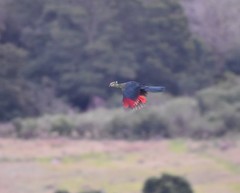
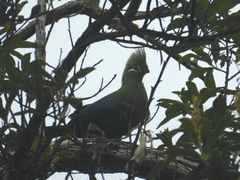
This species lays two eggs in a shallow platform nest made from sticks and placed in a tree or clump of creepers. Within its range, this is an unmistakable bird, although often inconspicuous in the treetops. It is 40–42 cm long, including a long tail. The small but thick orange-red bill and a white line just under the eye contrast with the mainly green plumage. It has a tall green crest, which is tipped with white. The eye is brown and the eye-ring deep red. In flight, Knysna turaco shows conspicuous crimson primary flight feathers. Sexes are similar, but juvenile birds have a shorter crest without the white tips.

The Knysna turaco is usually seen flying between forest trees, or hopping along branches. It feeds on fruit, insects and earthworms. It has a loud kow-kow-kow-kow call. This bird family is known as Loeries in South Africa, but the international name is Turaco. Turacos (the 10 species of the Tauraco and the 2 of the Musophaga) are the only birds to possess true red and green colour. The color human eyes see in most birds' plumage is a reflection produced by the feather structure. The turaco's red pigment (turacin) and green pigment (turacoverdin) both contain copper. In fact, a glass of water, if stirred with a red turaco feather, will turn pink. In museum species, the pigments deepen with age because the copper begins to oxidize. These birds maintain their colours throughout the year. The Knysna Loerie is thought to use its red wing feathers to escape predators. Indeed, when it flies, the predators tend to focus on the most visible colour and follow the red patch. As the Loerie lands and folds its wings, the red feathers of the wings become invisible and the Loerie has a chance of escaping unseen. Wikipedia →

Sounds

Song1:10

South Africa · 2023

© Albert Lastukhin · XC1146605 · CC BY-NC-ND 4.0

Call0:52

South Africa · 2022

© Lynette Rudman · XC741401 · CC BY-NC-SA 4.0

Call0:32

South Africa · 2020

© Tim Cockcroft · XC569101 · CC BY-NC-SA 4.0

Global Distribution

Parks Where Found

# Park Country Daily sighting probability
1 Garden Route National Park 🇿🇦 South Africa
~50%
2 Addo Elephant National Park 🇿🇦 South Africa
~10%
3 Kruger National Park 🇿🇦 South Africa
<5%

Zoos & Centres Where Found

# Zoo / Centre Country
1 San Diego Zoo 🇺🇸 United States In captivity
2 SeaWorld Abu Dhabi 🇦🇪 United Arab Emirates In captivity
3 Barcelona Zoo 🇪🇸 Spain In captivity
4 Badoca Safari Park 🇵🇹 Portugal In captivity
5 Ueno Zoo 🇯🇵 Japan In captivity
6 Bird Paradise 🇸🇬 Singapore In captivity
7 Aquarama Barcelona 🇪🇸 Spain In captivity
8 Rainforest Wild Asia 🇸🇬 Singapore In captivity
9 Zoomarine 🇮🇹 Italy In captivity
10 Aviario Nacional de Colombia 🇨🇴 Colombia In captivity
11 Monkeyland 🇿🇦 South Africa In captivity
12 Elephant Sanctuary, The Crags, Plettenberg Bay 🇿🇦 South Africa In captivity
13 Las Águilas Jungle Park 🇪🇸 Spain In captivity
14 Santa Fe College Teaching Zoo 🇺🇸 United States In captivity
15 Birds of Eden 🇿🇦 South Africa In captivity
16 Key West Butterfly and Nature Conservatory 🇺🇸 United States In captivity
17 The Green Planet 🇦🇪 United Arab Emirates In captivity
18 Exotic Animal World 🇿🇦 South Africa In captivity

Before you go

What are the chances of seeing a Knysna Turaco in Kruger National Park?

Rare

Under 5% of wildlife watchers report a Knysna Turaco sighting in Kruger National Park on a given day, based on 8 verified sightings from GBIF citizen-science data from 2019 to 2026. It is the 429th most-seen of the 464 birds we can rate there. Over three days the chance rises to under 5%, if each day is a fresh chance.

When is the best time to see a Knysna Turaco in Kruger National Park?

Any time of year

In every month with enough records, under 5% of wildlife watchers report a Knysna Turaco in Kruger National Park on a given day, so our monthly data shows no clear season.

What time of day is best to see a Knysna Turaco?

Between 8 and 11 am

Across all the parks we cover, that three-hour window holds the most Knysna Turaco sightings with a recorded time, and nearly all of them come between 6 am and 6 pm: it is a daytime animal.

Is Kruger National Park the best place to see a Knysna Turaco?

3rd of 3

Of the 3 parks where we can rate Knysna Turaco sightings, Kruger National Park ranks 3rd at under 5%. The best odds are in Garden Route National Park (South Africa, about 50%) and Addo Elephant National Park (South Africa, about 10%).

Where does the Knysna Turaco sighting chance come from?

GBIF citizen-science records

It is estimated from how often the Knysna Turaco is recorded against all the birds logged in Kruger National Park (8 verified sightings from 2019 to 2026), calibrated against known sighting rates. Figures are rounded to the nearest 10% because citizen-science data supports honest approximations, not decimals, and months with records from fewer than five people show "—". How it works.

← Back to Kruger National Park