Sharpe's Grysbok

Sharpe's Grysbok

Raphicerus sharpei

Silhouette: [unknown] · PhyloPic

LCLeast ConcernNTVUENCR
Daily sighting probability ~10% · With luck
at Kruger National Park

In 3 days ~40% in a week ~70%

88 Verified sightings at Kruger National Park From 2019 to 2026
100 In all 3 parks
October Best month
☀️ Diurnal When it's spotted

About the Sharpe's Grysbok

Sharpe's or northern grysbok (Raphicerus sharpei) is a small, shy, solitary antelope that is found from tropical to south-eastern Africa. They are found in the Transvaal (South Africa), the Caprivi Strip (Namibia), Botswana, Mozambique, Zimbabwe, Zambia, Malawi and Tanzania to Lake Victoria.

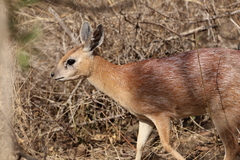
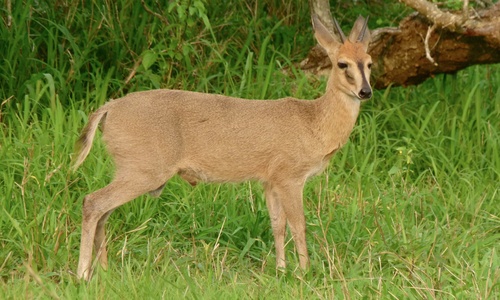
It is similar in size to the gray duiker, but has a stockier body and shaggy fur over the hindquarters. It stands about 20" (45–60 cm) at the shoulders and weighs only 7–11.5 kg. Its coat is reddish-brown streaked with white; eye-rings, muzzle, throat and underside are off-white. The males have stubby horns, which are widely spaced. Sharpe's grysbok has a short, deep muzzle with large mouth and heavy molars for grinding. The short neck and head on a long-legged body result in a high-rumped posture when browsing.

Although widespread, Sharpe's grysbok is infrequently seen. Males and females seem to form brief associations, but the species is usually encountered singly. Territory is marked with dung middens. Their habitat is rocky hill country, but preferring fertile zones on the lower slopes. They are nocturnal browsers and spend the day in the protective... Wikipedia →

Global Distribution

Parks Where Found

# Park Country Daily sighting probability
1 Gonarezhou National Park 🇿🇼 Zimbabwe
~30%
2 Kafue National Park 🇿🇲 Zambia
~30%
3 Kruger National Park 🇿🇦 South Africa
~10%

Before you go

What are the chances of seeing a Sharpe's Grysbok in Kruger National Park?

With luck

About 10% of wildlife watchers report a Sharpe's Grysbok sighting in Kruger National Park on a given day, based on 88 verified sightings from GBIF citizen-science data from 2019 to 2026. It is the 30th most-seen of the 60 mammals we can rate there. Over three days the chance rises to about 40%, and over a week to about 70%, if each day is a fresh chance.

When is the best time to see a Sharpe's Grysbok in Kruger National Park?

May–June and September–November

In those months about 20% of wildlife watchers report a Sharpe's Grysbok in Kruger National Park on a given day, against about 10% in July–August and December–April, the lowest months. Those are among Kruger National Park's driest months, with about 25 mm of rain a month against 110 mm in February.

What time of day is best to see a Sharpe's Grysbok?

Between 8 and 11 am

Across all the parks we cover, that three-hour window holds the most Sharpe's Grysbok sightings with a recorded time, and about 8 in 10 of them come between 6 am and 6 pm: it is a daytime animal.

Is Kruger National Park the best place to see a Sharpe's Grysbok?

3rd of 3

Of the 3 parks where we can rate Sharpe's Grysbok sightings, Kruger National Park ranks 3rd at about 10%. The best odds are in Gonarezhou National Park (Zimbabwe, about 30%) and Kafue National Park (Zambia, about 30%).

Where does the Sharpe's Grysbok sighting chance come from?

GBIF citizen-science records

It is estimated from how often the Sharpe's Grysbok is recorded against all the mammals logged in Kruger National Park (88 verified sightings from 2019 to 2026), calibrated against known sighting rates. Figures are rounded to the nearest 10% because citizen-science data supports honest approximations, not decimals, and months with records from fewer than five people show "—". How it works.

← Back to Kruger National Park