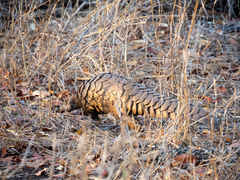
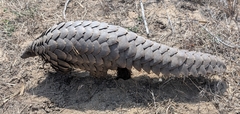
Temminck's Ground Pangolin

Temminck's Ground Pangolin

Manis temminckii

Silhouette: Steven Traver · PhyloPic

Daily sighting probability <5% · Rare
at Kruger National Park

In 3 days ~10% in a week ~20%

5 Verified sightings at Kruger National Park From 2019 to 2026
17 In all 2 parks
June Best month
☀️ Diurnal When it's spotted

About the Temminck's Ground Pangolin

The ground pangolin (Smutsia temminckii), also known as Temminck's pangolin, Cape pangolin or steppe pangolin is a species of pangolin from genus Smutsia of subfamily Smutsiinae the within family Manidae. It is one of four species of pangolins which can be found in Africa, and the only one in southern and eastern Africa. The animal was named for the Dutch zoologist Coenraad Jacob Temminck.

Pangolins are almost completely covered in overlapping, protective scales, which makes up about 20% of their body weight. The scales are composed of keratin, the same material that forms human hair and fingernails, and give pangolins an appearance similar to a pinecone or artichoke. The underside of a pangolin is not covered with scales, but sparse fur, instead. When threatened, it usually rolls up into a ball, thus protecting its vulnerable belly.

Pangolins are 30 to 90 cm (12 to 35 in) long exclusive of the tail and weigh from 5 to 27 kg (11 to 60 lb). Across all eight species, adult tail length ranges from about 26 to 70 cm (10 to 28 in). Mature adults are light brown, olive, and dark brown in color, while young are pale brown or pink in color.

Ground pangolins walk on... Wikipedia →

Global Distribution

Parks Where Found

# Park Country Daily sighting probability
1 Gorongosa National Park 🇲🇿 Mozambique
~30%
2 Kruger National Park 🇿🇦 South Africa
<5%

Zoos & Centres Where Found

# Zoo / Centre Country
1 Copenhagen Zoo 🇩🇰 Denmark In captivity
2 Zoológico de Concepción 🇨🇱 Chile In captivity

Before you go

What are the chances of seeing a Temminck's Ground Pangolin in Kruger National Park?

Rare

Under 5% of wildlife watchers report a Temminck's Ground Pangolin sighting in Kruger National Park on a given day, based on 5 verified sightings from GBIF citizen-science data from 2019 to 2026. It is the 57th most-seen of the 60 mammals we can rate there. Over three days the chance rises to about 10%, and over a week to about 20%, if each day is a fresh chance.

When is the best time to see a Temminck's Ground Pangolin in Kruger National Park?

June and August–September

In those months about 10% of wildlife watchers report a Temminck's Ground Pangolin in Kruger National Park on a given day, against under 5% in July and October–May, the lowest months. Those are among Kruger National Park's driest months, with about 10 mm of rain a month against 110 mm in February.

What time of day is best to see a Temminck's Ground Pangolin?

Between 3 and 6 pm

Across all the parks we cover, that three-hour window holds the most Temminck's Ground Pangolin sightings with a recorded time, and about 7 in 10 of them come between 6 am and 6 pm: it is a daytime animal.

Is Kruger National Park the best place to see a Temminck's Ground Pangolin?

2nd of 2

Of the 2 parks where we can rate Temminck's Ground Pangolin sightings, Kruger National Park ranks 2nd at under 5%. The best odds are in Gorongosa National Park (Mozambique, about 30%).

Where does the Temminck's Ground Pangolin sighting chance come from?

GBIF citizen-science records

It is estimated from how often the Temminck's Ground Pangolin is recorded against all the mammals logged in Kruger National Park (5 verified sightings from 2019 to 2026), calibrated against known sighting rates. Figures are rounded to the nearest 10% because citizen-science data supports honest approximations, not decimals, and months with records from fewer than five people show "—". How it works.

← Back to Kruger National Park