Black Thrush

Black Thrush

Turdus infuscatus

Silhouette: Sharon Wegner-Larsen · PhyloPic

LCLeast ConcernNTVUENCR
Daily sighting probability <5% · Rare
at La Tigra National Park

In 3 days ~10% in a week ~20%

14 Verified sightings at La Tigra National Park From 2019 to 2026
72 In all 2 parks
December Best month
☀️ Diurnal When it's spotted

About the Black Thrush

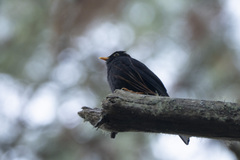
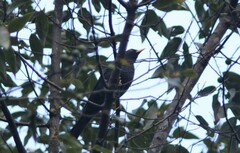
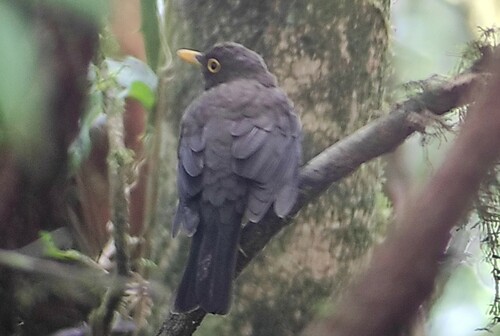
The black thrush (Turdus infuscatus) is a species of bird in the family Turdidae, the thrushes and allies. It is found in El Salvador, Guatemala, Honduras, and Mexico. It was formerly known as the black robin. The black thrush was originally described in 1844 as Merula infuscata. It was later reassigned to its present genus Turdus that had been erected in 1758. For a time it and the glossy-black thrush (T. serranus) were treated as conspecific but molecular studies determined that they are separate species and not closely related. The black thrush's closest relative is the sooty thrush (T. nigrescens).

The black thrush is monotypic. The black thrush is 22 to 23 cm (8.7 to 9.1 in) long and weighs about 60 to 90 g (2.1 to 3.2 oz). The species is sexually dimorphic. Adult males are almost entirely black with a slightly duller and more slaty belly and undertail coverts. They have a bright yellow ring of bare skin around the eye. Adult females have an olive brown head with dusky brown streaks on the cheeks and a dark brown eye ring. Their upperparts, tail, and upper surface of the wings are olive brown. Their chin and throat are whitish with... Wikipedia →

Sounds

Song0:56

Guatemala · 2024

© Peter Boesman · XC880357 · CC BY-NC-ND 4.0

Imitation0:42

Mexico · 2021

© Manuel Grosselet · XC651144 · CC BY-NC-SA 4.0

Call0:29

El Salvador · 2016

© Guillermo Funes · XC326052 · CC BY-NC-SA 4.0

Global Distribution

Parks Where Found

# Park Country Daily sighting probability
1 El Triunfo 🇲🇽 Mexico
~10%
2 La Tigra National Park 🇭🇳 Honduras
<5%

Before you go

What are the chances of seeing a Black Thrush in La Tigra National Park?

Rare

Under 5% of wildlife watchers report a Black Thrush sighting in La Tigra National Park on a given day, based on 14 verified sightings from GBIF citizen-science data from 2019 to 2026. It is the 133rd most-seen of the 176 birds we can rate there. Over three days the chance rises to about 10%, and over a week to about 20%, if each day is a fresh chance.

When is the best time to see a Black Thrush in La Tigra National Park?

February, April, June and December

In those months about 10% of wildlife watchers report a Black Thrush in La Tigra National Park on a given day, against under 5% in January, March, May and July–November, the lowest months.

What time of day is best to see a Black Thrush?

Between 7 and 10 am

Across all the parks we cover, that three-hour window holds the most Black Thrush sightings with a recorded time, and about 9 in 10 of them come between 6 am and 6 pm: it is a daytime animal.

Is La Tigra National Park the best place to see a Black Thrush?

2nd of 2

Of the 2 parks where we can rate Black Thrush sightings, La Tigra National Park ranks 2nd at under 5%. The best odds are in El Triunfo (Mexico, about 10%).

Where does the Black Thrush sighting chance come from?

GBIF citizen-science records

It is estimated from how often the Black Thrush is recorded against all the birds logged in La Tigra National Park (14 verified sightings from 2019 to 2026), calibrated against known sighting rates. Figures are rounded to the nearest 10% because citizen-science data supports honest approximations, not decimals, and months with records from fewer than five people show "—". How it works.

← Back to La Tigra National Park