
Great Swallow-tailed Swift

Great Swallow-tailed Swift

Panyptila sanctihieronymi

Silhouette: Aviceda (vectorized by T. Michael Keesey) · PhyloPic

LCLeast ConcernNTVUENCR
Daily sighting probability <5% · Rare
at La Tigra National Park

In 3 days ~10% in a week ~20%

9 Verified sightings at La Tigra National Park From 2019 to 2026
9 In 1 park
October Best month
☀️ Diurnal When it's spotted

About the Great Swallow-tailed Swift

The great swallow-tailed swift (Panyptila sanctihieronymi) is a species of bird in subfamily Apodinae of the swift family Apodidae. It is found in Costa Rica, Guatemala, Honduras, Mexico, and Nicaragua. The great swallow-tailed swift shares genus Panyptila with the lesser swallow-tailed swift (P. cayennensis). It is monotypic.

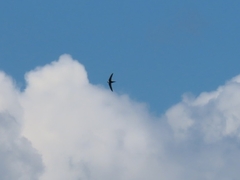
The great swallow-tailed swift is 18 to 20.5 cm (7.1 to 8.1 in) long and weighs about 48 g (1.7 oz). It has long narrow wings and a long deeply forked tail. The sexes are alike. Adults have a black crown and upper face with two white spots on the forehead. Most of their body is bluish black. Their lower face, throat, collar, upper chest, and flanks are white. Their flight feathers have grayish ends and white tips.

The great swallow-tailed swift is found from Nayarit in western Mexico south through Guatemala and Honduras into northern Nicaragua. There are also a few records in Costa Rica. It generally inhabits arid to semi-arid highland landscapes characterized by canyons and large cliffs. In elevation it typically ranges between 1,000 and 2,000 m (3,300 and 6,600 ft) but sometimes... Wikipedia →

Sounds

Call0:09

Honduras · 2013

© John van Dort · XC149485 · CC BY-NC-SA 3.0

Recording0:10

Honduras · 2018

© Francisco Dubón · iNaturalist · CC BY-NC 4.0

Global Distribution

Parks Where Found

# Park Country Daily sighting probability
1 La Tigra National Park 🇭🇳 Honduras
<5%

More parks will be added in future updates.

Before you go

What are the chances of seeing a Great Swallow-tailed Swift in La Tigra National Park?

Rare

Under 5% of wildlife watchers report a Great Swallow-tailed Swift sighting in La Tigra National Park on a given day, based on 9 verified sightings from GBIF citizen-science data from 2019 to 2026. It is the 147th most-seen of the 176 birds we can rate there. Over three days the chance rises to about 10%, and over a week to about 20%, if each day is a fresh chance.

When is the best time to see a Great Swallow-tailed Swift in La Tigra National Park?

October

In that month about 10% of wildlife watchers report a Great Swallow-tailed Swift in La Tigra National Park on a given day, against under 5% in November to September, the lowest months. That is one of La Tigra National Park's wettest months, with about 260 mm of rain against 25 mm in February.

What time of day is best to see a Great Swallow-tailed Swift?

Between 7 and 10 am

Across all the parks we cover, that three-hour window holds the most Great Swallow-tailed Swift sightings with a recorded time, and about 9 in 10 of them come between 6 am and 6 pm: it is a daytime animal.

Where else can you see a Great Swallow-tailed Swift?

Only La Tigra National Park, in our data

La Tigra National Park is the only park on Wallace's Line with enough records to rate Great Swallow-tailed Swift sightings: under 5% of wildlife watchers there report one on a given day.

Which relatives of the Great Swallow-tailed Swift live in La Tigra National Park?

Same family: Apodidae

The closest relatives of the Great Swallow-tailed Swift that you can see in La Tigra National Park (family Apodidae, Swifts) are Vaux's Swift (about 10%) and White-collared Swift (about 10%), with each one's daily chance of a sighting.

Where does the Great Swallow-tailed Swift sighting chance come from?

GBIF citizen-science records

It is estimated from how often the Great Swallow-tailed Swift is recorded against all the birds logged in La Tigra National Park (9 verified sightings from 2019 to 2026), calibrated against known sighting rates. Figures are rounded to the nearest 10% because citizen-science data supports honest approximations, not decimals, and months with records from fewer than five people show "—". How it works.

← Back to La Tigra National Park