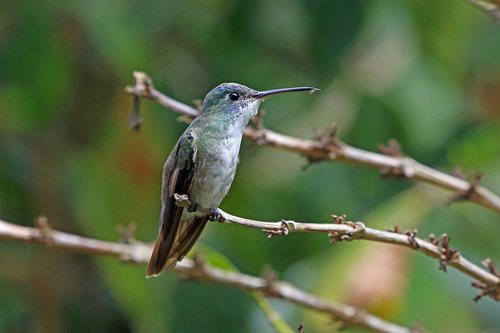
Rivoli's Hummingbird

Rivoli's Hummingbird

Eugenes fulgens

Silhouette: Ferran Sayol · PhyloPic

LCLeast ConcernNTVUENCR
Daily sighting probability ~20% · Possible
at La Tigra National Park

In 3 days ~40% in a week ~70%

64 Verified sightings at La Tigra National Park From 2019 to 2026
214 In all 6 parks
February Best month
☀️ Diurnal When it's spotted

About the Rivoli's Hummingbird

Rivoli's hummingbird (Eugenes fulgens), also known as the magnificent hummingbird, is a species of hummingbird in the "mountain gems", tribe Lampornithini in subfamily Trochilinae. It is found in El Salvador, Guatemala, Honduras, Mexico, Nicaragua, and the United States.

Eugenes fulgens was originally described as the magnificent hummingbird, and by the late 1800s was treated as having two subspecies. Beginning in 2017 the North American Classification Committee of the American Ornithological Society (NACC), the International Ornithological Committee (IOC), and the Clements taxonomy split them into the current Rivoli's hummingbird and the Talamanca hummingbird (E. spectabilis). However, as of 2020, BirdLife International's Handbook of the Birds of the World (HBW) retains the single species "magnificent" hummingbird treatment.

Rivoli's hummingbird is monotypic. Rivoli's hummingbird is about 11 to 14 cm (4.3 to 5.5 in) long and weighs about 6 to 10 g (0.21 to 0.35 oz), with males typically a little larger than females. It has a wingspan of 18 centimetres (7.1 in). Of the hummingbirds found in the United States, Rivoli's hummingbird is one... Wikipedia →

Sounds

Call0:05

Mexico · 2022

© Manuel Grosselet · XC744811 · CC BY-NC-SA 4.0

Song0:13

United States · 2011

© Richard E. Webster · XC133507 · CC BY-NC-SA 3.0

Call0:23

Mexico · 2022

© Manuel Grosselet Georgita Ruiz · XC737902 · CC BY-NC-SA 4.0

Global Distribution

Parks Where Found

# Park Country Daily sighting probability
1 Reserva de la Biosfera Mariposa Monarca 🇲🇽 Mexico
~40%
2 La Tigra National Park 🇭🇳 Honduras
~20%
3 Celaque National Park 🇭🇳 Honduras
~10%
4 Cumbres de Monterrey National Park 🇲🇽 Mexico
<5%
5 Cusuco National Park 🇭🇳 Honduras
<5%
6 Big Bend National Park 🇺🇸 United States
<5%

Cities Where Found

# City Country Daily sighting probability
1 Toluca 🇲🇽 México
~10%
2 Mexico City 🇲🇽 México
~10%
3 Guatemala City 🇬🇹 Guatemala
<5%

Before you go

What are the chances of seeing a Rivoli's Hummingbird in La Tigra National Park?

Possible

About 20% of wildlife watchers report a Rivoli's Hummingbird sighting in La Tigra National Park on a given day, based on 64 verified sightings from GBIF citizen-science data from 2019 to 2026. It is the 37th most-seen of the 176 birds we can rate there. Over three days the chance rises to about 40%, and over a week to about 70%, if each day is a fresh chance.

When is the best time to see a Rivoli's Hummingbird in La Tigra National Park?

January–February and May

In those months about 30% of wildlife watchers report a Rivoli's Hummingbird in La Tigra National Park on a given day, against under 5% in June, the lowest month. Those are among La Tigra National Park's driest months, with about 85 mm of rain a month against 260 mm in June.

What time of day is best to see a Rivoli's Hummingbird?

Between 10 am and 1 pm

Across all the parks we cover, that three-hour window holds the most Rivoli's Hummingbird sightings with a recorded time, and about 8 in 10 of them come between 6 am and 6 pm: it is a daytime animal.

Is La Tigra National Park the best place to see a Rivoli's Hummingbird?

2nd of 6

Of the 6 parks where we can rate Rivoli's Hummingbird sightings, La Tigra National Park ranks 2nd at about 20%. The best odds are in Reserva de la Biosfera Mariposa Monarca (Mexico, about 40%).

Where does the Rivoli's Hummingbird sighting chance come from?

GBIF citizen-science records

It is estimated from how often the Rivoli's Hummingbird is recorded against all the birds logged in La Tigra National Park (64 verified sightings from 2019 to 2026), calibrated against known sighting rates. Figures are rounded to the nearest 10% because citizen-science data supports honest approximations, not decimals, and months with records from fewer than five people show "—". How it works.

← Back to La Tigra National Park