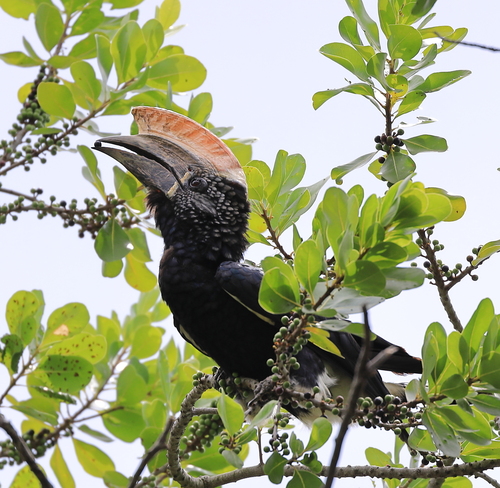

Bare-Faced Go-Away-Bird

Bare-Faced Go-Away-Bird

Corythaixoides personatus

Silhouette: Lisa M. "Pixxl" (photo), John E. McCormack, Michael G. Harvey, Brant C. Faircloth, Nicholas G. Crawford, Travis C. Glenn, Robb T. Brumfield & T. Michael Keesey · PhyloPic

LCLeast ConcernNTVUENCR
Daily sighting probability <5% · Rare
at Lake Manyara National Park

In 3 days <5% in a week ~10%

6 Verified sightings at Lake Manyara National Park From 2019 to 2026
4,558 In all 9 parks
August Best month
☀️ Diurnal When it's spotted

About the Bare-Faced Go-Away-Bird

The bare-faced go-away-bird (Crinifer personatus) is a species of bird in the family Musophagidae which is native to the eastern Afrotropics. It is named for its distinctive and uniquely bare, black face. The bare-faced go-away-bird was described in 1842 by the German naturalist Eduard Rüppell based on a specimen collected in Abyssinia (Ethiopia). He coined the binomial name Chizærhis personata. The specific epithet is from Latin personatus meaning "masked" (from persona meaning "mask"). The bare-faced go-away-bird was formerly placed in the genus Corythaixoides but based on a molecular phylogenetic study published in 2020, it was moved to the genus Crinifer.

Two geographically isolated races are recognised: Description: More extensive green breast plumage, underside of wings and tail greenish, face with minute brown plumes Description: Face bare and black, less extensive green breast plumage

The sexes are similar, other than the female's green beak. It is 48 cm (19 in) long beak to tail, and weighs... Wikipedia →

Global Distribution

Parks Where Found

# Park Country Daily sighting probability
1 Akagera National Park 🇷🇼 Rwanda
~60%
2 Ruaha National Park 🇹🇿 Tanzania
~60%
3 Lake Mburo National Park 🇺🇬 Uganda
~60%
4 Tarangire National Park 🇹🇿 Tanzania
~50%
5 Serengeti National Park 🇹🇿 Tanzania
~30%
6 Masai Mara National Reserve 🇰🇪 Kenya
~30%
7 Ngorongoro Conservation Area 🇹🇿 Tanzania
<5%
8 Queen Elizabeth National Park 🇺🇬 Uganda
<5%
9 Lake Manyara National Park 🇹🇿 Tanzania
<5%

Cities Where Found

# City Country Daily sighting probability
1 Kigali 🇷🇼 Rwanda
~10%
2 Kampala 🇺🇬 Uganda
<5%

Zoos & Centres Where Found

# Zoo / Centre Country
1 World of Birds Wildlife Sanctuary and Monkey Park 🇿🇦 South Africa In captivity

Before you go

What are the chances of seeing a Bare-Faced Go-Away-Bird in Lake Manyara National Park?

Rare

Under 5% of wildlife watchers report a Bare-Faced Go-Away-Bird sighting in Lake Manyara National Park on a given day, based on 6 verified sightings from GBIF citizen-science data from 2019 to 2026. It is the 276th most-seen of the 307 birds we can rate there. Over three days the chance rises to under 5%, and over a week to about 10%, if each day is a fresh chance.

When is the best time to see a Bare-Faced Go-Away-Bird in Lake Manyara National Park?

April and August

In those months about 10% of wildlife watchers report a Bare-Faced Go-Away-Bird in Lake Manyara National Park on a given day, against under 5% in May–July and September–March, the lowest months. Those are among Lake Manyara National Park's wettest months, with about 140 mm of rain a month against 15 mm in September.

What time of day is best to see a Bare-Faced Go-Away-Bird?

Between 5 and 8 am

Across all the parks we cover, that three-hour window holds the most Bare-Faced Go-Away-Bird sightings with a recorded time, and about 7 in 10 of them come between 6 am and 6 pm: it is a daytime animal.

Where does the Bare-Faced Go-Away-Bird sighting chance come from?

GBIF citizen-science records

It is estimated from how often the Bare-Faced Go-Away-Bird is recorded against all the birds logged in Lake Manyara National Park (6 verified sightings from 2019 to 2026), calibrated against known sighting rates. Figures are rounded to the nearest 10% because citizen-science data supports honest approximations, not decimals, and months with records from fewer than five people show "—". How it works.

← Back to Lake Manyara National Park