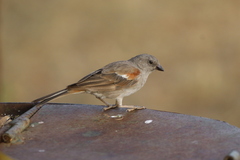
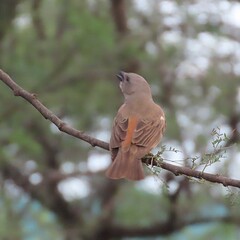
Swahili Sparrow

Swahili Sparrow

Passer suahelicus

Silhouette: Andrew Butko (modified) · PhyloPic

LCLeast ConcernNTVUENCR
Daily sighting probability ~10% · With luck
at Lake Manyara National Park

In 3 days ~30% in a week ~60%

46 Verified sightings at Lake Manyara National Park From 2019 to 2026
2,244 In all 7 parks
May Best month
☀️🌙 Day & Night When it's spotted

About the Swahili Sparrow

The Swahili sparrow (Passer suahelicus) is a passerine bird of the sparrow family Passeridae. It lives in the savanna of southern Kenya and Tanzania. Until recently, it was usually treated as a subspecies of the northern grey-headed sparrow (Passer griseus), with which it hybridizes in southern Tanzania and possibly elsewhere. It has a more rounded head profile however, a smaller eye and the grey head plumage extends unto the mantle.

In addition to the subtle physical characteristics, the Swahili sparrow also differs from the northern grey-headed sparrow in terms of habitat preference, nest construction and post-breeding behaviour. They build grass nests in Acacia trees in dry regions, and generally avoid moister coastal lowlands or uplands. Following the breeding season they form nomadic flocks, and the bill colour will change from black to horn-coloured. They may nest in the proximity of northern grey-headed sparrow, but not on buildings, and may be found beside individuals of the latter species as they disperse onto farmland.

Media related to Passer suahelicus at Wikimedia Commons Wikipedia →

Sounds

Call1:01

Tanzania · 2017

© Frank Lambert · XC450572 · CC BY-NC-ND 4.0

Call0:44

Tanzania · 2018

© Bernard BOUSQUET · XC426338 · CC BY-NC-SA 4.0

Global Distribution

Parks Where Found

# Park Country Daily sighting probability
1 Ruaha National Park 🇹🇿 Tanzania
~40%
2 Tarangire National Park 🇹🇿 Tanzania
~30%
3 Serengeti National Park 🇹🇿 Tanzania
~30%
4 Ngorongoro Conservation Area 🇹🇿 Tanzania
~20%
5 Lake Manyara National Park 🇹🇿 Tanzania
~10%
6 Masai Mara National Reserve 🇰🇪 Kenya
~10%
7 Lake Nakuru National Park 🇰🇪 Kenya
<5%

Before you go

What are the chances of seeing a Swahili Sparrow in Lake Manyara National Park?

With luck

About 10% of wildlife watchers report a Swahili Sparrow sighting in Lake Manyara National Park on a given day, based on 46 verified sightings from GBIF citizen-science data from 2019 to 2026. It is the 103rd most-seen of the 307 birds we can rate there. Over three days the chance rises to about 30%, and over a week to about 60%, if each day is a fresh chance.

When is the best time to see a Swahili Sparrow in Lake Manyara National Park?

May

In that month about 30% of wildlife watchers report a Swahili Sparrow in Lake Manyara National Park on a given day, against under 5% in January–February and August, the lowest months. That is one of Lake Manyara National Park's wettest months, with about 120 mm of rain against 15 mm in September.

What time of day is best to see a Swahili Sparrow?

Between 8 and 11 am

Across all the parks we cover, that three-hour window holds the most Swahili Sparrow sightings with a recorded time, and about 7 in 10 of them come between 6 am and 6 pm: it is seen both by day and at night.

Is Lake Manyara National Park the best place to see a Swahili Sparrow?

5th of 7

Of the 7 parks where we can rate Swahili Sparrow sightings, Lake Manyara National Park ranks 5th at about 10%. The best odds are in Ruaha National Park (Tanzania, about 40%), Tarangire National Park (Tanzania, about 30%) and Serengeti National Park (Tanzania, about 30%).

Where does the Swahili Sparrow sighting chance come from?

GBIF citizen-science records

It is estimated from how often the Swahili Sparrow is recorded against all the birds logged in Lake Manyara National Park (46 verified sightings from 2019 to 2026), calibrated against known sighting rates. Figures are rounded to the nearest 10% because citizen-science data supports honest approximations, not decimals, and months with records from fewer than five people show "—". How it works.

← Back to Lake Manyara National Park