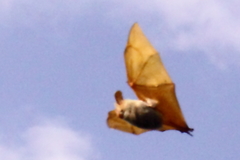
Yellow-winged Bat

Yellow-winged Bat

Lavia frons

Silhouette: T. Michael Keesey · PhyloPic

LCLeast ConcernNTVUENCR
Daily sighting probability ~20% · Possible
at Lake Mburo National Park

In 3 days ~60% in a week ~80%

6 Verified sightings at Lake Mburo National Park From 2019 to 2026
91 In all 6 parks
February Best month
🌅 Crepuscular When it's spotted

About the Yellow-winged Bat

The yellow-winged bat (Lavia frons) is one of five species of false vampire bat (family Megadermatidae) from Africa and is the only known species of its genus, Lavia. The yellow-winged bat has a total length of 58–80 mm (2.3–3.1 in) and a body weight of 28–36 g (0.99–1.27 oz). Females tend to be slightly larger than males. The wingspan averages 36 cm. This specie's pelage is made of long hairs that are typically pearl grey or slaty gray. Males may have greenish-yellow fur on the hindparts and on the ventral surfaces. As their name suggests, the bat has wings that are reddish-yellow which is also the color of their other membranes as well as their noseleaf and ears. The membranes are largely hairless although there is some fur on the upper arms. The ears are fairly long and have a spiky tragus. They have an elongated noseleaf with a blunt but pointed tip. Although the yellow-winged bat has an advanced interfemoral membrane, it lacks an external tail. The dental formula is 0.2.1.11.2.3.3. Glands exist on the lower back of males and discharge a yellow substance. Females have false nipples near the anus and are used by the young to hold on to.

The yellow... Wikipedia →

Global Distribution

Parks Where Found

# Park Country Daily sighting probability
1 Murchison Falls National Park 🇺🇬 Uganda
~30%
2 Queen Elizabeth National Park 🇺🇬 Uganda
~20%
3 Lake Mburo National Park 🇺🇬 Uganda
~20%
4 Serengeti National Park 🇹🇿 Tanzania
~20%
5 Ngorongoro Conservation Area 🇹🇿 Tanzania
~10%
6 Masai Mara National Reserve 🇰🇪 Kenya
~10%

Before you go

What are the chances of seeing a Yellow-winged Bat in Lake Mburo National Park?

Possible

About 20% of wildlife watchers report a Yellow-winged Bat sighting in Lake Mburo National Park on a given day, based on 6 verified sightings from GBIF citizen-science data from 2019 to 2026. It is the 14th most-seen of the 17 mammals we can rate there. Over three days the chance rises to about 60%, and over a week to about 80%, if each day is a fresh chance.

When is the best time to see a Yellow-winged Bat in Lake Mburo National Park?

February and December

In those months about 40% of wildlife watchers report a Yellow-winged Bat in Lake Mburo National Park on a given day, against under 5% in March and July–August, the lowest months.

What time of day is best to see a Yellow-winged Bat?

Between 5 and 8 pm

Across all the parks we cover, that three-hour window holds the most Yellow-winged Bat sightings with a recorded time, and about 6 in 10 of them come between 6 am and 6 pm: it is most active around dawn and dusk.

Is Lake Mburo National Park the best place to see a Yellow-winged Bat?

3rd of 6

Of the 6 parks where we can rate Yellow-winged Bat sightings, Lake Mburo National Park ranks 3rd at about 20%. The best odds are in Murchison Falls National Park (Uganda, about 30%) and Queen Elizabeth National Park (Uganda, about 20%).

Where does the Yellow-winged Bat sighting chance come from?

GBIF citizen-science records

It is estimated from how often the Yellow-winged Bat is recorded against all the mammals logged in Lake Mburo National Park (6 verified sightings from 2019 to 2026), calibrated against known sighting rates. Figures are rounded to the nearest 10% because citizen-science data supports honest approximations, not decimals, and months with records from fewer than five people show "—". How it works.

← Back to Lake Mburo National Park