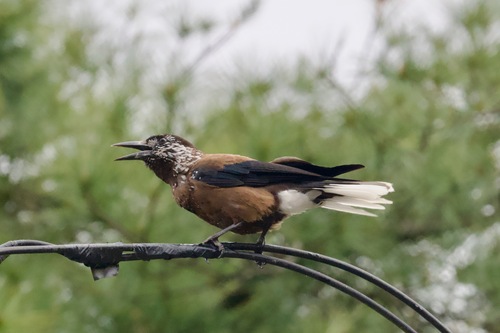
Gold-billed Magpie

Gold-billed Magpie

Urocissa flavirostris

Silhouette: Lip Kee Yap (vectorized by T. Michael Keesey) · PhyloPic

LCLeast ConcernNTVUENCR
Daily sighting probability ~40% · Likely
at Langtang National Park

In 3 days ~80% in a week >90%

188 Verified sightings at Langtang National Park From 2019 to 2026
188 In 1 park
November Best month
☀️ Diurnal When it's spotted

About the Gold-billed Magpie

The yellow-billed blue-magpie, or gold-billed magpie (Urocissa flavirostris), is a passerine bird in the family Corvidae, along with crows and jays. It forms a superspecies with the Taiwan blue magpie and the red-billed blue magpie. The species' range covers the northern parts of the Indian subcontinent, including the lower Himalayan foothills, with a disjunct population in Vietnam.

Length 66 cm (26 in), including tail of about 46 cm (18 in). Sexes alike. Head, neck, and breast black, with a white patch on the nape; remainder of lower plumage white, faintly tinged with lilac; whole upper plumage purplish-blue, brighter on the wings and tail; flight feathers tipped with white, along with white outermost wing feathers; tail long and graduated, with blue feathers tipped with white, except for the very long central pair which have a band of black in front of the white

The yellow-billed blue magpie is found throughout the Himalayas from Hazara to the Brahmaputra. It is divided into two sub-species. Of these, U. f. cucullata is the more common and is found from the Western boundary of the range to Western Nepal, being common through most of the hill stations... Wikipedia →

Sounds

Song0:27

China · 2024

© Dave GUO · XC971208 · CC BY-NC-SA 4.0

Alarm call0:46

India · 2024

© Lars Lachmann · XC891059 · CC BY-NC-SA 4.0

Call0:54

Nepal · 2023

© Greg Irving · XC841505 · CC BY-NC-SA 4.0

Global Distribution

Parks Where Found

# Park Country Daily sighting probability
1 Langtang National Park 🇳🇵 Nepal
~40%

More parks will be added in future updates.

Cities Where Found

# City Country Daily sighting probability
1 Srinagar 🇮🇳 India
~30%
2 Kathmandu 🇳🇵 Nepal
<5%

Before you go

What are the chances of seeing a Gold-billed Magpie in Langtang National Park?

Likely

About 40% of wildlife watchers report a Gold-billed Magpie sighting in Langtang National Park on a given day, based on 188 verified sightings from GBIF citizen-science data from 2019 to 2026. It is the 12th most-seen of the 225 birds we can rate there. Over three days the chance rises to about 80%, and over a week to over 90%, if each day is a fresh chance.

When is the best time to see a Gold-billed Magpie in Langtang National Park?

November

In that month about 60% of wildlife watchers report a Gold-billed Magpie in Langtang National Park on a given day, against about 30% in March, May and August, the lowest months. That is one of Langtang National Park's driest months, with about 10 mm of rain against 390 mm in July.

What time of day is best to see a Gold-billed Magpie?

Between 3 and 6 pm

Across all the parks we cover, that three-hour window holds the most Gold-billed Magpie sightings with a recorded time, and about 9 in 10 of them come between 6 am and 6 pm: it is a daytime animal.

Where else can you see a Gold-billed Magpie?

Only Langtang National Park, in our data

Langtang National Park is the only park on Wallace's Line with enough records to rate Gold-billed Magpie sightings: about 40% of wildlife watchers there report one on a given day.

Which relatives of the Gold-billed Magpie live in Langtang National Park?

Same family: Corvidae

The closest relatives of the Gold-billed Magpie that you can see in Langtang National Park (family Corvidae, Crows, Jays, and Magpies) are Large-billed Crow (about 70%), Southern Nutcracker (about 30%) and Red-billed Chough (about 20%), with each one's daily chance of a sighting.

Where does the Gold-billed Magpie sighting chance come from?

GBIF citizen-science records

It is estimated from how often the Gold-billed Magpie is recorded against all the birds logged in Langtang National Park (188 verified sightings from 2019 to 2026), calibrated against known sighting rates. Figures are rounded to the nearest 10% because citizen-science data supports honest approximations, not decimals, and months with records from fewer than five people show "—". How it works.

← Back to Langtang National Park