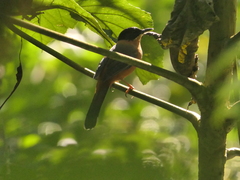
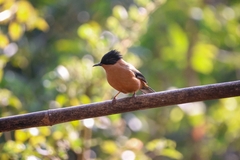

Rufous Sibia

Rufous Sibia

Heterophasia capistrata

Silhouette: Sheatherius · PhyloPic

LCLeast ConcernNTVUENCR
Daily sighting probability ~50% · Likely
at Langtang National Park

In 3 days ~90% in a week >90%

314 Verified sightings at Langtang National Park From 2019 to 2026
690 In all 4 parks
July Best month
🌅 Crepuscular When it's spotted

About the Rufous Sibia

The rufous sibia (Heterophasia capistrata) is a species of bird in the family Leiothrichidae. It feeds on berries and insects. It is found in the northern parts of the Indian subcontinent, ranging across India, Nepal and Bhutan. Its natural habitat is the temperate forests of the Lower to Middle Himalayas. The species has an unmistakable appearance with its rufous-dominated colouration and black head, and is often seen with its crest raised. It is a vigorous, melodious singer.

Media related to Category:Heterophasia capistrata at Wikimedia Commons Collar, N. J. & Robson C. 2007. Family Timaliidae (Babblers) pp. 70 – 291 in; del Hoyo, J., Elliott, A. & Christie, D.A. eds. Handbook of the Birds of the World, Vol. 12. Picathartes to Tits and Chickadees. Lynx Edicions, Barcelona. Wikipedia →

Sounds

Call0:39

Nepal · 2023

© Marc Anderson · XC815785 · CC BY-NC-ND 4.0

Song1:07

India · 2019

© Andrew Spencer · XC547735 · CC BY-NC-ND 4.0

Alarm call0:33

Bhutan · 2019

© Rolf A. de By · XC516302 · CC BY-NC-SA 4.0

Global Distribution

Parks Where Found

# Park Country Daily sighting probability
1 Langtang National Park 🇳🇵 Nepal
~50%
2 Royal Manas National Park 🇧🇹 Bhutan
~30%
3 Manas National Park 🇮🇳 India
<5%
4 Jim Corbett National Park 🇮🇳 India
<5%

Cities Where Found

# City Country Daily sighting probability
1 Kathmandu 🇳🇵 Nepal
<5%
2 Dehradun 🇮🇳 India
<5%

Before you go

What are the chances of seeing a Rufous Sibia in Langtang National Park?

Likely

About 50% of wildlife watchers report a Rufous Sibia sighting in Langtang National Park on a given day, based on 314 verified sightings from GBIF citizen-science data from 2019 to 2026. It is the 4th most-seen of the 225 birds we can rate there. Over three days the chance rises to about 90%, and over a week to over 90%, if each day is a fresh chance.

When is the best time to see a Rufous Sibia in Langtang National Park?

July

In that month about 80% of wildlife watchers report a Rufous Sibia in Langtang National Park on a given day, against about 30% in February, the lowest month. That is one of Langtang National Park's wettest months, with about 390 mm of rain against 10 mm in November.

What time of day is best to see a Rufous Sibia?

Between 4 and 7 am

Across all the parks we cover, that three-hour window holds the most Rufous Sibia sightings with a recorded time, and about 6 in 10 of them come between 6 am and 6 pm: it is most active around dawn and dusk.

Is Langtang National Park the best place to see a Rufous Sibia?

Yes

Of the 4 parks where we can rate Rufous Sibia sightings, Langtang National Park has the highest daily chance: about 50%. Next come Royal Manas National Park (Bhutan, about 30%) and Manas National Park (India, under 5%).

Where does the Rufous Sibia sighting chance come from?

GBIF citizen-science records

It is estimated from how often the Rufous Sibia is recorded against all the birds logged in Langtang National Park (314 verified sightings from 2019 to 2026), calibrated against known sighting rates. Figures are rounded to the nearest 10% because citizen-science data supports honest approximations, not decimals, and months with records from fewer than five people show "—". How it works.

← Back to Langtang National Park