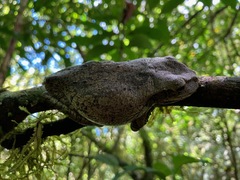
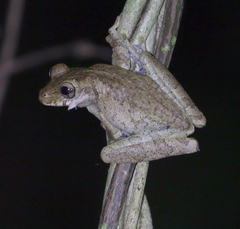

Hispaniolan Common Treefrog

Hispaniolan Common Treefrog

Osteopilus dominicensis

Silhouette: Dmitry Bogdanov (vectorized by T. Michael Keesey) · PhyloPic

LCLeast ConcernNTVUENCR
Daily sighting probability ~50% · Likely
at Los Haitises National Park

In 3 days ~90% in a week >90%

15 Verified sightings at Los Haitises National Park From 2019 to 2026
15 In 1 park
December Best month
☀️🌙 Day & Night When it's spotted

About the Hispaniolan Common Treefrog

The Hispaniolan common tree frog, Hispaniolan laughing tree frog (Osteopilus dominicensis), or Dominican tree frog, is a species of frog in the family Hylidae endemic to the island of Hispaniola (both the Dominican Republic and Haiti).

It is an abundant, ubiquitous species on Hispaniola, found from sea level up to 2,000 m (6,600 ft) asl. It occurs anywhere near water in forests and anthropogenic open areas. It breeds in standing bodies water, both temporary and permanent. Wikipedia →

Sounds

Recording0:10

Dominican Republic · 2026

© Ashton · iNaturalist · CC BY-NC 4.0

Recording0:26

Dominican Republic · 2024

© Heather Pickard · iNaturalist · CC BY-NC 4.0

Recording0:34

Dominican Republic · 2026

© JakeCM · iNaturalist · CC BY-NC 4.0

Global Distribution

Parks Where Found

# Park Country Daily sighting probability
1 Los Haitises National Park 🇩🇴 Dominican Republic
~50%

More parks will be added in future updates.

Cities Where Found

# City Country Daily sighting probability
1 Santo Domingo 🇩🇴 Dominican Republic
~30%

Zoos & Centres Where Found

# Zoo / Centre Country
1 Parque Municipal Summit 🇵🇦 Panama In captivity
2 Kyiv Zoo 🇺🇦 Ukraine In captivity

Before you go

What are the chances of seeing a Hispaniolan Common Treefrog in Los Haitises National Park?

Likely

About 50% of wildlife watchers report a Hispaniolan Common Treefrog sighting in Los Haitises National Park on a given day, based on 15 verified sightings from GBIF citizen-science data from 2019 to 2026. Over three days the chance rises to about 90%, and over a week to over 90%, if each day is a fresh chance.

When is the best time to see a Hispaniolan Common Treefrog in Los Haitises National Park?

March and December–January

In those months about 70% of wildlife watchers report a Hispaniolan Common Treefrog in Los Haitises National Park on a given day, against about 10% in February, May, July and November, the lowest months. Those are among Los Haitises National Park's driest months, with about 65 mm of rain a month against 170 mm in May. September has too few records to rate.

What time of day is best to see a Hispaniolan Common Treefrog?

Between 7 and 10 pm

Across all the parks we cover, that three-hour window holds the most Hispaniolan Common Treefrog sightings with a recorded time, and about 6 in 10 of them come between 6 pm and 6 am: it is seen both by day and at night.

Where else can you see a Hispaniolan Common Treefrog?

Only Los Haitises National Park, in our data

Los Haitises National Park is the only park on Wallace's Line with enough records to rate Hispaniolan Common Treefrog sightings: about 50% of wildlife watchers there report one on a given day.

Which relatives of the Hispaniolan Common Treefrog live in Los Haitises National Park?

Same order: Anura

The closest relatives of the Hispaniolan Common Treefrog that you can see in Los Haitises National Park (order Anura, Frogs and Toads) are Eastern Cane Toad (about 50%), Abbott's Robber Frog (about 40%) and Yellow Split-Toed Frog (about 30%), with each one's daily chance of a sighting.

Where does the Hispaniolan Common Treefrog sighting chance come from?

GBIF citizen-science records

It is estimated from how often the Hispaniolan Common Treefrog is recorded against all the amphibians logged in Los Haitises National Park (15 verified sightings from 2019 to 2026), calibrated against known sighting rates. Figures are rounded to the nearest 10% because citizen-science data supports honest approximations, not decimals, and months with records from fewer than five people show "—". How it works.

← Back to Los Haitises National Park