White-necked Crow

White-necked Crow

Corvus leucognaphalus

Silhouette: Peileppe · PhyloPic

LCNTVUVulnerableENCR
Daily sighting probability ~90% · Very likely
at Los Haitises National Park

In 3 days >90%

581 Verified sightings at Los Haitises National Park From 2019 to 2026
620 In all 2 parks
March Best month
☀️ Diurnal When it's spotted

About the White-necked Crow

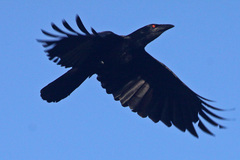
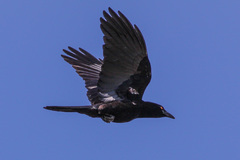
The white-necked crow (Corvus leucognaphalus) is the largest of the four Caribbean corvids. It is endemic to the island of Hispaniola (split between Haiti and the Dominican Republic); it was formerly also extant on Puerto Rico and Saint Croix in the United States Virgin Islands, but has been extirpated from both islands due to considerable forest clearance and hunting for meat.

Two other species, the Cuban crow (C. nasicus) and the Jamaican crow (C. jamaicensis), appear to be very closely related to it, sharing several key morphological features. The ancestor of the fourth and fifth species from this region, the Hispaniolan (C. palmarum) and Cuban palm crows (C. minutus), would appear to be a later arrival (at least in evolutionary terms); both species show more similarities to the fish crow (C. ossifragus) of mainland North America and two Mexican species. This is despite C. palmarum being sympatric with the white-necked crow on Hispaniola, indicating two distinct arrivals of crows onto the island, and a resulting niche differentiation, similar to C. nasicus and the Cuban palm crow (Corvus minutus) on Cuba.

A stocky bird, it is the largest Caribbean... Wikipedia →

Sounds

Flight call0:21

Dominican Republic · 2023

© Barry Edmonston · XC794220 · CC BY-NC-SA 4.0

Call0:45

Dominican Republic · 2016

© Andrew Spencer · XC362229 · CC BY-NC-ND 4.0

Song1:03

Dominican Republic · 2022

© Bobby Wilcox · XC713837 · CC BY-NC-SA 4.0

Global Distribution

Parks Where Found

# Park Country Daily sighting probability
1 Los Haitises National Park 🇩🇴 Dominican Republic
~90%
2 Jaragua National Park 🇩🇴 Dominican Republic
~20%

Before you go

What are the chances of seeing a White-necked Crow in Los Haitises National Park?

Very likely

About 90% of wildlife watchers report a White-necked Crow sighting in Los Haitises National Park on a given day, based on 581 verified sightings from GBIF citizen-science data from 2019 to 2026. It is the 2nd most-seen of the 106 birds we can rate there. Over three days the chance rises to over 90%, if each day is a fresh chance.

When is the best time to see a White-necked Crow in Los Haitises National Park?

March

In that month over 90% of wildlife watchers report a White-necked Crow in Los Haitises National Park on a given day, against about 60% in August, the lowest month.

What time of day is best to see a White-necked Crow?

Between 2 and 5 pm

Across all the parks we cover, that three-hour window holds the most White-necked Crow sightings with a recorded time, and about 8 in 10 of them come between 6 am and 6 pm: it is a daytime animal.

Is Los Haitises National Park the best place to see a White-necked Crow?

Yes

Of the 2 parks where we can rate White-necked Crow sightings, Los Haitises National Park has the highest daily chance: about 90%. Next come Jaragua National Park (Dominican Republic, about 20%).

Which relatives of the White-necked Crow live in Los Haitises National Park?

Same order: Passeriformes

The closest relatives of the White-necked Crow that you can see in Los Haitises National Park (order Passeriformes, Perching Birds) are Palmchat (about 80%), Gray Kingbird (about 80%) and Northern Mockingbird (about 70%), with each one's daily chance of a sighting.

Where does the White-necked Crow sighting chance come from?

GBIF citizen-science records

It is estimated from how often the White-necked Crow is recorded against all the birds logged in Los Haitises National Park (581 verified sightings from 2019 to 2026), calibrated against known sighting rates. Figures are rounded to the nearest 10% because citizen-science data supports honest approximations, not decimals, and months with records from fewer than five people show "—". How it works.

← Back to Los Haitises National Park