
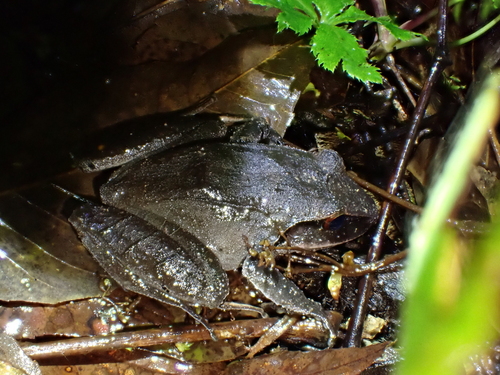
Stripe-throated Rocket Frog

Stripe-throated Rocket Frog

Leucostethus brachistriatus

Silhouette: Steven Traver · PhyloPic

LCLeast ConcernNTVUENCR
Daily sighting probability ~10% · With luck
at Los Nevados National Natural Park

In 3 days ~30% in a week ~60%

9 Verified sightings at Los Nevados National Natural Park From 2019 to 2026
9 In 1 park
January Best month
☀️ Diurnal When it's spotted

About the Stripe-throated Rocket Frog

Leucostethus brachistriatus is a species of frog in the family Dendrobatidae. It is endemic to Colombia and occurs on the western slopes of Cordillera Central and on Cordillera Occidental. Common name stripe-throated rocket frog has been proposed for it.

The holotype is a female measuring 22 mm (0.9 in) in snout–vent length. The tympanum is relatively large but partly concealed and not very conspicuous. The fingers have neither webbing nor lateral fringes. Basal webbing is present between the toes II–V. The dorsum is cream-colored. An oblique lateral band runs from the eye to the groin.

Leucostethus brachistriatus is a terrestrial frog found near streams in sub-Andean forests, where it has been observed about 1500 meters above sea level. It is common where forested habitat remains, but it is a very adaptable species that is also found in cropland and cow pastures. The eggs are deposited in leaf litter. The tadpoles are then carried to streams where they continue their development.

This species is not substantially threatened, although it can suffer from the forest loss that is occurring throughout its range. It is present in the Ucumari... Wikipedia →

Sounds

Advertisement call0:16

Colombia · 2024

© Sofía Vargas Gómez · XC1174543 · CC BY-NC-SA 4.0

Global Distribution

Parks Where Found

# Park Country Daily sighting probability
1 Los Nevados National Natural Park 🇨🇴 Colombia
~10%

More parks will be added in future updates.

Before you go

What are the chances of seeing a Stripe-throated Rocket Frog in Los Nevados National Natural Park?

With luck

About 10% of wildlife watchers report a Stripe-throated Rocket Frog sighting in Los Nevados National Natural Park on a given day, based on 9 verified sightings from GBIF citizen-science data from 2019 to 2026. It is the 5th most-seen of the 6 amphibians we can rate there. Over three days the chance rises to about 30%, and over a week to about 60%, if each day is a fresh chance.

When is the best time to see a Stripe-throated Rocket Frog in Los Nevados National Natural Park?

January

In that month about 30% of wildlife watchers report a Stripe-throated Rocket Frog in Los Nevados National Natural Park on a given day, against under 5% in March–April and June–November, the lowest months. That is one of Los Nevados National Natural Park's driest months, with about 100 mm of rain against 300 mm in April.

What time of day is best to see a Stripe-throated Rocket Frog?

Between 11 am and 2 pm

Across all the parks we cover, that three-hour window holds the most Stripe-throated Rocket Frog sightings with a recorded time, and about 7 in 10 of them come between 6 am and 6 pm: it is a daytime animal.

Where else can you see a Stripe-throated Rocket Frog?

Only Los Nevados National Natural Park, in our data

Los Nevados National Natural Park is the only park on Wallace's Line with enough records to rate Stripe-throated Rocket Frog sightings: about 10% of wildlife watchers there report one on a given day.

Which relatives of the Stripe-throated Rocket Frog live in Los Nevados National Natural Park?

Same order: Anura

The closest relatives of the Stripe-throated Rocket Frog that you can see in Los Nevados National Natural Park (order Anura, Frogs and Toads) are Cordillera central tree frog (about 20%), Northern Cordilleras Robber Frog (about 20%) and Cachabi Robber Frog (about 10%), with each one's daily chance of a sighting.

Where does the Stripe-throated Rocket Frog sighting chance come from?

GBIF citizen-science records

It is estimated from how often the Stripe-throated Rocket Frog is recorded against all the amphibians logged in Los Nevados National Natural Park (9 verified sightings from 2019 to 2026), calibrated against known sighting rates. Figures are rounded to the nearest 10% because citizen-science data supports honest approximations, not decimals, and months with records from fewer than five people show "—". How it works.

← Back to Los Nevados National Natural Park