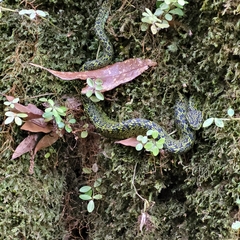
Talamancan Palm Pit Viper

Talamancan Palm Pit Viper

Bothriechis nubestris

Silhouette: Steven Traver · PhyloPic

Endemic
Daily sighting probability ~10% · With luck
at Los Quetzales National Park

In 3 days ~40% in a week ~60%

14 Verified sightings at Los Quetzales National Park From 2019 to 2026
14 In 1 park
July Best month
☀️ Diurnal When it's spotted

About the Talamancan Palm Pit Viper

Bothriechis nubestris, the Talamancan palm-pitviper, is a species of pit viper native to cloud forests and montane rainforests in Costa Rica, specifically San José, Cartago and Limón. The snake was mistaken for Bothriechis nigroviridis.

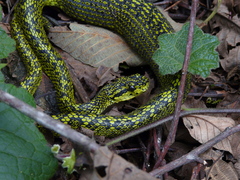
The snake is a small-medium size, slender snake. It lives in trees and has a green-black coloration. The snake grows up to 30 inches, but many grow less than 24 inches. It is only discovered in Costa Rica. The snake kills with a toxin which is likely to be nigroviriditoxin. The toxin itself was discovered in 2015, and B. nubestris would be the first new-world viperid outside of rattle snakes to produce it.

The snake lacks supercillary scales, differing the species from both B. schlegelii and B. supraciliaris. B. nubestris also differs from most other Bothriechis species with its colouring - only similar in that respect to B. nigroviridis, which it differs to in its scale numbers and shapes (specifically, B. nubestris has thin 'kidney-shaped' supraoculars.)

The snake was first spotted by the University of Central Florida in 2001, but was mistaken for another species. It was discovered by DNA tests and named recently.... Wikipedia →

Global Distribution

Parks Where Found

# Park Country Daily sighting probability
1 Los Quetzales National Park 🇨🇷 Costa Rica
~10%

More parks will be added in future updates.

Before you go

What are the chances of seeing a Talamancan Palm Pit Viper in Los Quetzales National Park?

With luck

About 10% of wildlife watchers report a Talamancan Palm Pit Viper sighting in Los Quetzales National Park on a given day, based on 14 verified sightings from GBIF citizen-science data from 2019 to 2026. It is the 3rd most-seen of the 6 reptiles we can rate there. Over three days the chance rises to about 40%, and over a week to about 60%, if each day is a fresh chance.

When is the best time to see a Talamancan Palm Pit Viper in Los Quetzales National Park?

July

In that month about 40% of wildlife watchers report a Talamancan Palm Pit Viper in Los Quetzales National Park on a given day, against under 5% in February, April–June, August and October, the lowest months.

What time of day is best to see a Talamancan Palm Pit Viper?

Between 9 am and noon

Across all the parks we cover, that three-hour window holds the most Talamancan Palm Pit Viper sightings with a recorded time, and about 8 in 10 of them come between 6 am and 6 pm: it is a daytime animal.

Where else can you see a Talamancan Palm Pit Viper?

Only Los Quetzales National Park, in our data

Los Quetzales National Park is the only park on Wallace's Line with enough records to rate Talamancan Palm Pit Viper sightings: about 10% of wildlife watchers there report one on a given day.

Where does the Talamancan Palm Pit Viper sighting chance come from?

GBIF citizen-science records

It is estimated from how often the Talamancan Palm Pit Viper is recorded against all the reptiles logged in Los Quetzales National Park (14 verified sightings from 2019 to 2026), calibrated against known sighting rates. Figures are rounded to the nearest 10% because citizen-science data supports honest approximations, not decimals, and months with records from fewer than five people show "—". How it works.

← Back to Los Quetzales National Park