Ecuadorian Piculet

Ecuadorian Piculet

Picumnus sclateri

Silhouette: Pepe Reigada · PhyloPic

LCLeast ConcernNTVUENCR
Daily sighting probability ~10% · With luck
at Machalilla National Park

In 3 days ~20% in a week ~40%

54 Verified sightings at Machalilla National Park From 2019 to 2026
54 In 1 park
May Best month
☀️ Diurnal When it's spotted

About the Ecuadorian Piculet

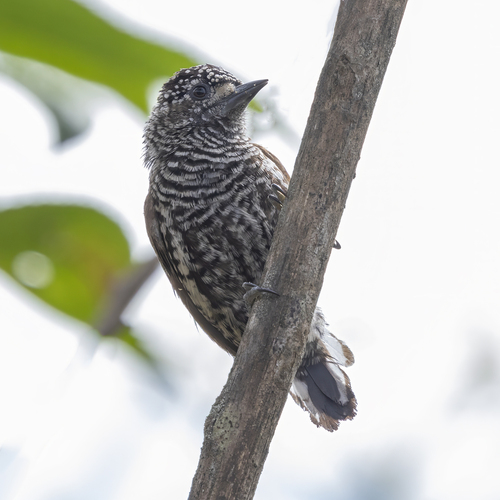
The Ecuadorian piculet (Picumnus sclateri) is a species of bird in subfamily Picumninae of the woodpecker family Picidae. It is found in Ecuador and Peru. The Ecuadorian piculet is 9 to 10 cm (3.5 to 3.9 in) long and weighs about 10 to 12 g (0.35 to 0.42 oz). Adult males of the nominate subspecies have a black cap with tiny yellow spots on the forehead and tiny white ones on the rest of it. Their upperparts are gray-brown with obscure darker bars. The upper side of their tail is blackish; the innermost pair of feathers have mostly white inner webs and the outer three pairs have a white area near the tip. Their underparts are whitish with black or dusky barring on the breast and flanks and black streaks on the belly. Adult females are identical but for whitish spots on their entire crown.

Subspecies P. s. parvistriatus has larger white spots on the crown than the nominate, and the bars and streaks on the... Wikipedia →

Sounds

Call0:26

Ecuador · 2023

© Manuel Sánchez-Nivicela · XC1142967 · CC BY-NC-ND 4.0

Song0:27

Ecuador · 2000

© Karl S. Berg · XC282537 · CC BY-NC-SA 4.0

Drum1:09

Ecuador · 2014

© Leonardo Ordóñez-Delgado · XC199212 · CC BY-NC-SA 4.0

Global Distribution

Parks Where Found

# Park Country Daily sighting probability
1 Machalilla National Park 🇪🇨 Ecuador
~10%

More parks will be added in future updates.

Cities Where Found

# City Country Daily sighting probability
1 Guayaquil 🇪🇨 Ecuador
<5%

Before you go

What are the chances of seeing an Ecuadorian Piculet in Machalilla National Park?

With luck

About 10% of wildlife watchers report an Ecuadorian Piculet sighting in Machalilla National Park on a given day, based on 54 verified sightings from GBIF citizen-science data from 2019 to 2026. It is the 112th most-seen of the 248 birds we can rate there. Over three days the chance rises to about 20%, and over a week to about 40%, if each day is a fresh chance.

When is the best time to see an Ecuadorian Piculet in Machalilla National Park?

May and December

In those months about 20% of wildlife watchers report an Ecuadorian Piculet in Machalilla National Park on a given day, against under 5% in January, March–April and June–August, the lowest months.

What time of day is best to see an Ecuadorian Piculet?

Between 10 am and 1 pm

Across all the parks we cover, that three-hour window holds the most Ecuadorian Piculet sightings with a recorded time, and about 9 in 10 of them come between 6 am and 6 pm: it is a daytime animal.

Where else can you see an Ecuadorian Piculet?

Only Machalilla National Park, in our data

Machalilla National Park is the only park on Wallace's Line with enough records to rate Ecuadorian Piculet sightings: about 10% of wildlife watchers there report one on a given day.

Which relatives of the Ecuadorian Piculet live in Machalilla National Park?

Same family: Picidae

The closest relatives of the Ecuadorian Piculet that you can see in Machalilla National Park (family Picidae, Woodpeckers) are Golden-olive Woodpecker (about 10%), Scarlet-backed Woodpecker (about 10%) and Guayaquil Woodpecker (about 10%), with each one's daily chance of a sighting.

Where does the Ecuadorian Piculet sighting chance come from?

GBIF citizen-science records

It is estimated from how often the Ecuadorian Piculet is recorded against all the birds logged in Machalilla National Park (54 verified sightings from 2019 to 2026), calibrated against known sighting rates. Figures are rounded to the nearest 10% because citizen-science data supports honest approximations, not decimals, and months with records from fewer than five people show "—". How it works.

← Back to Machalilla National Park