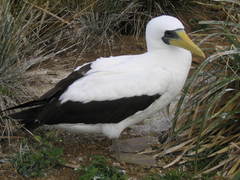
Masked Booby

Masked Booby

Sula dactylatra

Silhouette: Jon Hill (Photo by Benjamint444: http://en.wikipedia.org/wiki/File:Blue-footed-booby.jpg) · PhyloPic

LCLeast ConcernNTVUENCR
Daily sighting probability ~10% · With luck
at Machalilla National Park

In 3 days ~20% in a week ~30%

38 Verified sightings at Machalilla National Park From 2019 to 2026
199 In all 6 parks
January Best month
☀️ Diurnal When it's spotted

About the Masked Booby

The masked booby (Sula dactylatra), also called the masked gannet or the blue-faced booby, is a large seabird of the booby and gannet family, Sulidae. First described by the French naturalist René-Primevère Lesson in 1831, the masked booby is one of six species of booby in the genus Sula. It has a typical sulid body shape, with a long pointed yellowish bill, long neck, aerodynamic body, long slender wings and pointed tail. The adult is bright white with black wings, a black tail and a dark face mask; at 75–85 cm (30–33 in) long, it is the largest species of booby. The sexes have similar plumage. This species ranges across tropical oceans, except in the eastern Atlantic and eastern Pacific. In the latter, it is replaced by the Nazca booby (Sula granti), which was formerly regarded as a subspecies of masked booby.

Nesting takes place in colonies, generally on islands and atolls far from the mainland and close to deep water required for foraging. Territorial when breeding, the masked booby performs agonistic displays to defend its nest. Potential and mated pairs engage in courtship and greeting displays. The female lays two chalky white eggs in a shallow depression on flat ground away from vegetation. The chicks are born featherless, but are soon covered in white down. The second chick born generally does not survive and is killed by its elder sibling. These birds are spectacular plunge divers, plunging into the ocean at high speed in search of prey—mainly flying fish. The species faces few threats; although its population is declining, it is considered to be a least-concern species by the International Union for Conservation of Nature (IUCN). The masked booby primarily feeds on flying fish and squid, which it captures through high-speed plunge diving. Breeding Colonies are typically located on remote islands, where reduced predation allows for successful nesting. Wikipedia →

Sounds

Alarm call0:06

Mexico · 2022

© Alán Palacios · XC730160 · CC BY-NC-SA 4.0

Call0:07

Australia · 2018

© Eric S. J. Tan · XC431821 · CC BY-NC-SA 4.0

Song0:07

Brazil · 2018

© JAYRSON ARAUJO DE OLIVEIRA · XC431271 · CC BY-NC-SA 4.0

Global Distribution

Parks Where Found

# Park Country Daily sighting probability
1 Isla del Coco National Park 🇨🇷 Costa Rica
~40%
2 Channel Islands National Park 🇺🇸 United States
~10%
3 Machalilla National Park 🇪🇨 Ecuador
~10%
4 Padre Island National Seashore 🇺🇸 United States
<5%
5 Manuel Antonio National Park 🇨🇷 Costa Rica
<5%
6 Las Baulas Marine National Park 🇨🇷 Costa Rica
<5%

Cities Where Found

# City Country Daily sighting probability
1 Los Angeles 🇺🇸 United States
<5%
2 San Diego 🇺🇸 United States
<5%
3 Mumbai 🇮🇳 India
<5%

Before you go

What are the chances of seeing a Masked Booby in Machalilla National Park?

With luck

About 10% of wildlife watchers report a Masked Booby sighting in Machalilla National Park on a given day, based on 38 verified sightings from GBIF citizen-science data from 2019 to 2026. It is the 128th most-seen of the 248 birds we can rate there. Over three days the chance rises to about 20%, and over a week to about 30%, if each day is a fresh chance.

When is the best time to see a Masked Booby in Machalilla National Park?

January

In that month about 20% of wildlife watchers report a Masked Booby in Machalilla National Park on a given day, against under 5% in February–May, July–September and November–December, the lowest months.

What time of day is best to see a Masked Booby?

Between 9 am and noon

Across all the parks we cover, that three-hour window holds the most Masked Booby sightings with a recorded time, and about 8 in 10 of them come between 6 am and 6 pm: it is a daytime animal.

Is Machalilla National Park the best place to see a Masked Booby?

3rd of 6

Of the 6 parks where we can rate Masked Booby sightings, Machalilla National Park ranks 3rd at about 10%. The best odds are in Isla del Coco National Park (Costa Rica, about 40%) and Channel Islands National Park (United States, about 10%).

Which relatives of the Masked Booby live in Machalilla National Park?

Same genus: Sula

The closest relatives of the Masked Booby that you can see in Machalilla National Park (genus Sula, Typical Boobies) are Blue-footed Booby (about 40%), Nazca Booby (about 30%) and Red-footed Booby (about 20%), with each one's daily chance of a sighting.

Where does the Masked Booby sighting chance come from?

GBIF citizen-science records

It is estimated from how often the Masked Booby is recorded against all the birds logged in Machalilla National Park (38 verified sightings from 2019 to 2026), calibrated against known sighting rates. Figures are rounded to the nearest 10% because citizen-science data supports honest approximations, not decimals, and months with records from fewer than five people show "—". How it works.

← Back to Machalilla National Park