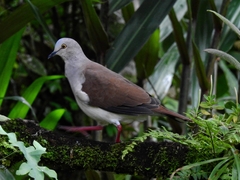
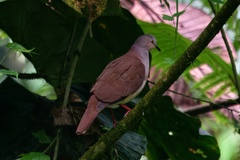

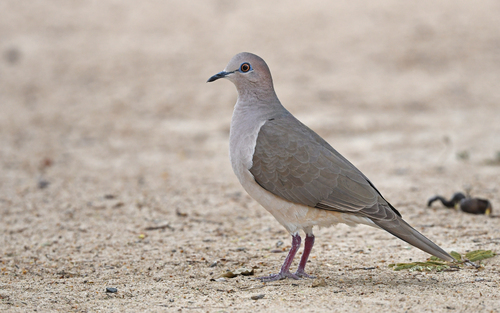
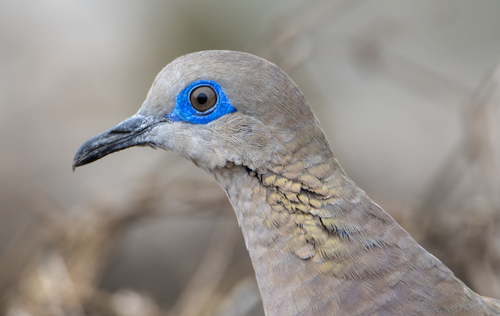
Pallid Dove

Pallid Dove

Leptotila pallida

Silhouette: Sheatherius · PhyloPic

LCLeast ConcernNTVUENCR
Daily sighting probability ~10% · With luck
at Machalilla National Park

In 3 days ~30% in a week ~50%

66 Verified sightings at Machalilla National Park From 2019 to 2026
66 In 1 park
October Best month
☀️ Diurnal When it's spotted

About the Pallid Dove

The pallid dove (Leptotila pallida) is a species of bird in the family Columbidae. It is found in Colombia, Ecuador, and Peru. The pallid dove is monotypic. It, the grey-fronted dove (Leptotila rufaxilla) of South America, the grey-headed dove (L. plumbeiceps) of South and Central America, the Azuero dove (Leptotila battyi) of Panama, and the Grenada dove (L. wellsi) of Grenada were at one time thought to be a single species. It has also been treated as a subspecies of grey-fronted dove.

The pallid dove is 23 to 26 cm (9.1 to 10.2 in) long. The male has a white forehead, face, and throat, a gray crown, and a purplish gray nape and hindneck. The sides of the neck and the breast are pale red and the belly white. Its upperparts are chestnut-brown with some chestnut-red markings. The hindneck and upper mantle have some purple iridescence. The outer tail feathers are dark chestnut with white tips. The eye is yellow and surrounded by bare red skin. The bill is black and the legs and feet pinkish red to brownish red. The female has less of a reddish tone on the upperparts and its pink and gray areas are duller. Wikipedia →

Sounds

Song0:45

Ecuador · 2022

© Paul Bourdin · XC750684 · CC BY-NC-SA 4.0

Duet0:33

Ecuador · 1996

© Olaf Jahn · XC261593 · CC BY-NC-SA 4.0

Song0:18

Ecuador · 2020

© Peter de Rouw · XC602239 · CC BY-NC-SA 4.0

Global Distribution

Parks Where Found

# Park Country Daily sighting probability
1 Machalilla National Park 🇪🇨 Ecuador
~10%

More parks will be added in future updates.

Cities Where Found

# City Country Daily sighting probability
1 Guayaquil 🇪🇨 Ecuador
<5%

Before you go

What are the chances of seeing a Pallid Dove in Machalilla National Park?

With luck

About 10% of wildlife watchers report a Pallid Dove sighting in Machalilla National Park on a given day, based on 66 verified sightings from GBIF citizen-science data from 2019 to 2026. It is the 88th most-seen of the 248 birds we can rate there. Over three days the chance rises to about 30%, and over a week to about 50%, if each day is a fresh chance.

When is the best time to see a Pallid Dove in Machalilla National Park?

October

In that month about 20% of wildlife watchers report a Pallid Dove in Machalilla National Park on a given day, against under 5% in February, the lowest month. That is one of Machalilla National Park's driest months, with about 10 mm of rain against 140 mm in February.

What time of day is best to see a Pallid Dove?

Between 1 and 4 pm

Across all the parks we cover, that three-hour window holds the most Pallid Dove sightings with a recorded time, and about 8 in 10 of them come between 6 am and 6 pm: it is a daytime animal.

Where else can you see a Pallid Dove?

Only Machalilla National Park, in our data

Machalilla National Park is the only park on Wallace's Line with enough records to rate Pallid Dove sightings: about 10% of wildlife watchers there report one on a given day.

Which relatives of the Pallid Dove live in Machalilla National Park?

Same genus: Leptotila

The closest relatives of the Pallid Dove that you can see in Machalilla National Park (genus Leptotila, Leptotila Doves) are White-tipped Dove (about 30%) and Ochre-bellied Dove (about 10%), with each one's daily chance of a sighting.

Where does the Pallid Dove sighting chance come from?

GBIF citizen-science records

It is estimated from how often the Pallid Dove is recorded against all the birds logged in Machalilla National Park (66 verified sightings from 2019 to 2026), calibrated against known sighting rates. Figures are rounded to the nearest 10% because citizen-science data supports honest approximations, not decimals, and months with records from fewer than five people show "—". How it works.

← Back to Machalilla National Park