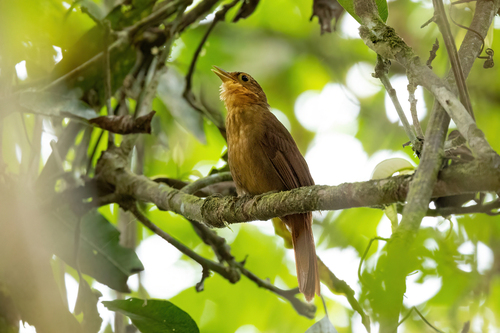
Rufous Cacholote

Rufous Cacholote

Pseudoseisura unirufa

Silhouette: Sheatherius · PhyloPic

LCLeast ConcernNTVUENCR
Daily sighting probability ~10% · With luck
at Madidi National Park

In 3 days ~40% in a week ~70%

23 Verified sightings at Madidi National Park From 2019 to 2026
513 In all 2 parks
April Best month
☀️ Diurnal When it's spotted

About the Rufous Cacholote

The grey-crested cacholote (Pseudoseisura unirufa) is a species of bird in the Furnariinae subfamily of the ovenbird family Furnariidae. It is found in Bolivia, Brazil, and Paraguay. The grey-crested cacholote is monotypic. It was previously considered a subspecies of the Caatinga cacholote (P. cristata) which was then called the rufous cacholote. The two taxa were split following the data in a paper published in 2000. Confusingly, and contrary to the suggestion of the 2000 paper's authors, the South American Classification Committee of the American Ornithological Society, the Clements taxonomy, and some field guide authors call P. unirufa the rufous cacholote.

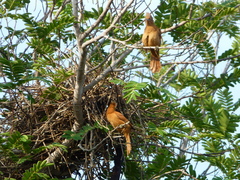
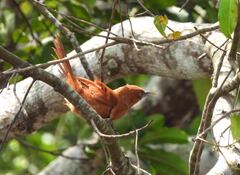
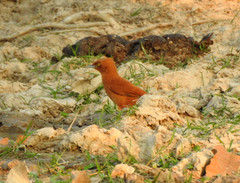
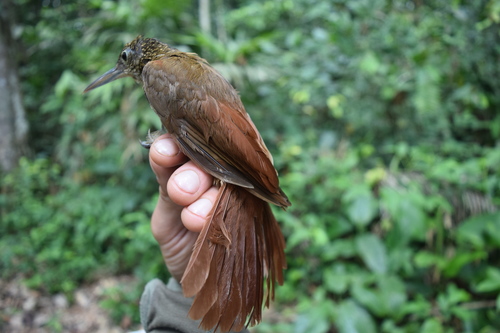
The grey-crested cacholote is 20 to 21 cm (7.9 to 8.3 in) long and weighs 42 to 57 g (1.5 to 2.0 oz). It is a large, crested, furnariid. The sexes have the same plumage. Adults are mostly bright reddish-rufous that is somewhat paler on their underparts. Their crest varies from entirely rufous to almost entirely grayish. The center of their throat has an orange tinge. Their flight feathers have fuscous tips and the ends of the tail feathers lack barbs. Their iris is yellow to buff...

Wikipedia →

Sounds

Song1:05

Brazil · 2022

© Kenny Uéslei · XC878525 · CC BY-NC-SA 4.0

Call1:10

Bolivia · 2021

© Richard E. Webster · XC702756 · CC BY-NC-SA 4.0

Duet0:14

Brazil · 2000

© Jeremy Minns · XC277445 · CC BY-NC-SA 4.0

Global Distribution

Parks Where Found

# Park Country Daily sighting probability
1 Parque Estadual Encontro das Águas 🇧🇷 Brazil
~30%
2 Madidi National Park 🇧🇴 Bolivia
~10%

Before you go

What are the chances of seeing a Rufous Cacholote in Madidi National Park?

With luck

About 10% of wildlife watchers report a Rufous Cacholote sighting in Madidi National Park on a given day, based on 23 verified sightings from GBIF citizen-science data from 2019 to 2026. It is the 76th most-seen of the 239 birds we can rate there. Over three days the chance rises to about 40%, and over a week to about 70%, if each day is a fresh chance.

When is the best time to see a Rufous Cacholote in Madidi National Park?

January, April, June and September–October

In those months about 20% of wildlife watchers report a Rufous Cacholote in Madidi National Park on a given day, against about 10% in February, May, July–August and November, the lowest months. March and December have too few records to rate.

What time of day is best to see a Rufous Cacholote?

Between 6 and 9 am

Across all the parks we cover, that three-hour window holds the most Rufous Cacholote sightings with a recorded time, and about 9 in 10 of them come between 6 am and 6 pm: it is a daytime animal.

Is Madidi National Park the best place to see a Rufous Cacholote?

2nd of 2

Of the 2 parks where we can rate Rufous Cacholote sightings, Madidi National Park ranks 2nd at about 10%. The best odds are in Parque Estadual Encontro das Águas (Brazil, about 30%).

Which relatives of the Rufous Cacholote live in Madidi National Park?

Same family: Furnariidae

The closest relatives of the Rufous Cacholote that you can see in Madidi National Park (family Furnariidae, Ovenbirds and Woodcreepers) are Buff-throated Woodcreeper (about 30%), Rufous Hornero (about 20%) and Plain-crowned Spinetail (about 20%), with each one's daily chance of a sighting.

Where does the Rufous Cacholote sighting chance come from?

GBIF citizen-science records

It is estimated from how often the Rufous Cacholote is recorded against all the birds logged in Madidi National Park (23 verified sightings from 2019 to 2026), calibrated against known sighting rates. Figures are rounded to the nearest 10% because citizen-science data supports honest approximations, not decimals, and months with records from fewer than five people show "—". How it works.

← Back to Madidi National Park