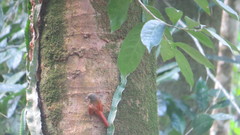
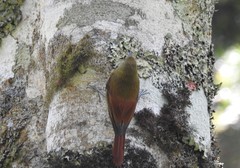

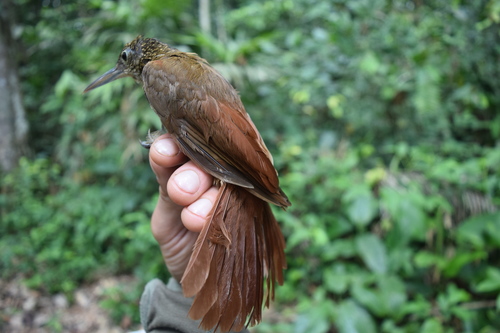
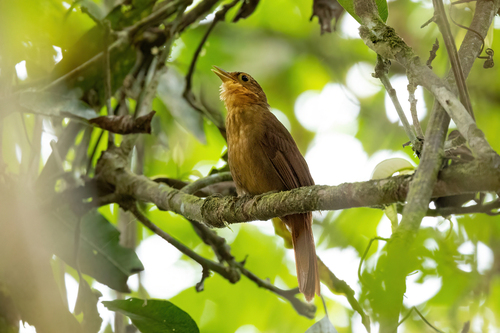
Olivaceous Woodcreeper

Olivaceous Woodcreeper

Sittasomus griseicapillus

Silhouette: Sheatherius · PhyloPic

LCLeast ConcernNTVUENCR
Daily sighting probability ~20% · Possible
at Madidi National Park

In 3 days ~40% in a week ~70%

24 Verified sightings at Madidi National Park From 2019 to 2026
15,226 In all 53 parks
January Best month
☀️ Diurnal When it's spotted

About the Olivaceous Woodcreeper

The olivaceous woodcreeper (Sittasomus griseicapillus) is a passerine bird in subfamily Dendrocolaptinae of the ovenbird family Furnariidae. It is found from central Mexico south through every Central American country, on the island of Tobago, and in every mainland South American country except Chile, French Guiana, and Suriname.

The olivaceous woodcreeper is the only member of genus Sittasomus. However, taxonomic systems vary in their treatment of the taxon, with some splitting it into two species. The International Ornithological Committee and the Clements taxonomy assign these 15 subspecies to the olivaceous woodcreeper; Clements distributes them among five groups.

"Grayish" group "Pacific"

Wikipedia →

Sounds

Song0:27

Brazil · 2026

© JAYRSON ARAUJO DE OLIVEIRA · XC1164940 · CC BY-NC-SA 4.0

Recording0:16

Brazil · 2023

© Mauro Celso Rodrigues dos Santos · XC1142146 · CC BY-NC-ND 4.0

Call0:39

Paraguay · 2024

© Guillermo Menéndez (gmmv80) · XC939085 · CC BY-NC-SA 4.0

Global Distribution

Parks Where Found

# Park Country Daily sighting probability
1 Serra dos Órgãos National Park 🇧🇷 Brazil
~60%
2 Itatiaia National Park 🇧🇷 Brazil
~50%
3 Amboró National Park 🇧🇴 Bolivia
~50%
4 Tikal National Park 🇬🇹 Guatemala
~50%
5 Main Ridge Forest Reserve 🇹🇹 Trinidad and Tobago
~30%
6 El Impenetrable National Park 🇦🇷 Argentina
~30%
7 Iguaçu National Park 🇧🇷 Brazil
~30%
8 Calakmul Biosphere Reserve 🇲🇽 Mexico
~30%
9 Santa Rosa National Park 🇨🇷 Costa Rica
~30%
10 Sian Ka'an Biosphere Reserve 🇲🇽 Mexico
~30%
11 Iguazú National Park 🇦🇷 Argentina
~30%
12 Monteverde Cloud Forest Reserve 🇨🇷 Costa Rica
~20%
13 Henri Pittier National Park 🇻🇪 Venezuela
~20%
14 El Triunfo 🇲🇽 Mexico
~20%
15 Chagres National Park 🇵🇦 Panama
~20%
16 Podocarpus National Park 🇪🇨 Ecuador
~20%
17 Biotopo Cerro Cahuí 🇬🇹 Guatemala
~20%
18 Madidi National Park 🇧🇴 Bolivia
~20%
19 Cabo Blanco Absolute Nature Reserve 🇨🇷 Costa Rica
~20%
20 Parque Natural Metropolitano 🇵🇦 Panama
~10%
21 Cañón del Sumidero National Park 🇲🇽 Mexico
~10%
22 Tambopata National Reserve 🇵🇪 Peru
~10%
23 Tijuca National Park 🇧🇷 Brazil
~10%
24 Chapada Diamantina National Park 🇧🇷 Brazil
~10%
25 Machalilla National Park 🇪🇨 Ecuador
~10%
26 Rincón de la Vieja National Park 🇨🇷 Costa Rica
~10%
27 Emas National Park 🇧🇷 Brazil
~10%
28 Cusuco National Park 🇭🇳 Honduras
~10%
29 Chapada dos Guimarães National Park 🇧🇷 Brazil
~10%
30 Soberanía National Park 🇵🇦 Panama
~10%
31 Montes Azules Biosphere Reserve 🇲🇽 Mexico
~10%
32 Manu National Park 🇵🇪 Peru
~10%
33 Cockscomb Basin Wildlife Sanctuary 🇧🇿 Belize
~10%
34 Tapantí-Macizo de la Muerte National Park 🇨🇷 Costa Rica
~10%
35 Sierra de la Macarena National Park 🇨🇴 Colombia
~10%
36 Cerro Azul Meámbar National Park 🇭🇳 Honduras
<5%
37 Parque Estadual Encontro das Águas 🇧🇷 Brazil
<5%
38 Anavilhanas National Park 🇧🇷 Brazil
<5%
39 Poás Volcano National Park 🇨🇷 Costa Rica
<5%
40 Ostional Wildlife Refuge 🇨🇷 Costa Rica
<5%
41 Celaque National Park 🇭🇳 Honduras
<5%
42 Serra da Canastra National Park 🇧🇷 Brazil
<5%
43 La Amistad International Park (Panama) 🇵🇦 Panama
<5%
44 Carara National Park 🇨🇷 Costa Rica
<5%
45 Braulio Carrillo National Park 🇨🇷 Costa Rica
<5%
46 Tenorio Volcano National Park 🇨🇷 Costa Rica
<5%
47 Yasuní National Park 🇪🇨 Ecuador
<5%
48 Lago de Yojoa 🇭🇳 Honduras
<5%
49 Pico Bonito National Park 🇭🇳 Honduras
<5%
50 Las Baulas Marine National Park 🇨🇷 Costa Rica
<5%
51 Chirripó National Park 🇨🇷 Costa Rica
<5%
52 Arenal Volcano National Park 🇨🇷 Costa Rica
<5%
53 Palo Verde National Park 🇨🇷 Costa Rica
<5%

Cities Where Found

# City Country Daily sighting probability
1 Campo Grande 🇧🇷 Brazil
~10%
2 Recife 🇧🇷 Brazil
~10%
3 Curitiba 🇧🇷 Brazil
<5%
4 Caracas 🇻🇪 Venezuela
<5%
5 Rio de Janeiro 🇧🇷 Brazil
<5%
6 Maceió 🇧🇷 Brazil
<5%
7 Belo Horizonte 🇧🇷 Brazil
<5%
8 São Paulo 🇧🇷 Brazil
<5%
9 Brasilia 🇧🇷 Brazil
<5%
10 Porto Alegre 🇧🇷 Brazil
<5%

Before you go

What are the chances of seeing an Olivaceous Woodcreeper in Madidi National Park?

Possible

About 20% of wildlife watchers report an Olivaceous Woodcreeper sighting in Madidi National Park on a given day, based on 24 verified sightings from GBIF citizen-science data from 2019 to 2026. It is the 72nd most-seen of the 239 birds we can rate there. Over three days the chance rises to about 40%, and over a week to about 70%, if each day is a fresh chance.

When is the best time to see an Olivaceous Woodcreeper in Madidi National Park?

January

In that month about 40% of wildlife watchers report an Olivaceous Woodcreeper in Madidi National Park on a given day, against about 10% in April–September and November, the lowest months. That is one of Madidi National Park's wettest months, with about 240 mm of rain against 40 mm in July. March and December have too few records to rate.

What time of day is best to see an Olivaceous Woodcreeper?

Between 9 am and noon

Across all the parks we cover, that three-hour window holds the most Olivaceous Woodcreeper sightings with a recorded time, and nearly all of them come between 6 am and 6 pm: it is a daytime animal.

Which relatives of the Olivaceous Woodcreeper live in Madidi National Park?

Same family: Furnariidae

The closest relatives of the Olivaceous Woodcreeper that you can see in Madidi National Park (family Furnariidae, Ovenbirds and Woodcreepers) are Buff-throated Woodcreeper (about 30%), Rufous Hornero (about 20%) and Plain-crowned Spinetail (about 20%), with each one's daily chance of a sighting.

Where does the Olivaceous Woodcreeper sighting chance come from?

GBIF citizen-science records

It is estimated from how often the Olivaceous Woodcreeper is recorded against all the birds logged in Madidi National Park (24 verified sightings from 2019 to 2026), calibrated against known sighting rates. Figures are rounded to the nearest 10% because citizen-science data supports honest approximations, not decimals, and months with records from fewer than five people show "—". How it works.

← Back to Madidi National Park