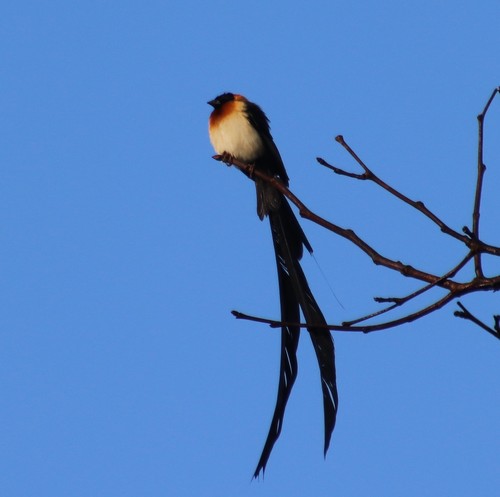
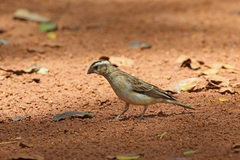

Broad-tailed Paradise Whydah

Broad-tailed Paradise Whydah

Vidua obtusa

Silhouette: Sheatherius · PhyloPic

LCLeast ConcernNTVUENCR
Daily sighting probability <5% · Rare
at Mana Pools National Park

In 3 days ~10%

9 Verified sightings at Mana Pools National Park From 2019 to 2026
45 In all 5 parks
February Best month
☀️ Diurnal When it's spotted

About the Broad-tailed Paradise Whydah

The broad-tailed paradise whydah (Vidua obtusa) is a species of bird in the family Viduidae. It is found in woodland and acacia savanna habitat in Sub-Saharan Africa from Angola to Uganda, Tanzania and Mozambique. A brood parasite, it has a wide range and the International Union for Conservation of Nature has assessed it as being of least concern.

Chapin described the broad-tailed paradise whydah as Steganura aucupum obtusa from Luchenza in 1922. Previously, Vidua obtusa, V. interjecta, V. orientalis, V. paradisaea and V. togoensis were considered to be in the same species, and these five species are sometimes placed in the genus Steganura. The broad-tailed paradise whydah is a monotypic species.

The breeding male is 31–36 cm (12–14 in) long, and the nonbreeding male and the female are 14–15 cm (5.5–5.9 in) long. Females have been measured to weigh approximately 19.5 g (0.69 oz). The breeding male has long, broad tail feathers with bluntly pointed to rounded tips; it is distinguished from the related long-tailed paradise whydah in the tail feathers being broader and not quite so long, and in the nape being orange-brown toned rather than paler buff. It... Wikipedia →

Sounds

Call0:07

Tanzania · 2014

© Thibaut Chansac · XC194823 · CC BY-NC-SA 4.0

Global Distribution

Parks Where Found

# Park Country Daily sighting probability
1 Liwonde National Park 🇲🇼 Malawi
<5%
2 Mana Pools National Park 🇿🇼 Zimbabwe
<5%
3 South Luangwa National Park 🇿🇲 Zambia
<5%
4 Lower Zambezi National Park 🇿🇲 Zambia
<5%
5 Chobe National Park 🇧🇼 Botswana
<5%

Before you go

What are the chances of seeing a Broad-tailed Paradise Whydah in Mana Pools National Park?

Rare

Under 5% of wildlife watchers report a Broad-tailed Paradise Whydah sighting in Mana Pools National Park on a given day, based on 9 verified sightings from GBIF citizen-science data from 2019 to 2026. It is the 240th most-seen of the 275 birds we can rate there. Over three days the chance rises to about 10%, if each day is a fresh chance.

When is the best time to see a Broad-tailed Paradise Whydah in Mana Pools National Park?

February

In that month about 20% of wildlife watchers report a Broad-tailed Paradise Whydah in Mana Pools National Park on a given day, against under 5% in April to January, the lowest months. That is one of Mana Pools National Park's wettest months, with about 180 mm of rain against almost none in August. March has too few records to rate.

What time of day is best to see a Broad-tailed Paradise Whydah?

Between 7 and 10 am

Across all the parks we cover, that three-hour window holds the most Broad-tailed Paradise Whydah sightings with a recorded time, and about 9 in 10 of them come between 6 am and 6 pm: it is a daytime animal.

Is Mana Pools National Park the best place to see a Broad-tailed Paradise Whydah?

Among the best

Of the 5 parks where we can rate Broad-tailed Paradise Whydah sightings, Mana Pools National Park ranks 2nd at under 5%, level with the leaders once rounded. The best odds are in Liwonde National Park (Malawi, under 5%).

Which relatives of the Broad-tailed Paradise Whydah live in Mana Pools National Park?

Same genus: Vidua

The closest relatives of the Broad-tailed Paradise Whydah that you can see in Mana Pools National Park (genus Vidua, Indigobirds and Whydahs) are Village Indigobird (about 10%), Long-tailed Paradise Whydah (about 10%) and Pin-tailed Whydah (about 10%), with each one's daily chance of a sighting.

Where does the Broad-tailed Paradise Whydah sighting chance come from?

GBIF citizen-science records

It is estimated from how often the Broad-tailed Paradise Whydah is recorded against all the birds logged in Mana Pools National Park (9 verified sightings from 2019 to 2026), calibrated against known sighting rates. Figures are rounded to the nearest 10% because citizen-science data supports honest approximations, not decimals, and months with records from fewer than five people show "—". How it works.

← Back to Mana Pools National Park