Grey-crowned Tetraka

Grey-crowned Tetraka

Xanthomixis cinereiceps

Silhouette: Sheatherius · PhyloPic

LCNTNear ThreatenedVUENCR Endemic
Daily sighting probability <5% · Rare
at Mantadia National Park

In 3 days ~10% in a week ~20%

17 Verified sightings at Mantadia National Park From 2019 to 2026
173 In all 2 parks
May Best month
🌅 Crepuscular When it's spotted

About the Grey-crowned Tetraka

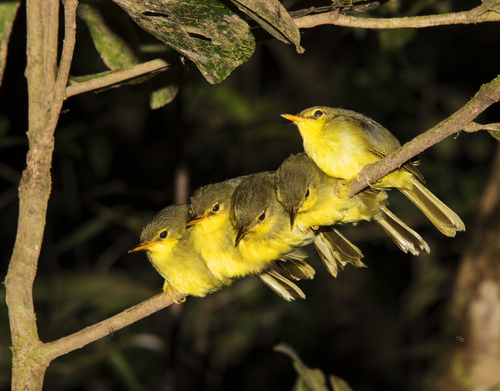
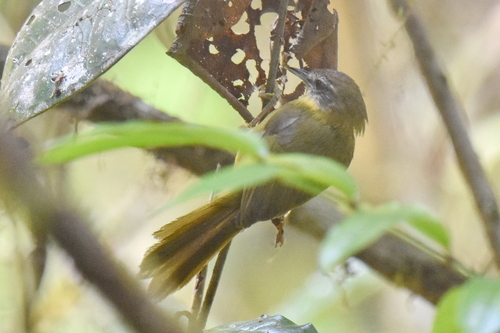
The grey-crowned tetraka (Xanthomixis cinereiceps), formerly known as the grey-crowned greenbul, is a species of Malagasy warbler in the family Bernieridae. It is found only in eastern and northern Madagascar. The bird is slender, with a green back, pale grey crown and ear coverts, a white throat, yellow underparts, and grey legs. The slim bill is pale pink with a darker culmen.

Its natural habitat is primary humid montane forests along the length of eastern Madagascar. It ranges from 900 to 2000 meters elevation, and is most common in higher-elevation forests at 1,400 to 1,800 meters. It is seldom found in disturbed forests or drier forests in the mountains' rain shadow.

It feeds on small insects on mossy tree trunks and sometimes on understory shrubs, but is seldom observed on the ground. It is often found in multi-species flocks. It is threatened by habitat loss. Birds have been observed nesting in November, and juveniles observed in November and December. Nests are bowl-shaped and made of moss lined with dry grass and palm fibers, built in horizontal branch forks one to two meters above the ground. Females generally lay three... Wikipedia →

Sounds

Song0:41

Madagascar · 2012

© Hans Matheve · XC154968 · CC BY-NC-ND 3.0

Call0:34

Madagascar · 2012

© Peter Boesman · XC763019 · CC BY-NC-ND 4.0

Call0:20

Madagascar · 2021

© Ken Behrens · XC624291 · CC BY-NC-SA 4.0

Global Distribution

Parks Where Found

# Park Country Daily sighting probability
1 Ranomafana National Park 🇲🇬 Madagascar
~20%
2 Mantadia National Park 🇲🇬 Madagascar
<5%

Before you go

What are the chances of seeing a Grey-crowned Tetraka in Mantadia National Park?

Rare

Under 5% of wildlife watchers report a Grey-crowned Tetraka sighting in Mantadia National Park on a given day, based on 17 verified sightings from GBIF citizen-science data from 2019 to 2026. It is the 83rd most-seen of the 98 birds we can rate there. Over three days the chance rises to about 10%, and over a week to about 20%, if each day is a fresh chance.

When is the best time to see a Grey-crowned Tetraka in Mantadia National Park?

May

In that month about 30% of wildlife watchers report a Grey-crowned Tetraka in Mantadia National Park on a given day, against under 5% in June–July and September–December, the lowest months. That is one of Mantadia National Park's driest months, with about 80 mm of rain against 340 mm in January. January to April have too few records to rate.

What time of day is best to see a Grey-crowned Tetraka?

Between 4 and 7 am

Across all the parks we cover, that three-hour window holds the most Grey-crowned Tetraka sightings with a recorded time, and about 6 in 10 of them come between 6 am and 6 pm: it is most active around dawn and dusk.

Is Mantadia National Park the best place to see a Grey-crowned Tetraka?

2nd of 2

Of the 2 parks where we can rate Grey-crowned Tetraka sightings, Mantadia National Park ranks 2nd at under 5%. The best odds are in Ranomafana National Park (Madagascar, about 20%).

Where does the Grey-crowned Tetraka sighting chance come from?

GBIF citizen-science records

It is estimated from how often the Grey-crowned Tetraka is recorded against all the birds logged in Mantadia National Park (17 verified sightings from 2019 to 2026), calibrated against known sighting rates. Figures are rounded to the nearest 10% because citizen-science data supports honest approximations, not decimals, and months with records from fewer than five people show "—". How it works.

← Back to Mantadia National Park