Amazon Climbing Salamander

Amazon Climbing Salamander

Bolitoglossa altamazonica

Silhouette: C. Camilo Julián-Caballero · PhyloPic

LCNTNear ThreatenedVUENCR
Daily sighting probability ~10% · With luck
at Manu National Park

In 3 days ~30% in a week ~60%

13 Verified sightings at Manu National Park From 2019 to 2026
13 In 1 park
October Best month
🌙 Nocturnal When it's spotted

About the Amazon Climbing Salamander

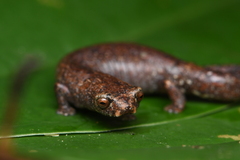
Nauta salamander (Bolitoglossa altamazonica), also known as the Nauta mushroomtongue salamander, is a species of salamander in the family Plethodontidae. It is found on the eastern and lower slopes of the Andes from Venezuela and Colombia through Ecuador and Peru to Bolivia and east into adjacent Brazil. Its common name refers to its type locality, Nauta, in the Loreto Province, Peruvian Amazon. It might be a composite of several species.

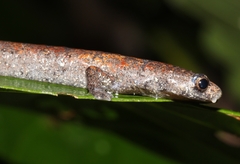
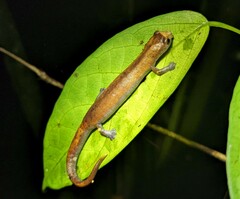
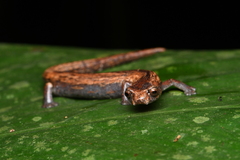
Adult individuals measure 31–48 mm (1.2–1.9 in) in snout–vent length; the tail is almost as long. Colouration is variable: most individuals are darker dorsally and laterally than ventrally, but some have light dorsal streaking and mottling; others are uniformly dorsally dark-coloured.

Natural habitat of Bolitoglossa altamazonica is lowland rainforest where it occurs on low vegetation. It is a locally common species throughout its range. It is locally threatened by habitat loss caused by agriculture and planting of trees. Wikipedia →

Global Distribution

Parks Where Found

# Park Country Daily sighting probability
1 Manu National Park 🇵🇪 Peru
~10%

More parks will be added in future updates.

Closest Relatives at Manu National Park

No species of the same family or order lives in Manu National Park, so these are its closest relatives here: other amphibians.

Before you go

What are the chances of seeing an Amazon Climbing Salamander in Manu National Park?

With luck

About 10% of wildlife watchers report an Amazon Climbing Salamander sighting in Manu National Park on a given day, based on 13 verified sightings from GBIF citizen-science data from 2019 to 2026. It is the 38th most-seen of the 67 amphibians we can rate there. Over three days the chance rises to about 30%, and over a week to about 60%, if each day is a fresh chance.

When is the best time to see an Amazon Climbing Salamander in Manu National Park?

August and October

In those months about 20% of wildlife watchers report an Amazon Climbing Salamander in Manu National Park on a given day, against under 5% in March–May and September, the lowest months.

What time of day is best to see an Amazon Climbing Salamander?

Between 7 and 10 pm

Across all the parks we cover, that three-hour window holds the most Amazon Climbing Salamander sightings with a recorded time, and about 9 in 10 of them come between 6 pm and 6 am: it is mostly seen at night.

Where else can you see an Amazon Climbing Salamander?

Only Manu National Park, in our data

Manu National Park is the only park on Wallace's Line with enough records to rate Amazon Climbing Salamander sightings: about 10% of wildlife watchers there report one on a given day.

Where does the Amazon Climbing Salamander sighting chance come from?

GBIF citizen-science records

It is estimated from how often the Amazon Climbing Salamander is recorded against all the amphibians logged in Manu National Park (13 verified sightings from 2019 to 2026), calibrated against known sighting rates. Figures are rounded to the nearest 10% because citizen-science data supports honest approximations, not decimals, and months with records from fewer than five people show "—". How it works.

← Back to Manu National Park