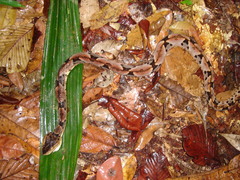
Brazil's Lancehead

Brazil's Lancehead

Bothrops brazili

Silhouette: Steven Traver · PhyloPic

LCLeast ConcernNTVUENCR
Daily sighting probability ~10% · With luck
at Manu National Park

In 3 days ~30% in a week ~50%

8 Verified sightings at Manu National Park From 2019 to 2026
8 In 1 park
November Best month
☀️🌙 Day & Night When it's spotted

About the Brazil's Lancehead

Brazil's lancehead (Bothrops brazili) is a venomous pitviper species endemic to South America. There are no subspecies that are recognized as being valid. The specific name, brazili, is in honor of Dr. Vital Brazil, a Brazilian physician and founder of the Instituto Butantan in São Paulo.

Stoutly built and terrestrial, adults of B. brazili are usually 70–90 cm (28–35 in) in total length (including tail), but may exceed 140 cm (55 in). The largest specimen on record is 149.3 cm (58+3⁄4 in). The available evidence would indicate that, among adult specimens, females are much larger than males.

The scalation includes 23-29 (usually 25–27) rows of dorsal scales at midbody, 151-180 ventral scales in males and 159-202 (usually less than 190) in females, and 44-68/42-56 usually paired subcaudal scales in males/females. On the head there are 3-10 (usually 5–8) intersupraocular scales, 7-9 (usually 8) supralabial scales, the second of which is fused with the prelacunal, and 10-12 sublabial scales.

The color pattern consists of a pinkish tan to pinkish or reddish gray ground color overlaid with a series of 9-19 dark ash gray dorsolateral blotches. These may alternate... Wikipedia →

Global Distribution

Parks Where Found

# Park Country Daily sighting probability
1 Manu National Park 🇵🇪 Peru
~10%

More parks will be added in future updates.

Before you go

What are the chances of seeing a Brazil's Lancehead in Manu National Park?

With luck

About 10% of wildlife watchers report a Brazil's Lancehead sighting in Manu National Park on a given day, based on 8 verified sightings from GBIF citizen-science data from 2019 to 2026. It is the 42nd most-seen of the 56 reptiles we can rate there. Over three days the chance rises to about 30%, and over a week to about 50%, if each day is a fresh chance.

When is the best time to see a Brazil's Lancehead in Manu National Park?

November

In that month about 20% of wildlife watchers report a Brazil's Lancehead in Manu National Park on a given day, against under 5% in January–February, April–July and September–October, the lowest months. That is one of Manu National Park's wettest months, with about 240 mm of rain against 60 mm in August.

What time of day is best to see a Brazil's Lancehead?

Between 7 and 10 pm

Across all the parks we cover, that three-hour window holds the most Brazil's Lancehead sightings with a recorded time, and about half of them come between 6 am and 6 pm: it is seen both by day and at night.

Where else can you see a Brazil's Lancehead?

Only Manu National Park, in our data

Manu National Park is the only park on Wallace's Line with enough records to rate Brazil's Lancehead sightings: about 10% of wildlife watchers there report one on a given day.

Which relatives of the Brazil's Lancehead live in Manu National Park?

Same genus: Bothrops

The closest relatives of the Brazil's Lancehead that you can see in Manu National Park (genus Bothrops, Neotropical Lanceheads) are Barba Amarilla (about 30%) and Green Jararaca (about 10%), with each one's daily chance of a sighting.

Where does the Brazil's Lancehead sighting chance come from?

GBIF citizen-science records

It is estimated from how often the Brazil's Lancehead is recorded against all the reptiles logged in Manu National Park (8 verified sightings from 2019 to 2026), calibrated against known sighting rates. Figures are rounded to the nearest 10% because citizen-science data supports honest approximations, not decimals, and months with records from fewer than five people show "—". How it works.

← Back to Manu National Park