Forest Chirping Frog

Forest Chirping Frog

Adenomera hylaedactyla

Silhouette: PhyloPic

LCLeast ConcernNTVUENCR
Daily sighting probability ~10% · With luck
at Manu National Park

In 3 days ~20% in a week ~40%

5 Verified sightings at Manu National Park From 2019 to 2026
5 In 1 park
December Best month
🌙 Nocturnal When it's spotted

About the Forest Chirping Frog

The dark-spotted thin-toed frog, Napo tropical bullfrog, or rana dedilarga de manchas oscuras (Adenomera hylaedactyla) is a species of frog in the family Leptodactylidae. It is found in Argentina, Bolivia, Brazil, Colombia, Ecuador, French Guiana, Guyana, Paraguay, Peru, Suriname, Trinidad and Tobago, and Venezuela.

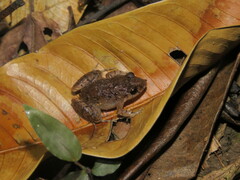
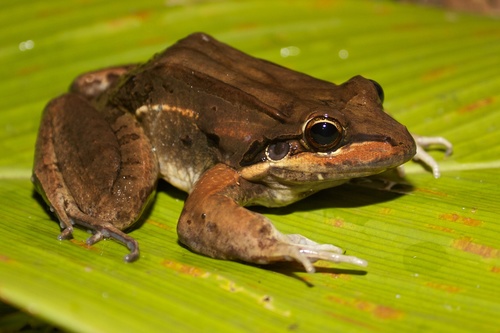
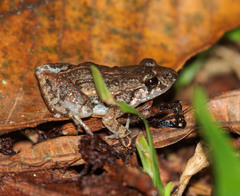
This frog is small. The adult male measures 22-24 mm long in snout-vent length and the adult female frog 26-27 mm. The skin of the dorsum is brown in color with many dark marks. There are two distinct folds of skin on each side of the body. The belly and throat are white in color. The lower parts and fronts of the back legs are yellowish in color. The iris of the eye is bronze in color.

This terrestrial frog is found in open areas, such as next to rivers and agricultural clearings. Mostly, it is associated with primary and secondary forest. Scientists have seen it between 0 and 1,000 m (0 and 3,281 ft) meters above sea level.

Scientists have seen these frogs in protected places. The female frog desposits her eggs in a foam nest underground. The tadpoles develop in the nest, feeding solely from the yolk sac. Wikipedia →

Sounds

Recording0:15

French Guiana · 2023

© Augustin Bussac · XC928974 · CC BY-NC-SA 4.0

Advertisement call0:13

Trinidad & Tobago · 2018

© Chris Harrison · XC1091090 · CC BY-NC-SA 4.0

Recording0:02

Peru · 2018

© probreviceps · iNaturalist · CC BY-NC 4.0

Global Distribution

Parks Where Found

# Park Country Daily sighting probability
1 Manu National Park 🇵🇪 Peru
~10%

More parks will be added in future updates.

Closest Relatives at Manu National Park

Before you go

What are the chances of seeing a Forest Chirping Frog in Manu National Park?

With luck

About 10% of wildlife watchers report a Forest Chirping Frog sighting in Manu National Park on a given day, based on 5 verified sightings from GBIF citizen-science data from 2019 to 2026. It is the 61st most-seen of the 67 amphibians we can rate there. Over three days the chance rises to about 20%, and over a week to about 40%, if each day is a fresh chance.

When is the best time to see a Forest Chirping Frog in Manu National Park?

June, August and October–December

In those months about 10% of wildlife watchers report a Forest Chirping Frog in Manu National Park on a given day, against under 5% in January–May, July and September, the lowest months.

What time of day is best to see a Forest Chirping Frog?

Between 6 and 9 pm

Across all the parks we cover, that three-hour window holds the most Forest Chirping Frog sightings with a recorded time, and about 8 in 10 of them come between 6 pm and 6 am: it is mostly seen at night.

Where else can you see a Forest Chirping Frog?

Only Manu National Park, in our data

Manu National Park is the only park on Wallace's Line with enough records to rate Forest Chirping Frog sightings: about 10% of wildlife watchers there report one on a given day.

Where does the Forest Chirping Frog sighting chance come from?

GBIF citizen-science records

It is estimated from how often the Forest Chirping Frog is recorded against all the amphibians logged in Manu National Park (5 verified sightings from 2019 to 2026), calibrated against known sighting rates. Figures are rounded to the nearest 10% because citizen-science data supports honest approximations, not decimals, and months with records from fewer than five people show "—". How it works.

← Back to Manu National Park