Central American Bushmaster

Central American Bushmaster

Lachesis stenophrys

Silhouette: Steven Traver · PhyloPic

LCNTNear ThreatenedVUENCR
Daily sighting probability ~10% · With luck
at Gandoca-Manzanillo Wildlife Refuge

In 3 days ~30% in a week ~60%

7 Verified sightings at Gandoca-Manzanillo Wildlife Refuge From 2019 to 2026
7 In 1 park
December Best month
☀️🌙 Day & Night When it's spotted

About the Central American Bushmaster

Lachesis stenophrys, commonly called the Central American bushmaster, is a species of pit viper in the family Viperidae. The species is native to Central America. The specific name, stenophrys, is derived from the Greek words stenos, meaning "narrow", and ophrys, meaning "brow" or "eyebrow". There are no subspecies that are recognized as being valid. Campbell and Lamar (2004) also recognized Lachesis acrochorda (García, 1896) as a valid species, which McDiarmid et al. (1999) had treated as a synonym of L. stenophrys. The Reptile Database follows the position of Campbell and Lamar.

Adults of L. stenophrys commonly grow to more than 200 cm (6 feet 6¾ inches) and may exceed 330 cm (10 feet 10 inches) in total length (including tail). Ditmars (1910) reported a specimen from Costa Rica that was 11 feet 4 inches (349 cm). Many accounts exist of much larger specimens, but these are poorly documented. Solórzano (2004) cites historical records that put the maximum length at 360 cm (11 feet 9¾ inches).

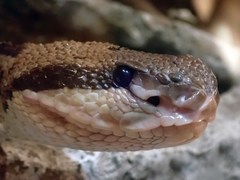
It has a broadly rounded head and a snout that is not elevated. Typically, the species has a pronounced middorsal ridge that is most distinct on the... Wikipedia →

Global Distribution

Parks Where Found

# Park Country Daily sighting probability
1 Gandoca-Manzanillo Wildlife Refuge 🇨🇷 Costa Rica
~10%

More parks will be added in future updates.

Zoos & Centres Where Found

# Zoo / Centre Country
1 National Zoological Park 🇺🇸 United States In captivity
2 Faunia 🇪🇸 Spain In captivity
3 International Animal Rescue – Costa Rica 🇨🇷 Costa Rica In captivity
4 Monteverde Theme Park 🇨🇷 Costa Rica In captivity

Before you go

What are the chances of seeing a Central American Bushmaster in Gandoca-Manzanillo Wildlife Refuge?

With luck

About 10% of wildlife watchers report a Central American Bushmaster sighting in Gandoca-Manzanillo Wildlife Refuge on a given day, based on 7 verified sightings from GBIF citizen-science data from 2019 to 2026. It is the 30th most-seen of the 33 reptiles we can rate there. Over three days the chance rises to about 30%, and over a week to about 60%, if each day is a fresh chance.

When is the best time to see a Central American Bushmaster in Gandoca-Manzanillo Wildlife Refuge?

December

In that month about 30% of wildlife watchers report a Central American Bushmaster in Gandoca-Manzanillo Wildlife Refuge on a given day, against under 5% in January, March, May–June and September–November, the lowest months.

What time of day is best to see a Central American Bushmaster?

Between 7 and 10 pm

Across all the parks we cover, that three-hour window holds the most Central American Bushmaster sightings with a recorded time, and about 6 in 10 of them come between 6 pm and 6 am: it is seen both by day and at night.

Where else can you see a Central American Bushmaster?

Only Gandoca-Manzanillo Wildlife Refuge, in our data

Gandoca-Manzanillo Wildlife Refuge is the only park on Wallace's Line with enough records to rate Central American Bushmaster sightings: about 10% of wildlife watchers there report one on a given day.

Which relatives of the Central American Bushmaster live in Gandoca-Manzanillo Wildlife Refuge?

Same family: Viperidae

The closest relatives of the Central American Bushmaster that you can see in Gandoca-Manzanillo Wildlife Refuge (family Viperidae, Vipers) are Fer-de-lance (about 20%) and Rainforest Hog-nosed Viper (about 20%), with each one's daily chance of a sighting.

Where does the Central American Bushmaster sighting chance come from?

GBIF citizen-science records

It is estimated from how often the Central American Bushmaster is recorded against all the reptiles logged in Gandoca-Manzanillo Wildlife Refuge (7 verified sightings from 2019 to 2026), calibrated against known sighting rates. Figures are rounded to the nearest 10% because citizen-science data supports honest approximations, not decimals, and months with records from fewer than five people show "—". How it works.

← Back to Gandoca-Manzanillo Wildlife Refuge