Tasmanian Thornbill

Tasmanian Thornbill

Acanthiza ewingii

Silhouette: Matt Wilkins (photo by Patrick Kavanagh) · PhyloPic

LCLeast ConcernNTVUENCR Endemic
Daily sighting probability ~50% · Likely
at Maria Island National Park

In 3 days ~90% in a week >90%

190 Verified sightings at Maria Island National Park From 2019 to 2026
689 In all 3 parks
June Best month
🌙 Nocturnal When it's spotted

About the Tasmanian Thornbill

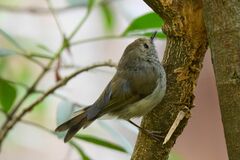
The Tasmanian Thornbill (Acanthiza ewingii) is a small bushland member of the Acanthizidae (Australian warbler) family, endemic to Tasmania and the Bass Strait Islands. It is a common bird in these regions and is often found occupying the colder, wetter portions of them. The brown thornbill (Acanthiza pusilla) will typically occupy the correspondingly drier portions of habitat.

The Tasmanian Thornbill is olive-brown above, darkening toward the back and tail, and can exhibit a patch of reddish-brown colouration on the forehead. The wings are dark grey with olive-brown edge lining. Grey on light grey scalloping is present from the chin to breast, with similar scalloping occurring on the sides of the head. The bill, feet, and legs are all dark grey and the eyes are distinctly large and dark, with red irises.

It's long, thin, thorn-shaped beak is a distinguishing characteristic of the Acanthiza (thornbill) family. Visibly fluffy, white under-tail coverts are a distinguishing feature of the species. The Tasmanian Thornbill averages in size at around 10 cm and shows no significant coloration or size differentiation between sexes. Wikipedia →

Sounds

Call0:37

Australia · 2026

© JJSUN · XC1088811 · CC BY-NC-SA 4.0

Song0:46

Australia · 2023

© Peter Boesman · XC859573 · CC BY-NC-ND 4.0

Call0:44

Australia · 2023

© Khristos Nizamis · XC881661 · CC BY-NC-ND 4.0

Global Distribution

Parks Where Found

# Park Country Daily sighting probability
1 Cradle Mountain-Lake St Clair National Park 🇦🇺 Australia
~70%
2 Maria Island National Park 🇦🇺 Australia
~50%
3 Freycinet National Park 🇦🇺 Australia
~10%

Before you go

What are the chances of seeing a Tasmanian Thornbill in Maria Island National Park?

Likely

About 50% of wildlife watchers report a Tasmanian Thornbill sighting in Maria Island National Park on a given day, based on 190 verified sightings from GBIF citizen-science data from 2019 to 2026. It is the 24th most-seen of the 81 birds we can rate there. Over three days the chance rises to about 90%, and over a week to over 90%, if each day is a fresh chance.

When is the best time to see a Tasmanian Thornbill in Maria Island National Park?

June

In that month about 70% of wildlife watchers report a Tasmanian Thornbill in Maria Island National Park on a given day, against about 40% in April, September and December–January, the lowest months.

What time of day is best to see a Tasmanian Thornbill?

Between 1 and 4 am

Across all the parks we cover, that three-hour window holds the most Tasmanian Thornbill sightings with a recorded time, and about 8 in 10 of them come between 6 pm and 6 am: it is mostly seen at night.

Is Maria Island National Park the best place to see a Tasmanian Thornbill?

2nd of 3

Of the 3 parks where we can rate Tasmanian Thornbill sightings, Maria Island National Park ranks 2nd at about 50%. The best odds are in Cradle Mountain-Lake St Clair National Park (Australia, about 70%).

Which relatives of the Tasmanian Thornbill live in Maria Island National Park?

Same genus: Acanthiza

The closest relatives of the Tasmanian Thornbill that you can see in Maria Island National Park (genus Acanthiza, Australasian Thornbills) are Yellow-rumped Thornbill (about 60%) and Brown Thornbill (about 30%), with each one's daily chance of a sighting.

Where does the Tasmanian Thornbill sighting chance come from?

GBIF citizen-science records

It is estimated from how often the Tasmanian Thornbill is recorded against all the birds logged in Maria Island National Park (190 verified sightings from 2019 to 2026), calibrated against known sighting rates. Figures are rounded to the nearest 10% because citizen-science data supports honest approximations, not decimals, and months with records from fewer than five people show "—". How it works.

← Back to Maria Island National Park