Blue Mockingbird

Blue Mockingbird

Melanotis caerulescens

Silhouette: Sheatherius · PhyloPic

LCLeast ConcernNTVUENCR Endemic
Daily sighting probability ~10% · With luck
at Reserva de la Biosfera Mariposa Monarca

In 3 days ~20% in a week ~30%

14 Verified sightings at Reserva de la Biosfera Mariposa Monarca From 2019 to 2026
22 In all 2 parks
February Best month
☀️ Diurnal When it's spotted

About the Blue Mockingbird

The blue mockingbird (Melanotis caerulescens) is a species of bird in the family Mimidae. It is endemic to Mexico, but has occurred as a vagrant in the southern United States. Its natural habitats are subtropical or tropical dry forests, subtropical or tropical moist montane forests, and heavily degraded former forest.

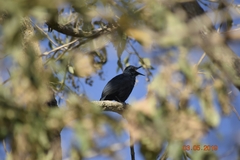
The blue mockingbird is uniformly blue on its back, tail, wings, head and underbelly. This color is a result of feather structure rather than pigment, and therefore can look gray in the shade. It has a black "mask" surrounding its reddish-brown eyes. It has a rather long, slightly graduated tail, and dark blue streaks over its breast. Its bill is long, thin and slightly curved, and its legs and feet are black.

When he first described the blue mockingbird in 1827, William Swainson assigned it to the mockingbird Orpheus, and when Orpheus became a junior synonym for the genus Mimus, the species was moved accordingly. Not all authorities agreed; several placed it in the thrush Turdus. However, when Charles Lucien Bonaparte moved it to its current genus Melanotis in 1850, most authorities quickly followed suit. There is disagreement as to whether it is monotypic... Wikipedia →

Sounds

Song1:01

Mexico · 2023

© Brad Mowers · XC818268 · CC BY-NC-SA 4.0

Call0:34

Mexico · 2023

© Manuel Grosselet · XC804652 · CC BY-NC-SA 4.0

Uncertain1:00

Mexico · 2023

© Hugo de Alba · XC786423 · CC BY-NC-SA 4.0

Global Distribution

Parks Where Found

# Park Country Daily sighting probability
1 Reserva de la Biosfera Mariposa Monarca 🇲🇽 Mexico
~10%
2 Cumbres de Monterrey National Park 🇲🇽 Mexico
<5%

Cities Where Found

# City Country Daily sighting probability
1 Guadalajara 🇲🇽 México
~40%
2 León 🇲🇽 México
~20%
3 Mexico City 🇲🇽 México
~10%
4 Puebla 🇲🇽 México
~10%

Before you go

What are the chances of seeing a Blue Mockingbird in Reserva de la Biosfera Mariposa Monarca?

With luck

About 10% of wildlife watchers report a Blue Mockingbird sighting in Reserva de la Biosfera Mariposa Monarca on a given day, based on 14 verified sightings from GBIF citizen-science data from 2019 to 2026. It is the 76th most-seen of the 103 birds we can rate there. Over three days the chance rises to about 20%, and over a week to about 30%, if each day is a fresh chance.

When is the best time to see a Blue Mockingbird in Reserva de la Biosfera Mariposa Monarca?

February

In that month about 10% of wildlife watchers report a Blue Mockingbird in Reserva de la Biosfera Mariposa Monarca on a given day, against under 5% in March, May and October–January, the lowest months. That is one of Reserva de la Biosfera Mariposa Monarca's driest months, with about 30 mm of rain against 270 mm in July. April and June–September have too few records to rate.

What time of day is best to see a Blue Mockingbird?

Between 7 and 10 am

Across all the parks we cover, that three-hour window holds the most Blue Mockingbird sightings with a recorded time, and about 9 in 10 of them come between 6 am and 6 pm: it is a daytime animal.

Is Reserva de la Biosfera Mariposa Monarca the best place to see a Blue Mockingbird?

Yes

Of the 2 parks where we can rate Blue Mockingbird sightings, Reserva de la Biosfera Mariposa Monarca has the highest daily chance: about 10%. Next come Cumbres de Monterrey National Park (Mexico, under 5%).

Where does the Blue Mockingbird sighting chance come from?

GBIF citizen-science records

It is estimated from how often the Blue Mockingbird is recorded against all the birds logged in Reserva de la Biosfera Mariposa Monarca (14 verified sightings from 2019 to 2026), calibrated against known sighting rates. Figures are rounded to the nearest 10% because citizen-science data supports honest approximations, not decimals, and months with records from fewer than five people show "—". How it works.

← Back to Reserva de la Biosfera Mariposa Monarca


