Heloise's Hummingbird

Heloise's Hummingbird

Selasphorus heloisa

Silhouette: Ferran Sayol · PhyloPic

LCLeast ConcernNTVUENCR Endemic
Daily sighting probability <5% · Rare
at Reserva de la Biosfera Mariposa Monarca

In 3 days ~10% in a week ~20%

8 Verified sightings at Reserva de la Biosfera Mariposa Monarca From 2019 to 2026
8 In 1 park
May Best month
☀️ Diurnal When it's spotted

About the Heloise's Hummingbird

The bumblebee hummingbird (Selasphorus heloisa) is a species of hummingbird in tribe Mellisugini of subfamily Trochilinae, the "bee hummingbirds". It is endemic to Mexico, but has occurred as a vagrant in the United States.

The International Ornithological Committee (IOC), the North American Classification Committee of the American Ornithological Society, and the Clements taxonomy place the bumblebee hummingbird in genus Selasphorus. BirdLife International's Handbook of the Birds of the World (HBW) places it in genus Atthis.

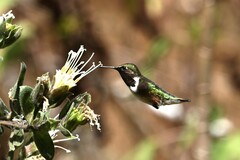
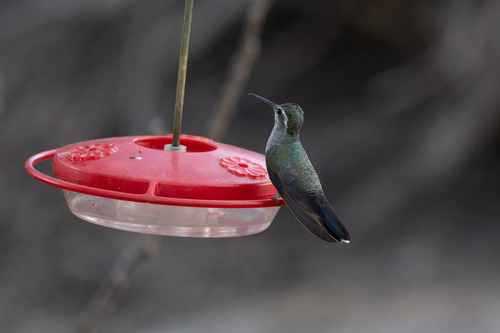
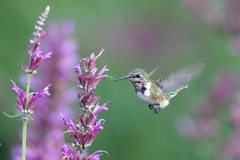
The bumblebee hummingbird is 5.9 to 7.5 cm (2.3 to 3.0 in) long and weighs 2 to 2.7 g (0.071 to 0.095 oz); it is one of the smallest hummingbirds. Both sexes of both subspecies have a short, straight, blackish bill and a small white spot behind the eye.

Males of the nominate subspecies have metallic bronze green to golden bronze upperparts. Their gorget is metallic magenta purple to bluish purple at its edges, and its longer hindward feathers flare out and back. The flanks... Wikipedia →

Sounds

Song0:13

Mexico · 2024

© Joren van Schie · XC956575 · CC BY-NC-SA 4.0

Flight call0:18

Mexico · 2021

© Manuel Grosselet · XC681644 · CC BY-NC-SA 4.0

Song0:43

Mexico · 2020

© Isain Contreras Rodríguez · XC606555 · CC BY-NC-SA 4.0

Global Distribution

Parks Where Found

# Park Country Daily sighting probability
1 Reserva de la Biosfera Mariposa Monarca 🇲🇽 Mexico
<5%

More parks will be added in future updates.

Cities Where Found

# City Country Daily sighting probability
1 Toluca 🇲🇽 México
~10%
2 Mexico City 🇲🇽 México
<5%
3 Puebla 🇲🇽 México
<5%

Before you go

What are the chances of seeing a Heloise's Hummingbird in Reserva de la Biosfera Mariposa Monarca?

Rare

Under 5% of wildlife watchers report a Heloise's Hummingbird sighting in Reserva de la Biosfera Mariposa Monarca on a given day, based on 8 verified sightings from GBIF citizen-science data from 2019 to 2026. It is the 90th most-seen of the 103 birds we can rate there. Over three days the chance rises to about 10%, and over a week to about 20%, if each day is a fresh chance.

When is the best time to see a Heloise's Hummingbird in Reserva de la Biosfera Mariposa Monarca?

January, May and November

In those months about 10% of wildlife watchers report a Heloise's Hummingbird in Reserva de la Biosfera Mariposa Monarca on a given day, against under 5% in February–March, October and December, the lowest months. Those are among Reserva de la Biosfera Mariposa Monarca's driest months, with about 50 mm of rain a month against 270 mm in July. April and June–September have too few records to rate.

What time of day is best to see a Heloise's Hummingbird?

Between 9 am and noon

Across all the parks we cover, that three-hour window holds the most Heloise's Hummingbird sightings with a recorded time, and about 9 in 10 of them come between 6 am and 6 pm: it is a daytime animal.

Where else can you see a Heloise's Hummingbird?

Only Reserva de la Biosfera Mariposa Monarca, in our data

Reserva de la Biosfera Mariposa Monarca is the only park on Wallace's Line with enough records to rate Heloise's Hummingbird sightings: under 5% of wildlife watchers there report one on a given day.

Where does the Heloise's Hummingbird sighting chance come from?

GBIF citizen-science records

It is estimated from how often the Heloise's Hummingbird is recorded against all the birds logged in Reserva de la Biosfera Mariposa Monarca (8 verified sightings from 2019 to 2026), calibrated against known sighting rates. Figures are rounded to the nearest 10% because citizen-science data supports honest approximations, not decimals, and months with records from fewer than five people show "—". How it works.

← Back to Reserva de la Biosfera Mariposa Monarca