
Blue Swallow

Blue Swallow

Hirundo atrocaerulea

Silhouette: Matt Wilkins · PhyloPic

LCNTVUENEndangeredCR
Daily sighting probability <5% · Rare
at Masai Mara National Reserve

In 3 days <5%

7 Verified sightings at Masai Mara National Reserve From 2019 to 2026
7 In 1 park
September Best month
☀️ Diurnal When it's spotted

About the Blue Swallow

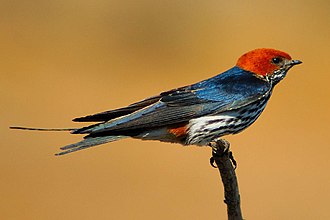
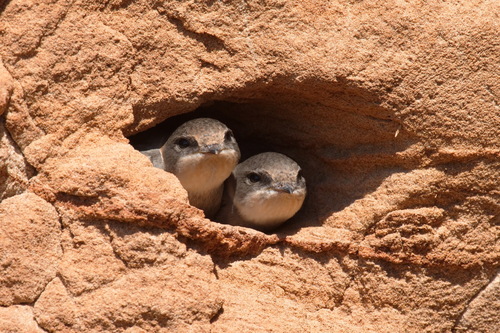
The blue swallow (Hirundo atrocaerulea) is a small bird within the swallow family which is in the order Passeriformes. Swallows are somewhat similar in habits and appearance to other aerial insectivores, such as the martins (also a passerine) and the swifts (order Apodiformes). It breeds in the Afromontane (from South Africa to Tanzania), wintering north of Lake Victoria.

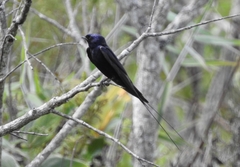
This bird breeds in montane grassland, preferring high rainfall, undulating areas. In winter it prefers open grassland, with bushes and trees. The nest is usually attached to the roof or side of a hole in the ground. This species is a small swallow at 18–25 centimetres (7.1–9.8 in). Adult birds have a highly lustrous dark metallic steel-blue appearance and long tail streamers, which are particularly noticeable in males. White feathers are visible on the rump and flanks when the birds are preening and especially during courtship. In poor light, blue swallows appear almost black and therefore can be mistaken for black saw-wing swallows (Psalidoprocne spp.) which occur throughout its breeding range. Young blue swallows start life a brownish-grey, acquiring their blue colour as they mature. This species... Wikipedia →

Sounds

Song0:12

Zimbabwe · 2024

© Dries Van de Loock · XC963300 · CC BY-NC-ND 4.0

Call0:11

Malawi · 2017

© Peter Boesman · XC398060 · CC BY-NC-ND 4.0

Flight call0:46

Malawi · 2015

© Frank Lambert · XC364651 · CC BY-NC-ND 4.0

Global Distribution

Parks Where Found

# Park Country Daily sighting probability
1 Masai Mara National Reserve 🇰🇪 Kenya
<5%

More parks will be added in future updates.

Before you go

What are the chances of seeing a Blue Swallow in Masai Mara National Reserve?

Rare

Under 5% of wildlife watchers report a Blue Swallow sighting in Masai Mara National Reserve on a given day, based on 7 verified sightings from GBIF citizen-science data from 2019 to 2026. It is the 388th most-seen of the 398 birds we can rate there. Over three days the chance rises to under 5%, if each day is a fresh chance.

When is the best time to see a Blue Swallow in Masai Mara National Reserve?

Any time of year

In every month with enough records, under 5% of wildlife watchers report a Blue Swallow in Masai Mara National Reserve on a given day, so our monthly data shows no clear season.

What time of day is best to see a Blue Swallow?

Between 7 and 10 am

Across all the parks we cover, that three-hour window holds the most Blue Swallow sightings with a recorded time, and nearly all of them come between 6 am and 6 pm: it is a daytime animal.

Where else can you see a Blue Swallow?

Only Masai Mara National Reserve, in our data

Masai Mara National Reserve is the only park on Wallace's Line with enough records to rate Blue Swallow sightings: under 5% of wildlife watchers there report one on a given day.

Which relatives of the Blue Swallow live in Masai Mara National Reserve?

Same genus: Hirundo

The closest relatives of the Blue Swallow that you can see in Masai Mara National Reserve (genus Hirundo, Typical Swallows) are Wire-tailed Swallow (about 30%) and Barn Swallow (about 30%), with each one's daily chance of a sighting.

Where does the Blue Swallow sighting chance come from?

GBIF citizen-science records

It is estimated from how often the Blue Swallow is recorded against all the birds logged in Masai Mara National Reserve (7 verified sightings from 2019 to 2026), calibrated against known sighting rates. Figures are rounded to the nearest 10% because citizen-science data supports honest approximations, not decimals, and months with records from fewer than five people show "—". How it works.

← Back to Masai Mara National Reserve