
Lesser Striped-Swallow

Lesser Striped-Swallow

Cecropis abyssinica

Silhouette: Andy Wilson · PhyloPic

LCLeast ConcernNTVUENCR
Daily sighting probability ~20% · Possible
at Masai Mara National Reserve

In 3 days ~60% in a week ~90%

879 Verified sightings at Masai Mara National Reserve From 2019 to 2026
12,148 In all 44 parks
May Best month
☀️ Diurnal When it's spotted

About the Lesser Striped-Swallow

The lesser striped swallow (Cecropis abyssinica) is a large swallow. It breeds in Sub-Saharan Africa from Sierra Leone and southern Sudan south into eastern South Africa. It is partially migratory with South African birds wintering further north. West African birds leave the north of the breeding range in the dry season.

This is a bird of wooded, mainly lowland habitats. The lesser striped swallow prefers less open habitats, and is replaced in montane grassland by the greater striped swallow, Hirundo cucullata. It is common and often found around human habitation.

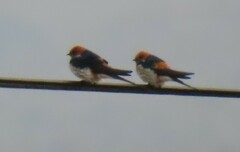
The lesser striped swallow is 15–19 cm long. It has dark blue upperparts with a red rump and a rufous-chestnut crown, nape and sides of the head. The underparts are white with dark streaking, and the upper wings and underwing flight feathers are blackish-brown. The underwing coverts are tawny. The blackish tail has very long outer feathers; these are slightly longer in the male than the female. Juveniles are duller and browner, with less contrast and shorter outer tail feathers. There are five or six subspecies differing in the extent of the underpart streaking.

The lesser striped swallow has... Wikipedia →

Sounds

Song0:24

Uganda · 2026

© Phil Shaw · XC1157619 · CC BY-NC-ND 4.0

Flight call0:15

South Africa · 2006

© Nature sounds by Simply Birding · XC753612 · CC BY-NC-ND 4.0

Call0:15

Uganda · 2022

© Peter Boesman · XC739490 · CC BY-NC-ND 4.0

Global Distribution

Parks Where Found

# Park Country Daily sighting probability
1 uMkhuze Game Reserve 🇿🇦 South Africa
~70%
2 Gonarezhou National Park 🇿🇼 Zimbabwe
~40%
3 Mikumi National Park 🇹🇿 Tanzania
~40%
4 Odzala-Kokoua National Park 🇨🇬 Republic of the Congo
~40%
5 Mkomazi National Park 🇹🇿 Tanzania
~40%
6 Tarangire National Park 🇹🇿 Tanzania
~40%
7 Ruaha National Park 🇹🇿 Tanzania
~40%
8 iSimangaliso Wetland Park 🇿🇦 South Africa
~30%
9 Kibale National Park 🇺🇬 Uganda
~30%
10 Nairobi National Park 🇰🇪 Kenya
~30%
11 Akagera National Park 🇷🇼 Rwanda
~30%
12 Pilanesberg National Park 🇿🇦 South Africa
~30%
13 Hluhluwe-Imfolozi Park 🇿🇦 South Africa
~30%
14 Semuliki National Park 🇺🇬 Uganda
~30%
15 Kruger National Park 🇿🇦 South Africa
~30%
16 Queen Elizabeth National Park 🇺🇬 Uganda
~30%
17 Tsavo West National Park 🇰🇪 Kenya
~30%
18 Lake Mburo National Park 🇺🇬 Uganda
~30%
19 Amboseli National Park 🇰🇪 Kenya
~30%
20 Serengeti National Park 🇹🇿 Tanzania
~30%
21 Masai Mara National Reserve 🇰🇪 Kenya
~20%
22 Tsavo East National Park 🇰🇪 Kenya
~20%
23 Arusha National Park 🇹🇿 Tanzania
~20%
24 Kafue National Park 🇿🇲 Zambia
~20%
25 Bwindi Impenetrable National Park 🇺🇬 Uganda
~20%
26 Addo Elephant National Park 🇿🇦 South Africa
~20%
27 Moremi Game Reserve 🇧🇼 Botswana
~20%
28 South Luangwa National Park 🇿🇲 Zambia
~20%
29 Kidepo Valley National Park 🇺🇬 Uganda
~20%
30 Waterberg Plateau Park 🇳🇦 Namibia
~10%
31 Chobe National Park 🇧🇼 Botswana
~10%
32 Hwange National Park 🇿🇼 Zimbabwe
~10%
33 Virunga National Park 🇨🇩 Democratic Republic of the Congo
~10%
34 Mana Pools National Park 🇿🇼 Zimbabwe
~10%
35 Lake Manyara National Park 🇹🇿 Tanzania
~10%
36 Murchison Falls National Park 🇺🇬 Uganda
~10%
37 Meru National Park 🇰🇪 Kenya
~10%
38 Gorongosa National Park 🇲🇿 Mozambique
<5%
39 Lower Zambezi National Park 🇿🇲 Zambia
<5%
40 De Hoop Nature Reserve 🇿🇦 South Africa
<5%
41 Ngorongoro Conservation Area 🇹🇿 Tanzania
<5%
42 Garden Route National Park 🇿🇦 South Africa
<5%
43 Aberdare National Park 🇰🇪 Kenya
<5%
44 Lake Nakuru National Park 🇰🇪 Kenya
<5%

Cities Where Found

# City Country Daily sighting probability
1 Brazzaville 🇨🇬 Republic of the Congo
~40%
2 Kigali 🇷🇼 Rwanda
~30%
3 Maputo 🇲🇿 Mozambique
~30%
4 Dar es-Salaam 🇹🇿 Tanzania
~20%
5 Yaoundé 🇨🇲 Cameroon
~20%
6 Nairobi 🇰🇪 Kenya
~10%
7 Durban 🇿🇦 South Africa
~10%
8 Pretoria 🇿🇦 South Africa
~10%
9 Zanzibar City 🇹🇿 Tanzania
~10%
10 Abuja 🇳🇬 Nigeria
~10%

Before you go

What are the chances of seeing a Lesser Striped-Swallow in Masai Mara National Reserve?

Possible

About 20% of wildlife watchers report a Lesser Striped-Swallow sighting in Masai Mara National Reserve on a given day, based on 879 verified sightings from GBIF citizen-science data from 2019 to 2026. It is the 53rd most-seen of the 398 birds we can rate there. Over three days the chance rises to about 60%, and over a week to about 90%, if each day is a fresh chance.

When is the best time to see a Lesser Striped-Swallow in Masai Mara National Reserve?

May

In that month about 50% of wildlife watchers report a Lesser Striped-Swallow in Masai Mara National Reserve on a given day, against under 5% in September and October, the lowest months.

What time of day is best to see a Lesser Striped-Swallow?

Between 7 and 10 am

Across all the parks we cover, that three-hour window holds the most Lesser Striped-Swallow sightings with a recorded time, and about 9 in 10 of them come between 6 am and 6 pm: it is a daytime animal.

Which relatives of the Lesser Striped-Swallow live in Masai Mara National Reserve?

Same genus: Cecropis

The closest relatives of the Lesser Striped-Swallow that you can see in Masai Mara National Reserve (genus Cecropis, Red-rumped Swallows, Striped Swallows, and Allies) are Mosque Swallow (about 10%) and Rufous-chested Swallow (about 10%), with each one's daily chance of a sighting.

Where does the Lesser Striped-Swallow sighting chance come from?

GBIF citizen-science records

It is estimated from how often the Lesser Striped-Swallow is recorded against all the birds logged in Masai Mara National Reserve (879 verified sightings from 2019 to 2026), calibrated against known sighting rates. Figures are rounded to the nearest 10% because citizen-science data supports honest approximations, not decimals, and months with records from fewer than five people show "—". How it works.

← Back to Masai Mara National Reserve