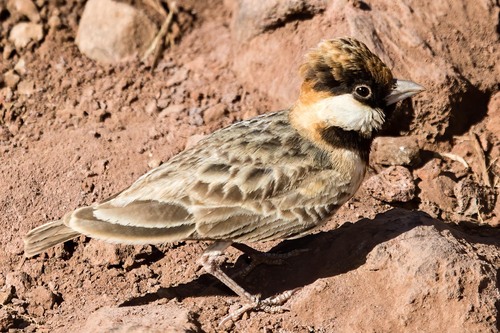
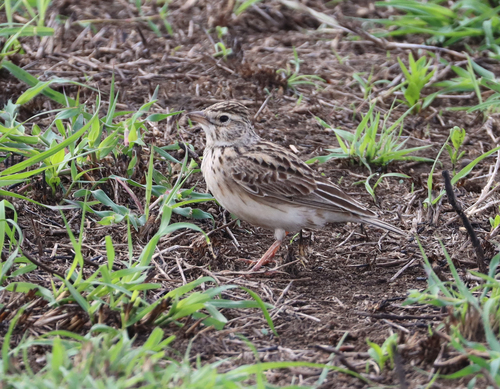
Latakoo Lark

Latakoo Lark

Mirafra cheniana

Silhouette: Gossipguy and T. Michael Keesey · PhyloPic

LCLeast ConcernNTVUENCR
Daily sighting probability <5% · Rare
at Masai Mara National Reserve

In 3 days ~10% in a week ~20%

71 Verified sightings at Masai Mara National Reserve From 2019 to 2026
83 In all 2 parks
May Best month
☀️ Diurnal When it's spotted

About the Latakoo Lark

The melodious lark (Mirafra cheniana) is a species of lark in the family Alaudidae found in southern Africa. It is currently threatened by habitat loss. The alternate name of singing bush lark usually refers to the species of that name, Mirafra cantillans. Other alternate names for the melodious lark include: Latakoo lark, Latakoo bush lark, melodious bushlark, singing bush lark, Southern lark, Southern singing bush lark and Southern singing lark.

The melodious lark has a probable maximum range of 110,400 square kilometres (42,600 sq mi), separated into many disjunct populations located in South Africa (Eastern Cape, the Free State, Gauteng, KwaZulu-Natal, Limpopo, and North West Province), Botswana and Zimbabwe. At times, local populations will abandon one area for another when the regular dry-season fires occur.

The natural habitat of the melodious lark is subtropical or tropical, seasonally wet or flooded, lowland grassland. Within these regions, it prefers the drier slopes, especially in open runs between grassy tussocks. Melodious larks select different textures of grass or grass parts to build their domed... Wikipedia →

Sounds

Call0:34

South Africa · 2025

© Dawie de Swardt · XC1069415 · CC BY-NC-SA 4.0

Song0:32

South Africa · 2022

© Maarten Sluijter · XC813170 · CC BY-NC-SA 4.0

Song0:37

South Africa · 2020

© Tony Archer · XC599122 · CC BY-NC-SA 4.0

Global Distribution

Parks Where Found

# Park Country Daily sighting probability
1 Masai Mara National Reserve 🇰🇪 Kenya
<5%
2 Serengeti National Park 🇹🇿 Tanzania
<5%

Before you go

What are the chances of seeing a Latakoo Lark in Masai Mara National Reserve?

Rare

Under 5% of wildlife watchers report a Latakoo Lark sighting in Masai Mara National Reserve on a given day, based on 71 verified sightings from GBIF citizen-science data from 2019 to 2026. It is the 262nd most-seen of the 398 birds we can rate there. Over three days the chance rises to about 10%, and over a week to about 20%, if each day is a fresh chance.

When is the best time to see a Latakoo Lark in Masai Mara National Reserve?

May and November

In those months about 10% of wildlife watchers report a Latakoo Lark in Masai Mara National Reserve on a given day, against under 5% in June–October and December–April, the lowest months. Those are among Masai Mara National Reserve's wettest months, with about 90 mm of rain a month against 15 mm in July.

What time of day is best to see a Latakoo Lark?

Between 7 and 10 am

Across all the parks we cover, that three-hour window holds the most Latakoo Lark sightings with a recorded time, and about 9 in 10 of them come between 6 am and 6 pm: it is a daytime animal.

Is Masai Mara National Reserve the best place to see a Latakoo Lark?

Yes

Of the 2 parks where we can rate Latakoo Lark sightings, Masai Mara National Reserve has the highest daily chance: under 5%. Next come Serengeti National Park (Tanzania, under 5%).

Which relatives of the Latakoo Lark live in Masai Mara National Reserve?

Same family: Alaudidae

The closest relatives of the Latakoo Lark that you can see in Masai Mara National Reserve (family Alaudidae, Larks) are Red-capped Lark (about 20%) and Fischer's Sparrow-Lark (about 10%), with each one's daily chance of a sighting.

Where does the Latakoo Lark sighting chance come from?

GBIF citizen-science records

It is estimated from how often the Latakoo Lark is recorded against all the birds logged in Masai Mara National Reserve (71 verified sightings from 2019 to 2026), calibrated against known sighting rates. Figures are rounded to the nearest 10% because citizen-science data supports honest approximations, not decimals, and months with records from fewer than five people show "—". How it works.

← Back to Masai Mara National Reserve